2003issue C031-4
US rebound, capital-flow funding, and dollar translation
By October 2002 a US equity rally had appeared after markets had long discounted historically low policy rates, a strong housing sector, and consumer spending described as about two-thirds of the economy. Editorial reading: that bounce was still incomplete until the same position was scored as a weeks-to-months intermarket-regime of capital-flow-funding, currency-translation, and an event-driven-overlay.
- A late-year US equity rally was treated as an incomplete signal until the same position was scored as a weeks-to-months intermarket-regime.
- Capital-flow-funding of a current-account-gap larger than 5% of GDP had shifted toward portfolio inflows after direct investment and merger activity faded.
- Currency-translation into a weaker dollar changed the foreign holder's home-currency result even when the local-market bounce looked constructive.
- An event-driven-overlay of insurance, tort, tax, protection, and security shocks could rewrite the cost of keeping the same US equity position.
The bounce was not yet the regime
By October 2002 a US equity rally had appeared after markets had long discounted historically low policy rates, a strong housing sector, and consumer spending described as about two-thirds of the economy.
Editorial reading: the recovery answered only whether equities had bounced. It did not yet describe the intermarket-regime, the joint state of equities, rates, the dollar, trade, and capital-flow conditions over a weeks-to-months horizon.
Who still funded the current-account gap
The contemporaneous US current-account-gap was described as exceeding 5% of GDP, and the case argued that about 2 billion of foreign investment per day was needed to keep that funding path intact. The first-quarter 2002 current-account deficit reached 112.5 billion, up from 95.1 billion, and the goods-and-services trade gap was still about 38 billion in August to September.
By June 2002 foreign direct investment was reported more than 60% below 2000 levels, and March to April merger-and-acquisition investment was more than 80% lower than a year earlier, so portfolio inflows had become a larger share of dollar support.
Net foreign investment into the United States fell from 67.32 billion in July 2002 to 39.14 billion in August, while nonresident Treasury purchases fell from 21.02 billion to 1.12 billion even as agency and corporate-bond buying rose.
Combined euro-area net direct and portfolio inflows rose from 2.2 billion euros in March 2002 to 19.3 billion euros in April, a relocation the case linked to tighter US disclosure and antiterror rules rather than to stronger European fundamentals.
Editorial reading: once direct investment faded, dollar support depended more on reversible portfolio flows. A single US equity position was also a claim on continued capital-flow-funding of the current-account-gap.
US trade deficit, 3-month average, 1992–2002
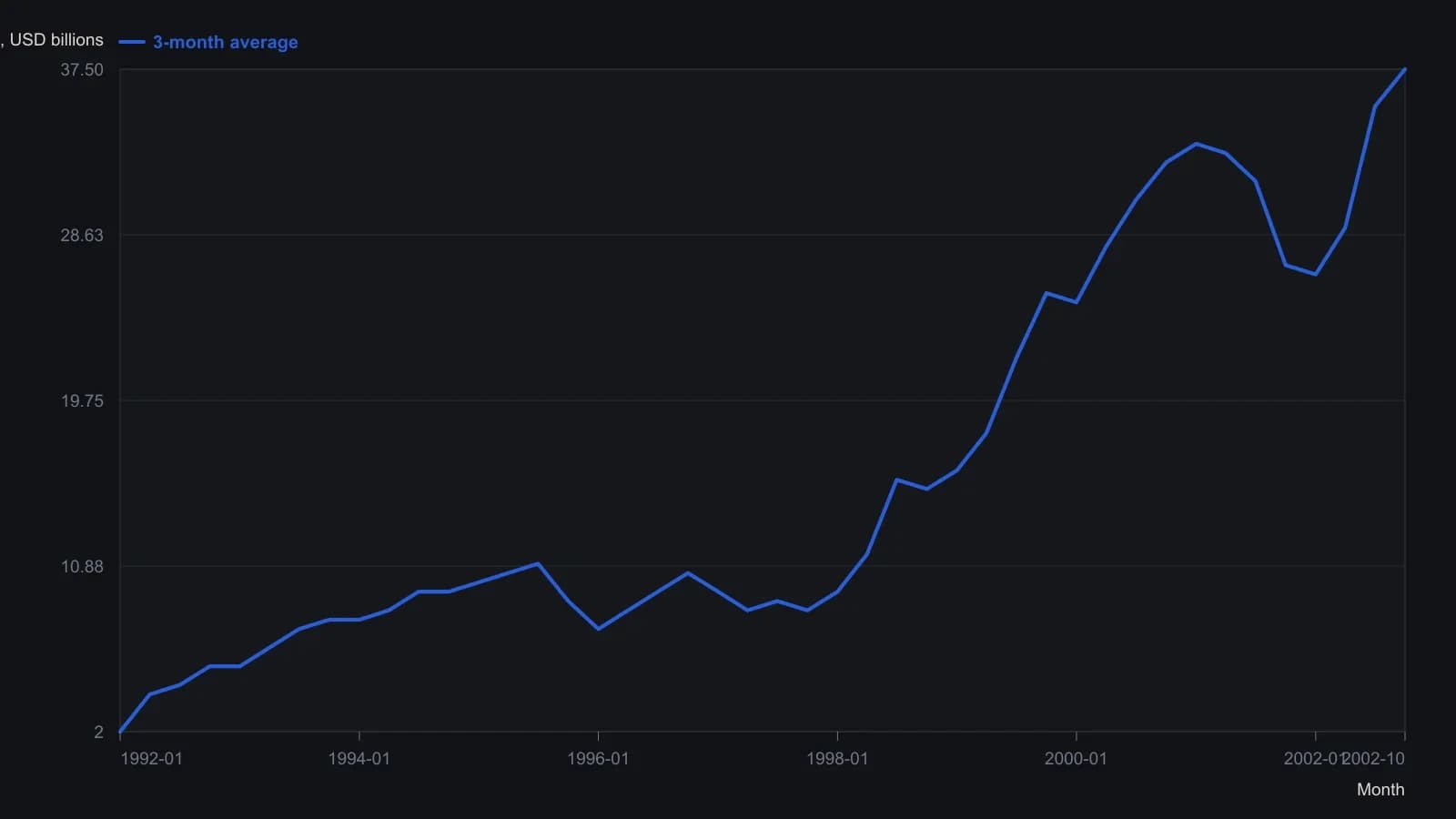
Digitized from the printed bar-and-line chart dated 19 November 2002. Points are quarterly samples of the 3-month-average line, rounded to the nearest half-billion dollars; individual monthly bars were not transcribed.
What dollar translation did to the foreign holder
By December the dollar was reported 9% lower versus the euro and 8% lower versus the yen.
Editorial reading: currency-translation converts a local-market gain or loss into the foreign investor's home currency. A US rebound that coincided with a softer dollar could leave the non-dollar holder with a smaller home-currency result than the local index implied.
Policy, insurance, and tax as an event overlay
After September 2001, insurers were described as lifting premia 30% to 100% while cutting coverage, with some ship war-risk cover 400% higher and some New York building cover 500% higher, raising the cost base of US-domiciled firms.
A 2002 official estimate put US tort costs at 1.8% of GDP, or 180 billion a year, with only about 20% of that pool reaching claimants as economic damages.
Citizenship-based multinational tax rules, anti-inversion bills, protectionist pressure on lumber and steel, and a broad security-policy overlay were treated as event shocks that could change insurance, housing, dollar, and capital-flow conditions around a single US equity position.
Editorial reading: those shocks were an event-driven-overlay around an otherwise technical rebound. Corporate-inversion, a headquarters shift toward a territorial-tax jurisdiction after citizenship-based worldwide tax rules raise the cost of remaining domestically domiciled, sat inside the same cost-of-keeping-the-trade question.
Multiples that had not compressed
Mid-2002 forward Nasdaq multiples were described near 50 and the S&P 500 near 23. By mid-November the Dow trailing multiple was 20.5, the S&P 500 trailing multiple 29, and the Nasdaq 100 forward multiple 41, levels treated as inconsistent with typical post-recession compression.
Editorial reading: valuation that had not reset in the usual post-recession way left the bounce harder to read as a completed regime shift.
How the same position was scored
Editorial synthesis: the same US equity position was scored three ways. Intermarket analysis asked whether equities, rates, the dollar, trade, and capital-flow-funding still formed a coherent weeks-to-months intermarket-regime. Currency-translation asked whether a foreign holder kept the local-market result after the dollar moved against the euro and the yen. Event-driven context asked whether an event-driven-overlay of insurance, tort, tax, protection, and security shocks had rewritten the cost of keeping the trade.
All readings on this track · 23 readings
- 1990The discount-rate path as an equity regime overlay
- 1991Evaluating successive policy hikes as equity regime warnings
- 2002Easing season meets commodity-bond reflation
- 2002Precious metals as portfolio insurance in uncertain regimes
- 2003Housing leverage after an equity crash
- 2003US rebound, capital-flow funding, and dollar translation
- 2003A three-path tape for recovery, inflation, or deflation
- 2006Disaster shocks, energy bottlenecks, and intermarket spillover
- 2008Speculative leaders and regime context for ten-bagger setups
- 2008A presidential transition as a dollar regime-timestamp
- 2009Check the regime before you hunt a setup
- 2009Withhold an equity regime label until credit-linked ratios agree
- 2010Energy futures, the dollar, inventory, and scenario risk
- 2011Official floors, sidelines, and scale-in after a telegraphed FX intervention
- 2014Scheduled prints as sector pair filters
- 2016Place a yuan devaluation inside peg, contract, and funding context
- 2017Quiet tape, seasonal soft edges, and event risks
- 2017A search-theme mood compass for regime-aware trade context
- 2018Bound headline trades with if-then paths
- 2019Election windows as testable regime filters
- 2020Climate capital rotation as a regime, then an event test
- 2020New listings as regime-aware portfolio events
- 2020One pre-trade checklist for event phase, pairs, and pattern outcomes