2005issue C081-2
Regime shifts reorder US data impact
In the 2004 EUR/USD sample, which US release ranked first depended on horizon and on the prevailing regime. The archive workflow overlays the cycle, seats one print in that ranking, and feeds a single news-trading procedure that can enter, stand aside, or wait for persistence.
- Which US release ranks first is regime-dependent: the trade balance led in 1992, then unemployment and interest-rate decisions took precedence.
- The 2004 ranking by twenty-minute EUR/USD range differed from the ranking by daily range, so an immediate reaction and a full-session span need not name the same first-tier print.
- Nonfarm payrolls posted the largest listed 2004 averages on both horizons, while GDP was among the smaller movers even when the print itself looked large.
- The same impact ranking can support opposite news-trading rules: stand aside on high-impact days, or treat those sessions as breakout candidates.
Rank the calendar before one print
The archive describes a historical workflow that ranks scheduled US releases before any one of them is treated as a trade. Event-driven context seats a single print inside that diversified calendar rather than treating every release as equal.
A fundamental overlay uses the prevailing regime to reorder the list. Regime here is the economic narrative that changes which scheduled releases the market treats as first-tier. News trading is then one procedure that reads the ranked calendar and the surprise, and decides entry, exit, or abstention.
2004 EUR/USD pip ranges by US release
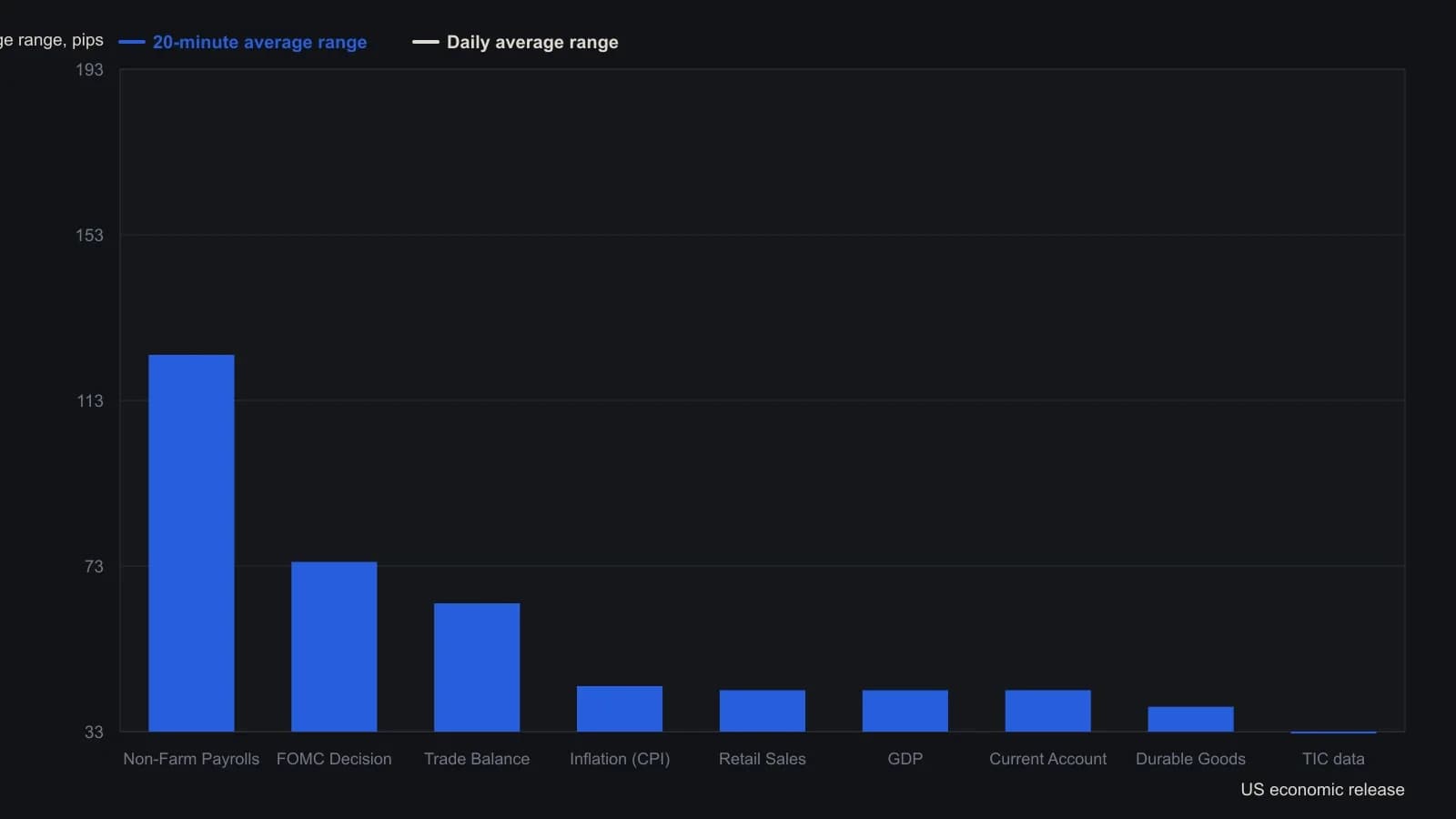
Ranges are 2004 averages after each US release. Lien states the typical EUR/USD day that year ran 111 pips, so the 110-pip GDP daily average sat at or below a normal session.
Immediate range and daily range can disagree
In the 2004 EUR/USD sample, nonfarm payrolls produced the largest listed average twenty-minute range, at 124 pips, and the largest listed average daily range, at 193 pips. The twenty-minute range is the immediate post-release EUR/USD span used to rank short-horizon impact. The daily range is the full-session EUR/USD span used to judge whether an immediate reaction lasts.
The 2004 US-release ranking by twenty-minute range differed from the ranking by daily range. Trade balance, consumer prices, and retail sales ranked higher immediately, while Treasury international capital, the current account, and durable goods ranked higher over the full day.
A large GDP print can still leave a small dollar move
GDP ranked among the smaller 2004 EUR/USD movers on both horizons, at 43 pips in twenty minutes and 110 pips on the day, beside a 111-pip average daily range. One stated reason GDP can print large yet move the dollar less is lower publication frequency plus mixed composition: export-led growth can support the home currency, while inventory-led growth can be read as negative.
The first-tier release follows the regime
Which US release ranks first is regime-dependent. The trade balance was described as the top US data mover in 1992, later giving ground to unemployment and interest-rate decisions. Market ranking of a release is shaped by perception, consensus, media emphasis, and the cycle's hot topic, not only by how complete the statistic is as an economic gauge.
Persistence decides whether the reaction lasts
A sharp twenty-minute reaction after a release need not last. Persistence depends on prevailing sentiment, the size of the surprise, and whether the print still matters on a longer horizon. The same impact ranking can feed opposite rules: range-style traders may stand aside on high-impact days, while breakout-style traders may treat those sessions as candidate days.