2002issue C091-5
Precious metals as portfolio insurance in uncertain regimes
Earlier in 2002, gold traded above 300 dollars per ounce for the first time since 1999, while mining shares and metals funds rose as the S&P 500 lagged. This article treats that tape as a classroom case in how jewelry demand, producer hedges, and crisis buying sit against dollar and equity regimes, so a metals sleeve is sized as insurance and diversification.
- Earlier in 2002, gold traded above 300 dollars per ounce for the first time since 1999, and mining shares and metals funds rose while the S&P 500 lagged.
- Annual supply was described as relatively steady, and producer hedges left more of the short-term move on demand, including jewelry seasons, currency collapses, and investment trends.
- Precious metals were presented as often moving opposite the dollar and the stock market, so a metals sleeve was taught as a diversifier when those regimes weakened.
- Gold’s long-run average yearly return was given as about 3 percent, similar to long-run inflation and to a short-term bond, and the metal was framed as crisis insurance rather than a high-return core holding.
A 2002 tape used as a classroom case
Earlier in 2002, gold traded above 300 dollars per ounce for the first time since 1999. Mining shares and metals funds rose as the S&P 500 lagged.
Contemporaneous commentary tied the renewed interest to dollar worries, Middle East geopolitics, higher oil prices, extra troops in Afghanistan, and early inflation warnings. In that setting, gold was framed as a portfolio diversifier.
Steady supply and jewelry-heavy demand
Of roughly 115 million ounces of gold reaching the market in a given year around 2000, about 80 to 85 percent went to jewelry. Smaller shares went to electronics, other industry, and bullion or hoarding.
Annual gold supply was described as relatively steady: about 85 million ounces mined, about 15 million ounces of scrap, and about 14 million ounces from central banks. Most price action was therefore attributed to demand.
Demand was said to shift with industrial use, seasonal jewelry cycles such as India’s marriage season, currency collapses, and investment trends. London fixed gold twice daily, and New York opened on the second London fix.
Gold fabrication in 2000 was jewelry-heavy
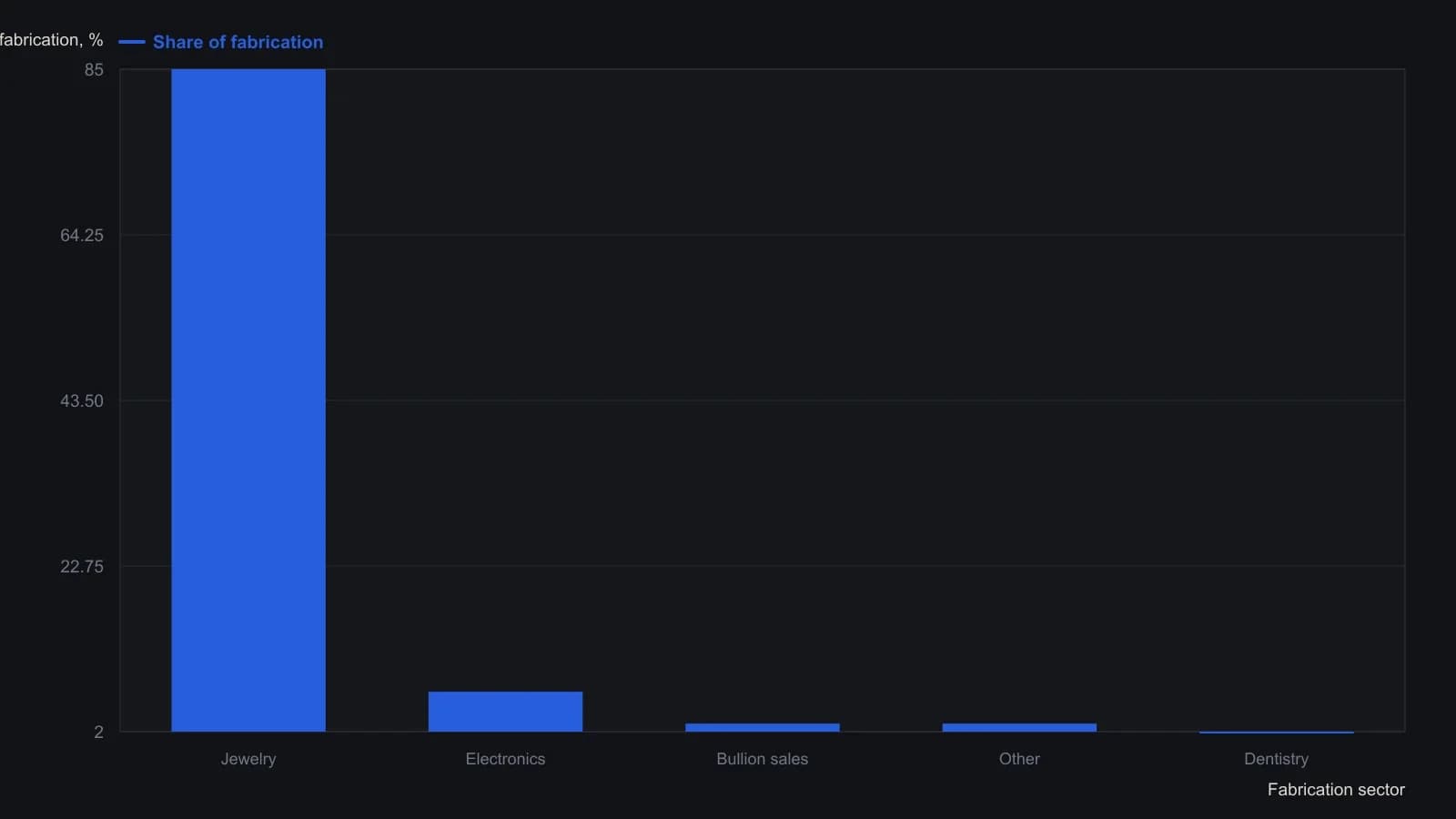
The body text also gives jewelry as 80–85 percent of the roughly 115 million ounces brought to market in a typical year; the pie locks the 2000 jewelry share at 85 percent.
Producer hedges left the short-term move with demand
Traders were described as letting producers hedge sale prices out as far as 10 years with options, forwards, and spots. That producer-hedge practice reduced producer price risk and left more of the short-term move on the demand side.
Several large miners were reducing hedges, read as a signal they expected prices to stay firm.
How the sleeve sat in the book
Precious metals were presented as often moving opposite the dollar and the stock market. A metals sleeve was taught as a diversifier when those regimes weakened, so one trade is judged by what it does to the whole book, not by its isolated return.
Editorial reading: that negative-correlation is why the sleeve is sized as an overlay in a market-regime of uncertainty, dollar weakness, or equity stress, not as a permanent core holding. Asset-allocation is then the share given to bullion, mining shares, or funds, given the regime, the correlation, and the sleeve’s insurance role. Event-driven-context is the reading of geopolitics, oil, currency collapses, and seasonal jewelry demand as the shocks that reprice metals and change how the sleeve behaves in the book.
Mining shares are not the same as bullion
A managed mining-equity sleeve was said to be able to mimic ownership of the metal. Precious-metals-equities were also said to fall faster than bullion and to price company debt, cash costs, assets, and management as well as the metal.
Mining stocks and metals funds were listed among the stronger recent performers in that weak equity tape. Editorial reading: choosing shares instead of bullion changes what the sleeve is doing in the book, because company balance sheets and hedge-book changes move with the metal and often move faster.
Insurance overlay, not a high-return core
Gold’s long-run average yearly return was given as about 3 percent, similar to long-run inflation and to a short-term bond. The metal was framed as portfolio insurance for financial or political crisis rather than as a high-return core holding.
Editorial reading: that return profile is why the 2002 tape is useful as a sizing case. The sleeve is there for what it does when the dollar or equities are under stress, not as a standalone bet.
All readings on this track · 23 readings
- 1990The discount-rate path as an equity regime overlay
- 1991Evaluating successive policy hikes as equity regime warnings
- 2002Easing season meets commodity-bond reflation
- 2002Precious metals as portfolio insurance in uncertain regimes
- 2003Housing leverage after an equity crash
- 2003US rebound, capital-flow funding, and dollar translation
- 2003A three-path tape for recovery, inflation, or deflation
- 2006Disaster shocks, energy bottlenecks, and intermarket spillover
- 2008Speculative leaders and regime context for ten-bagger setups
- 2008A presidential transition as a dollar regime-timestamp
- 2009Check the regime before you hunt a setup
- 2009Withhold an equity regime label until credit-linked ratios agree
- 2010Energy futures, the dollar, inventory, and scenario risk
- 2011Official floors, sidelines, and scale-in after a telegraphed FX intervention
- 2014Scheduled prints as sector pair filters
- 2016Place a yuan devaluation inside peg, contract, and funding context
- 2017Quiet tape, seasonal soft edges, and event risks
- 2017A search-theme mood compass for regime-aware trade context
- 2018Bound headline trades with if-then paths
- 2019Election windows as testable regime filters
- 2020Climate capital rotation as a regime, then an event test
- 2020New listings as regime-aware portfolio events
- 2020One pre-trade checklist for event phase, pairs, and pattern outcomes