1982issue C041-6
Six-category classification as a trend and pyramiding case study
Daily prices were logged through six-category-classification, and the walk-through acted only after a three-point-penetration of a pivot-point. Editorial note: read the ledger as one procedure that allows a pyramiding-add only when the next print stays in the same trend class, and that reverses after a stop only on a configuration-reversal.
- Daily prices were recorded vertically and assigned horizontally to one of six activity classes so the column in use, not a narrative, stated the market condition.
- For active issues near 30 or higher, only a swing of 6 points or more entered a class, and a three-point-penetration through a marked pivot-point defined a change in the character of price action.
- A pyramiding-add was placed only after a later pivot was broken by three points and classified as continued trend activity.
- After a stop-out the procedure usually waited for the next major signal, unless a configuration-reversal printed on the stop itself.
How the six-column ledger assigned price
Daily prices were recorded vertically and assigned horizontally to one of six activity classes: secondary rally, natural rally, uptrend, downtrend, natural reaction, and secondary reaction. That six-category-classification is a vertical price log. Each qualifying swing is assigned to a class so the column in use, not a narrative, states the market condition.
For active issues near 30 or higher, only a swing of 6 points or more was treated as large enough to enter a class, so smaller oscillations were filtered out. A pivot-point is a swing extreme that becomes a reference level only after an opposite move of at least six points has printed.
When the character of activity changed
A change in the character of price action was defined as a three-point-penetration: a move of three points or more through a previously marked pivot-point.
A natural-rally is a countertrend advance inside a classified downtrend that fails to break the last pivot high by three points. A natural-reaction is a countertrend decline inside a classified uptrend that does not break the last pivot low by three points.
What the Homestake Mining walk-through showed
The Homestake Mining walk-through used a 6-point swing chart. It was framed as a demonstration of major-trend identification, not as a finished trading system.
Case-study orders were placed in 1000-share units from a 300000 starting balance, with risk kept near 10 percent of capital and a stated round-turn charge of 700 per 1000 shares.
Stops, a pyramiding-add, and a secondary-reaction
After a stop-out, the procedure usually waited for the next major signal instead of reversing. A configuration-reversal is the sole exception to that wait: reverse only when that stop print also shows a higher high and higher low, or a lower low and lower high.
Additional short units were a pyramiding-add. They were added when a later swing low was broken by 3 points and classified as continued downtrend activity, with the protective stop kept 3 points above the most recent classified high.
A secondary-reaction is a decline that starts from within three points of the last high but not above it. When that decline retraced 6 points or more from the last high, it was treated as a major-trend change and could authorize a new short after the prior uptrend class.
Reversing from short to long
The walk-through reversed from short to long only after a higher-high and higher-low structure printed. It then added long units on later 3-point breaks of classified highs while trailing stops under the last reaction low.
Homestake Mining six-point swing, 1980-82
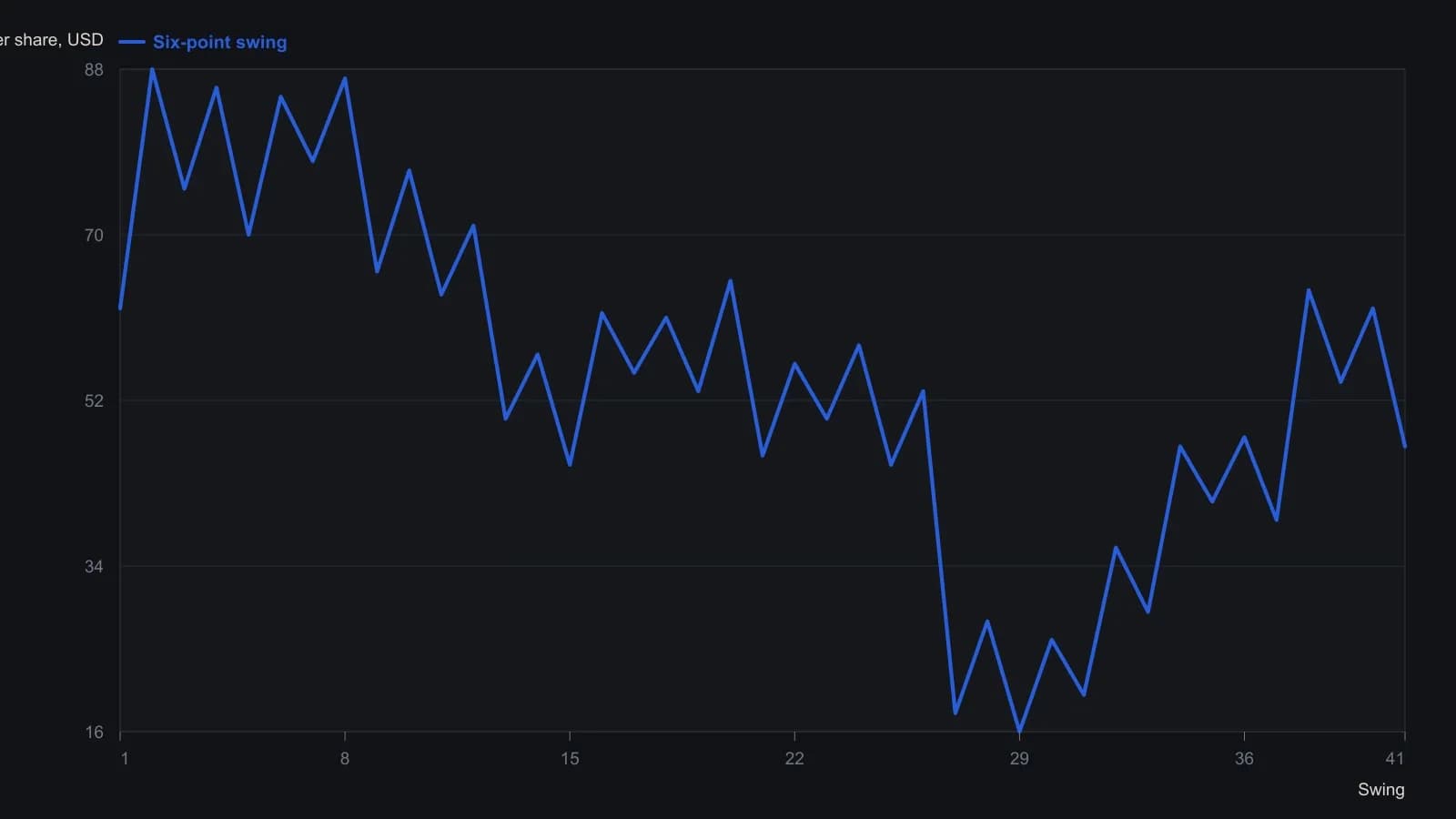
Only swings of $6 or more are recorded. The source rounded swing lows down and highs up on the printed chart; 63.5 and 61.5 are kept as written. The drop from 53 to 18 is a single swing because the article says no $6 rally occurred until 18.
All readings on this track · 17 readings
- 1982Six-category classification as a trend and pyramiding case study
- 1986Fear signals an untested decision process
- 1987Paper lots, stop orders, and pyramids as a Wyckoff apprenticeship
- 1992A pre-trade checklist for locked stops and trend pyramiding
- 1992Stop-first pyramid adds from locked profit
- 1997Long-term trend following and pyramiding as one holding-period procedure
- 1999Pyramiding after a maximum favorable excursion support
- 1999Confirm early scale-ins, then shrink late units
- 2004Stacking crossovers, MACD and pyramiding across currency timeframes
- 2008Scale in after launch confirmation
- 2008Range-breakout trend entries with early stops and pyramids
- 2015Why win-rate chasing fails the decision process
- 2016Expectancy through loss cuts, add-ons, and bounded leverage
- 2018Wide-range breakout, trailing stops, and pyramiding
- 2019Inverse ETF pair daytrading with pyramiding and a trailing stop
- 2019One procedure for breakout entry, trailing stops, and pyramid adds
- 2020Scale-in construction for swing breakouts