2019issue C0948-56
One procedure for breakout entry, trailing stops, and pyramid adds
A complete entry procedure can place a buy-stop a fixed distance above the prior day's high, set a protective stop on the fill, add only to the working side, and trail the exit under the same rules. This archive article treats the breakout, the trailing stop, and the pyramid add as one entry-and-exit-rules procedure.
- A complete entry procedure can place buy-stop orders a fixed distance above the prior day's high on each candidate chart at the open, then place a fixed-dollar protective stop under the entry as soon as a buy-stop fills.
- Shares may be added only to the side already moving in the trader's favor, at fixed price intervals, while a matching trailing stop governs the exit.
- When two charts are inversely related, trade whichever side breaks out or pivots first, add size only to that working side, and enter the opposite chart only after its own trigger if the first trade is stopped out.
- Share size, position-sizing intervals, and trailing stops are the named controls that keep exposure bounded through the holding period.
The combined procedure
A breakout-system is a rule set that waits for price to clear a defined level and then treats that event as the entry, exit, or abstention signal for the holding period. Pyramiding is adding to a position only after it has already moved in the intended direction, using the same rule inputs and constraints as the original entry. A trailing-stop is a stop that follows favorable price movement so a loss or exposure decision stays bounded before entry and throughout the position.
Entry-and-exit-rules are the combined procedure that decides when to enter, when to add, when to exit, and when to stand aside. The archive places those steps inside one management frame rather than as disconnected actions.
Placing the entry and the first stop
A complete entry procedure can place buy-stop orders a fixed distance above the prior day's high on each candidate chart at the open.
Once a buy-stop fills, the same procedure immediately places a fixed-dollar protective stop under the entry.
Adding only on the working side
Shares may be added only to the side that is already moving in the trader's favor, at fixed price intervals, while a matching trailing stop governs the exit. The add uses the same rule inputs and constraints as the original entry.
Inversely related charts
When two charts are inversely related, trading whichever one breaks out or pivots first can be paired with position sizing so size is added only to the working side. That constraint is an inverse-pair-filter: only the side that breaks out or pivots first is traded.
A trailing stop on a winning trade can be tightened. If that trade is stopped out, the opposite chart can be entered only after its own trigger is reached.
The controls that bound exposure
The same management frame names share size, position-sizing intervals, and trailing stops as the controls that keep exposure bounded through the holding period.
Editorial note: keeping the breakout, the add, and the trail in one procedure makes standing aside a rule outcome, not a separate instinct. That reading is editorial and is not attributed to the archive.
S&P 500 share of months that closed higher
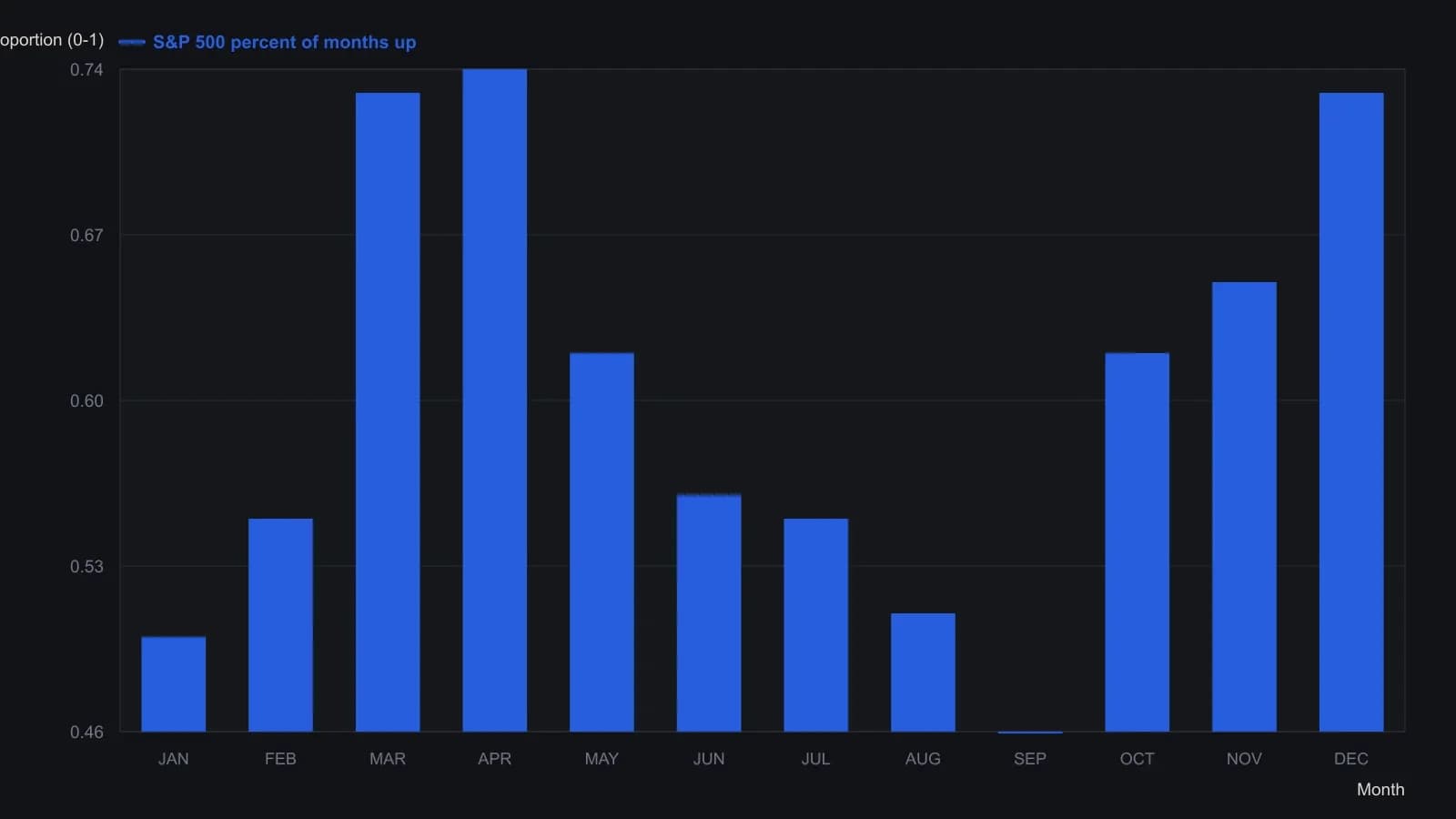
A month is counted as up only when that month's close is above its open. The EasyLanguage code requires a monthly bar interval and reports the historical fraction of such months, scaled from 0 to 1.
All readings on this track · 17 readings
- 1982Six-category classification as a trend and pyramiding case study
- 1986Fear signals an untested decision process
- 1987Paper lots, stop orders, and pyramids as a Wyckoff apprenticeship
- 1992A pre-trade checklist for locked stops and trend pyramiding
- 1992Stop-first pyramid adds from locked profit
- 1997Long-term trend following and pyramiding as one holding-period procedure
- 1999Pyramiding after a maximum favorable excursion support
- 1999Confirm early scale-ins, then shrink late units
- 2004Stacking crossovers, MACD and pyramiding across currency timeframes
- 2008Scale in after launch confirmation
- 2008Range-breakout trend entries with early stops and pyramids
- 2015Why win-rate chasing fails the decision process
- 2016Expectancy through loss cuts, add-ons, and bounded leverage
- 2018Wide-range breakout, trailing stops, and pyramiding
- 2019Inverse ETF pair daytrading with pyramiding and a trailing stop
- 2019One procedure for breakout entry, trailing stops, and pyramid adds
- 2020Scale-in construction for swing breakouts