2008issue C071-5
Scale in after launch confirmation
There is no single correct entry, only a sequence of opportunities with different structural-risk and confidence mixes. Size can be added after confirmation, and a launch-based ten-times mark can cap the reward for every unit, including later adds.
- A strategy is judged first on effectiveness and only then on efficiency. A buy before any launch-point pairs the largest remaining upside with the highest chance the decision is incorrect.
- A durable launch-point keeps price and volume rising. A false-launch can push price above a six-month average on volume well above a three-month average and then fail.
- There is no single correct entry, so a scale-in-position can add later units after confirmation, and pyramiding places those units only after price has already advanced.
- Once a name has doubled, a ten-times goal from the new buy point is a twenty-times move from the launch-point. A launch-based ten-times cap keeps the risk-reward-ratio from silently worsening.
Judge the name before the clock
A strategy is judged first on effectiveness, meaning whether the name later does what was expected, and only then on efficiency, meaning whether that result arrived when expected.
A purchase before any launch-point uses only speculative evidence. That pairing leaves the largest remaining upside and the highest chance the decision is incorrect.
On any single name the outcome is binary. The working risk factor is the buyer's error rate along the prelaunch-to-late-move path, not a property of one stock.
Bound eligibility before any size
Eligibility can be bounded before any size is placed by requiring a price-to-sales multiple under 1, a price under one dollar, fewer than 25 million shares, institutional ownership under 25 percent, and no bankruptcy stress.
The risk-reward-ratio is the relationship between remaining upside to a stated destination and the capital still exposed if the move fails. That check belongs before entry and stays in force for every later unit.
Tell a launch-point from a false-launch
A false-launch can push price above a six-month average on volume well above a three-month average and then fail.
A durable launch-point is the one that keeps both price and volume rising instead of fading.
A launch-point plus several months of heavier chart activity reduces structural risk while a correct buy stays highly effective. After about six months, company results can add a second confirmation layer.
FRPT share turnover at false launches and the real launch
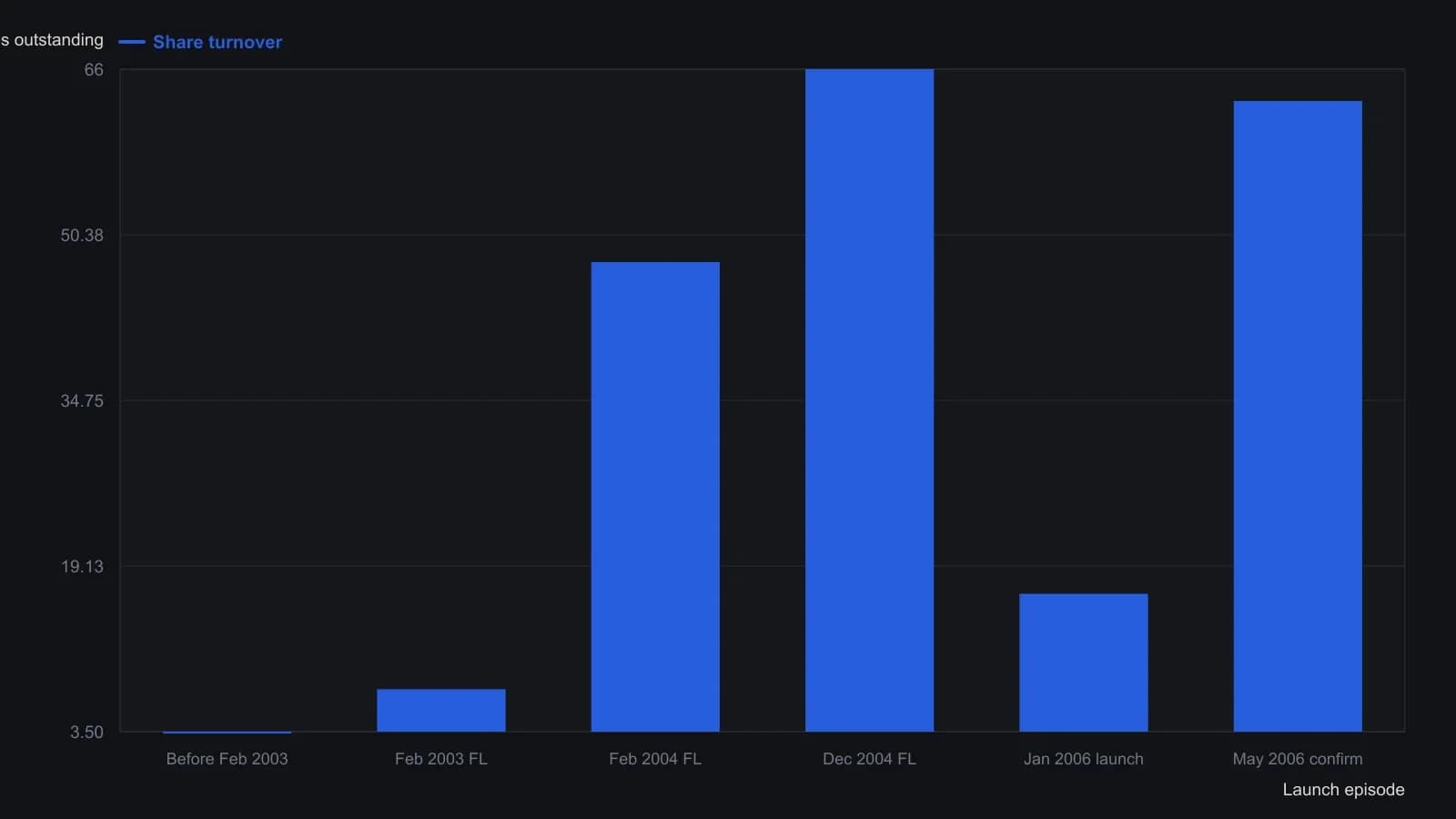
Turnover is monthly volume as a percentage of then-current shares outstanding. February 2004 uses the 47.8 percent figure label, described in the text as almost 48 percent.
Add size after confirmation
There is no single correct entry, only a sequence of opportunities with different structural-risk and confidence mixes. Size can be added in later units after confirmation rather than committed all at first contact.
A scale-in-position adds to a holding in planned increments after later confirmation rather than committing the full size at first contact.
Pyramiding increases size only after price has already advanced in the intended direction, so later units sit on top of earlier ones.
The confidence-threshold is the personal mix of skill and confirmation a buyer requires before putting on or adding size.
Keep the destination attached to the launch
Once a name has already doubled, a later ten-times goal from the new buy point requires a twenty-times move from the launch-point. Both remaining effectiveness and the chance of hitting the goal deteriorate.
A launch-based ten-times mark can cap the reward for every unit, including later adds.
An alternative path is to take a series of two-, three-, or four-times segments and recycle size toward a similar dollar destination.
Editorial: flatten the book at the launch-based ten-times mark so those recycled segments do not silently demand a rarer twenty-times move from the launch-point.
All readings on this track · 17 readings
- 1982Six-category classification as a trend and pyramiding case study
- 1986Fear signals an untested decision process
- 1987Paper lots, stop orders, and pyramids as a Wyckoff apprenticeship
- 1992A pre-trade checklist for locked stops and trend pyramiding
- 1992Stop-first pyramid adds from locked profit
- 1997Long-term trend following and pyramiding as one holding-period procedure
- 1999Pyramiding after a maximum favorable excursion support
- 1999Confirm early scale-ins, then shrink late units
- 2004Stacking crossovers, MACD and pyramiding across currency timeframes
- 2008Scale in after launch confirmation
- 2008Range-breakout trend entries with early stops and pyramids
- 2015Why win-rate chasing fails the decision process
- 2016Expectancy through loss cuts, add-ons, and bounded leverage
- 2018Wide-range breakout, trailing stops, and pyramiding
- 2019Inverse ETF pair daytrading with pyramiding and a trailing stop
- 2019One procedure for breakout entry, trailing stops, and pyramid adds
- 2020Scale-in construction for swing breakouts