2020issue C017
Scale-in construction for swing breakouts
A scale-in construction writes the first fill, later adds, and breakout permission as one procedure so size increases only when a predeclared price or structure event is hit.
- Scaling in adds size to an already open long after the first fill rather than committing the full intended size at a single price.
- The construction is presented as a way to reduce dependence on any one entry price when building a swing long.
- Later adds are written in advance as fixed price increments or as permission after a chart-defined breakout.
- The outlined procedure scans for uptrending charts, takes an initial long from existing entry rules, and predefines later long add prices.
A written plan after the first fill
Scaling in is defined as adding size to an already open long after the first fill rather than committing the full intended size at a single price. A scale-in-position plan is that written plan: later size is added instead of placing the full intended size at one price.
The construction is presented as a way to reduce dependence on any one entry price when building a swing long. Position-sizing rules decide how much capital is at risk at the first fill and at each later add. The swing-holding-period is the multi-session window in which the initial entry and any adds remain part of one procedure.
A cited trader survey stated that fewer than 30% of respondents regularly used staged position sizing.
First fill, later adds, and breakout permission
The outlined procedure starts by scanning for uptrending charts, taking an initial long from existing entry rules, then predefining later long add prices.
Pyramiding means adding to an already profitable swing position according to preset add prices or structure events. A breakout is a move through a charted resistance area used, if specified in advance, as permission for an add.
Fixed increments and chart-defined breakouts
Two add-on constructions are specified: fixed price increments and adds after chart-defined breakouts. A two-dollar increment is given as a starting add interval for shares in the 20 to 50 dollar range, with other intervals to be tested outside that band.
Pattern-based add permission is illustrated as a break above resistance after a cup, ascending triangle, or bull flag.
Western Union daily closes with cup resistance and scale-in adds
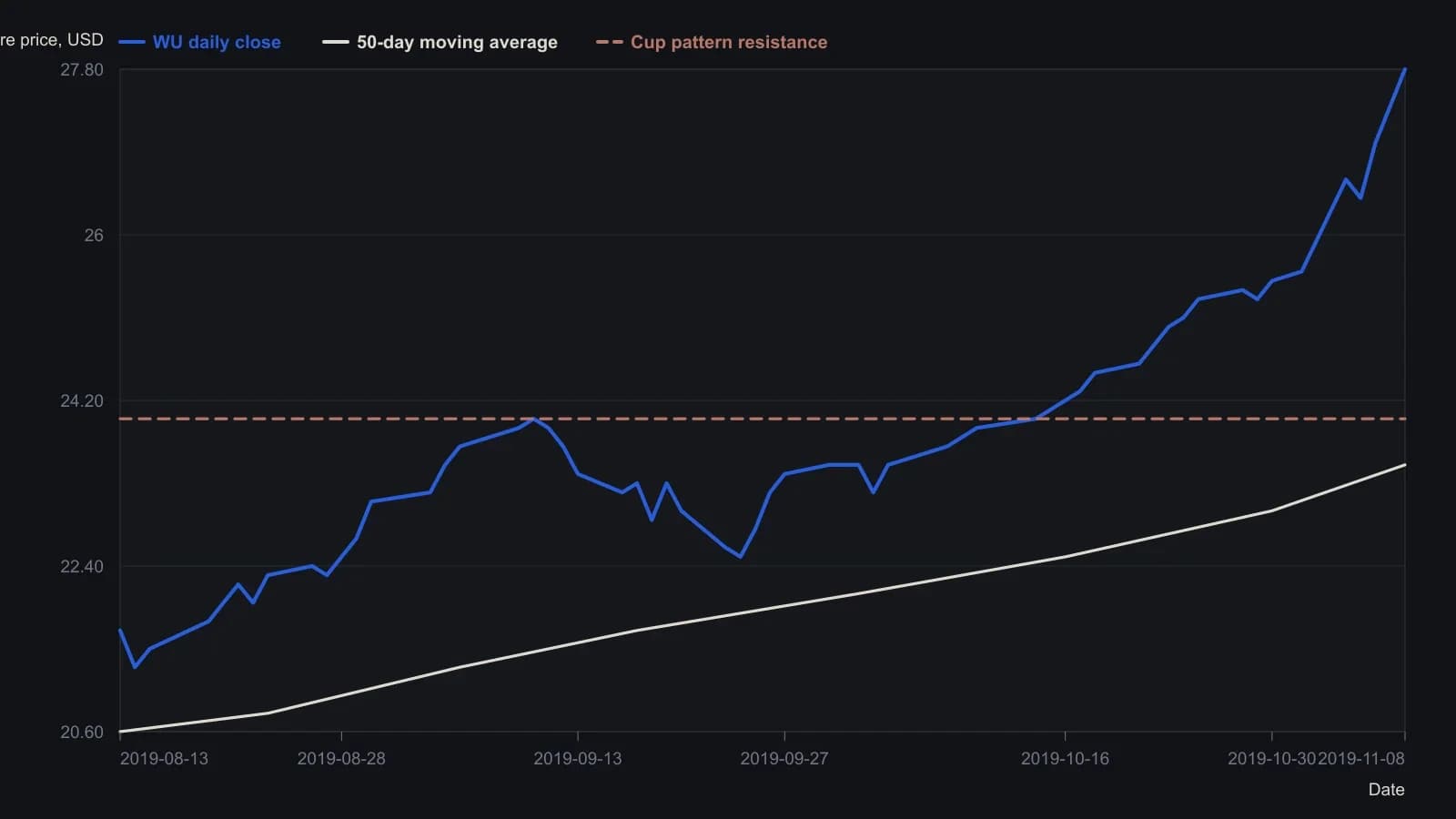
Closes taken from the daily candles on the 90-day chart, rounded to the nearest tenth of a dollar. The source’s two-dollar add is meant for stocks in the 20–50 dollar range.
All readings on this track · 17 readings
- 1982Six-category classification as a trend and pyramiding case study
- 1986Fear signals an untested decision process
- 1987Paper lots, stop orders, and pyramids as a Wyckoff apprenticeship
- 1992A pre-trade checklist for locked stops and trend pyramiding
- 1992Stop-first pyramid adds from locked profit
- 1997Long-term trend following and pyramiding as one holding-period procedure
- 1999Pyramiding after a maximum favorable excursion support
- 1999Confirm early scale-ins, then shrink late units
- 2004Stacking crossovers, MACD and pyramiding across currency timeframes
- 2008Scale in after launch confirmation
- 2008Range-breakout trend entries with early stops and pyramids
- 2015Why win-rate chasing fails the decision process
- 2016Expectancy through loss cuts, add-ons, and bounded leverage
- 2018Wide-range breakout, trailing stops, and pyramiding
- 2019Inverse ETF pair daytrading with pyramiding and a trailing stop
- 2019One procedure for breakout entry, trailing stops, and pyramid adds
- 2020Scale-in construction for swing breakouts