1999issue C091-11
Confirm early scale-ins, then shrink late units
Adding to a winner is a two-stage size schedule. Keep early scale-ins large only while market structure is still proving the break, then cut later pyramid units against the stop that would show the trend is over.
- Trade-risk is the dollar loss from an adverse move, including give-back of open profit, and it changes when the add-on rule changes even if the stop exit stays the same.
- Repeating the first share count at later, higher prices puts more cash into each new unit and concentrates dollar risk at the late, expensive end of the pyramid.
- Trend risk is concentrated just after the first entry and again as the move ages, with a longer middle window of lower risk after the break has been confirmed.
- After early confirmed units, late-unit-shrink cuts later pyramid dollars, more sharply when the name is judged fast and volatile.
Scale-in, pyramiding, and unit size
Scale-in-position adds successive units after the first fill as price continues in the trade's favor. Pyramiding increases total exposure on that working trade by stacking later units on earlier ones, whether those units keep share count or dollar outlay constant.
Volatility-position-sizing sets each unit from account equity, stop distance, and the judged remaining speed or life of the trend so a stop-out stays inside a pre-set equity fraction.
Trade-risk follows the add-on rule
Trade-risk is the dollar loss from an adverse move, counting both cash drawdown and give-back of open profit. That quantity changes when the add-on rule changes even if the stop exit stays the same.
Equal shares and equal dollars are not the same pyramid
Repeating the first share count at later, higher prices puts more cash into each new unit and therefore concentrates dollar risk in the late, expensive end of the pyramid.
Repeating the first dollar outlay at later prices buys fewer shares per add and therefore uses less total cash than equal-share pyramiding. It still treats later units as if the trend will continue.
Risk bunches at the open and at the end
Trend risk is concentrated just after the first entry and again as the move ages, with a longer middle window of lower risk after price action has confirmed the break.
TradersWeek editorial reading: that middle window is where early confirmed units can stay large. The late window is where the schedule has to shrink.
Confirm the add, then bound the unit
Later scale-ins can be triggered only when a range-based trailing stop rises through prior confirmation levels, so adds follow market-defined continuation instead of a fixed price increment.
A unit can be sized from the distance between fill and a market-defined stop so that a stop-out would risk no more than 2 percent of total intended trading equity, not merely of cash already in the market.
Shrink what you add late
Late-unit-shrink cuts the dollar size of later adds once confirmation gives way to the risk that the trend is ending. After early confirmed units, later pyramid units can be cut in dollar size, more sharply when the name is judged fast and volatile, so a late collapse hits smaller recent units than the early book.
Compare plans on committed capital
Add-on plans can be compared on one price series, one shared list of candidate add prices, and an exit that is allowed to arrive late rather than at an optimized turning point.
When add-on plans share the same first entry and the same exit but commit different amounts of cash, percentage return on committed capital is the comparison that puts those plans on equal footing.
Grow-up adds stay large until the break is confirmed
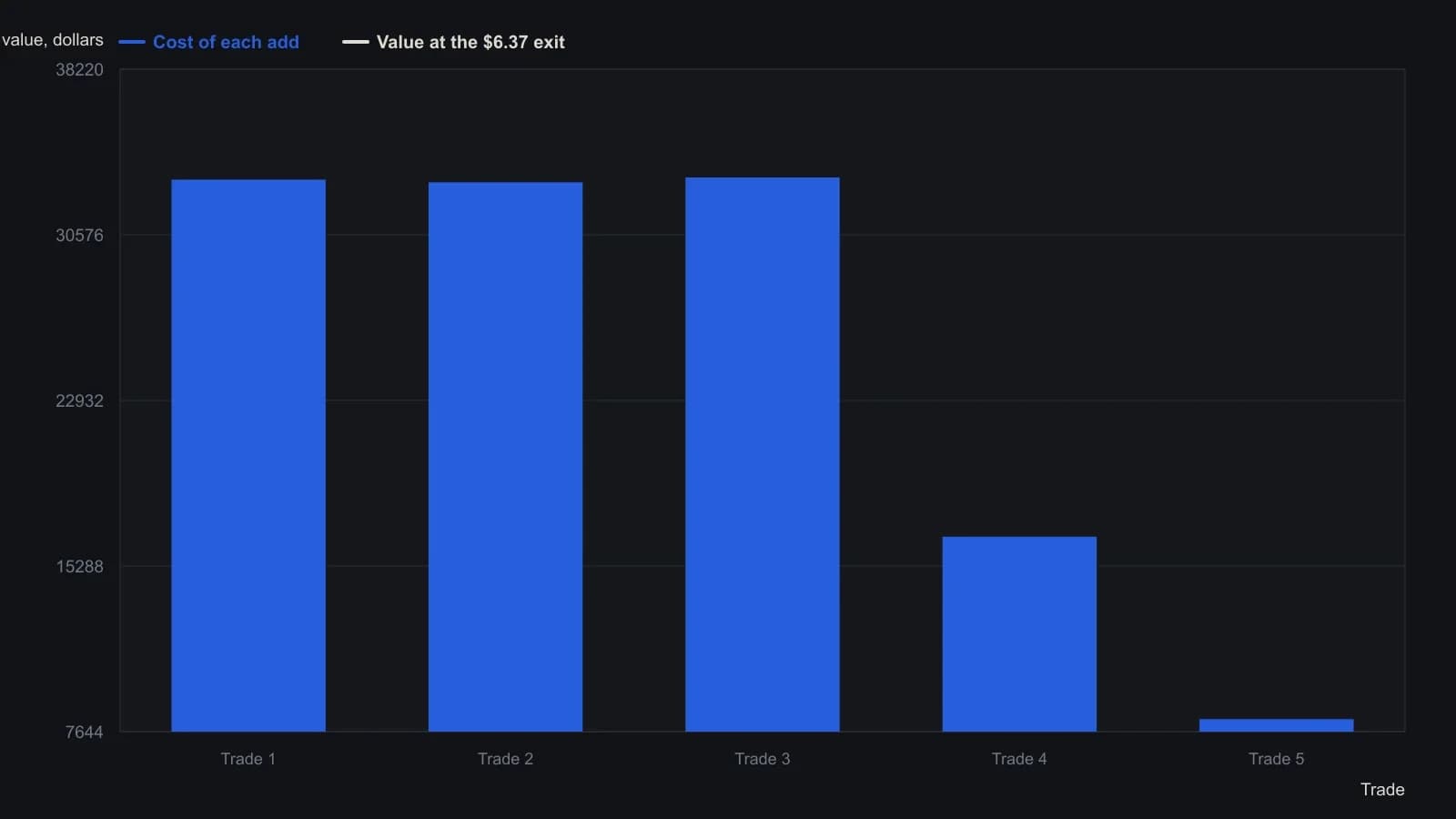
All five lots are marked to the same $6.37 10- and 30-day EMA crossover exit used for the other plans. The last two adds were taken above that price, so they finish as small losses.
All readings on this track · 17 readings
- 1982Six-category classification as a trend and pyramiding case study
- 1986Fear signals an untested decision process
- 1987Paper lots, stop orders, and pyramids as a Wyckoff apprenticeship
- 1992A pre-trade checklist for locked stops and trend pyramiding
- 1992Stop-first pyramid adds from locked profit
- 1997Long-term trend following and pyramiding as one holding-period procedure
- 1999Pyramiding after a maximum favorable excursion support
- 1999Confirm early scale-ins, then shrink late units
- 2004Stacking crossovers, MACD and pyramiding across currency timeframes
- 2008Scale in after launch confirmation
- 2008Range-breakout trend entries with early stops and pyramids
- 2015Why win-rate chasing fails the decision process
- 2016Expectancy through loss cuts, add-ons, and bounded leverage
- 2018Wide-range breakout, trailing stops, and pyramiding
- 2019Inverse ETF pair daytrading with pyramiding and a trailing stop
- 2019One procedure for breakout entry, trailing stops, and pyramid adds
- 2020Scale-in construction for swing breakouts