1993issue C111-9
Evaluating filter-trigger trailing exits after breakouts
This article evaluates a trailing-exit as its own stage of a breakout-system. After a long entry, flattening is issued only when a mature-uptrend filter and an unusual low-to-low-decline trigger are both true, and fewer remaining positions are treated as useful only if risk-of-ruin stays low enough to govern size.
- After a long entry, the trailing-exit is issued only under filter-trigger-concurrence: the concurrent-highest-lows filter and the low-to-low-fall trigger must both be true.
- The same exit can stay silent on short or narrow advances that never make a 19-bar low breakout, or fire too early in strong advances once the filter turns on quickly and the trigger becomes more sensitive.
- The 5/19 filter windows, the 17-bar trigger window, and a 6-bar lowest-low trailing comparison were chosen by optimization and described as data-dependent rather than portable.
- Fewer selective positions are framed as useful for money management only if risk-of-ruin stays low enough, which is tied to a high win-loss percentage and/or a favorable average-win-to-average-loss ratio.
Exit only when filter and trigger agree
A breakout-system enters when price clears a prior close extreme over a set bar count and then applies a separate exit rule through the holding period. A trailing-exit is a flatten rule that waits for a specified retracement or for a filter and trigger to agree, instead of reversing the original entry signal.
After a long entry, an exit is issued only when a mature-uptrend filter and an unusual low-to-low-decline trigger are both true at the same time. That pairing is filter-trigger-concurrence: if the filter and the trigger disagree, no exit is issued. The construction is presented as having structural parallels on the short side.
How the long-side filter and trigger work
The concurrent-highest-lows filter is true when the highest low of the last 5 bars is also the highest low of the last 19 bars, and it remains true until a 5-bar downside breakout of lows.
The low-to-low-fall trigger measures the one-bar change in lows and fires when that change is the largest decline in a 17-bar lookback.
After a long entry the exit is described as able to leave a mature advance or a wide-range rally that made a 19-bar breakout, while remaining inactive through a narrow range that never makes that breakout.
T-bond low-to-low oscillator, July–August 1989
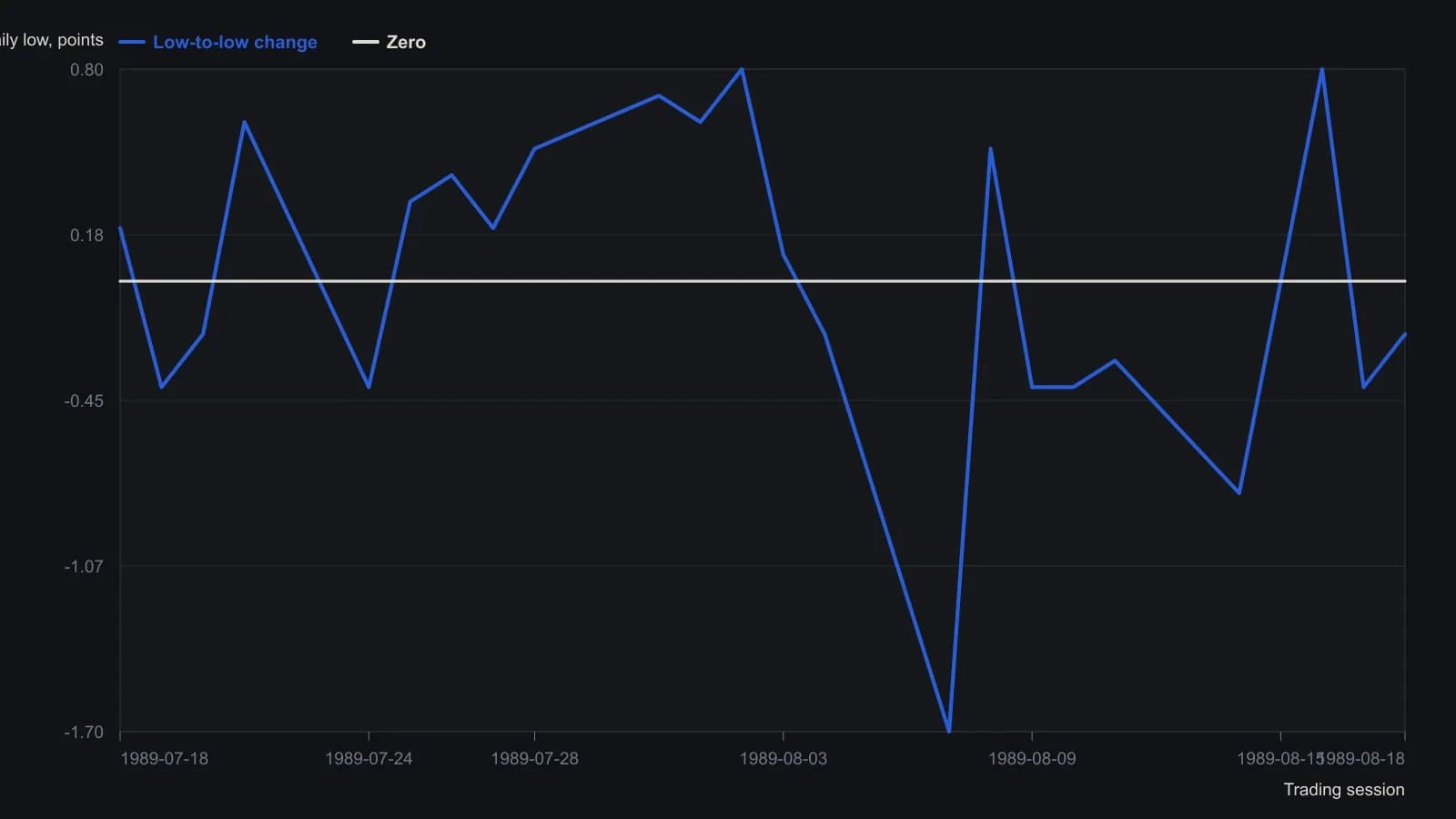
Digitized from the raster to the nearest tenth of a point. The article’s LLF rule uses a 17-session lookback that is not drawn as a separate series here.
The historical demonstration
The demonstration entered on a 10-bar close breakout in a 1,000-bar daily sample, filled both entry and exit on the next open, and omitted commission and interest.
The 5/19 filter windows, the 17-bar trigger window, and a 6-bar lowest-low trailing comparison exit were chosen by optimization and described as data-dependent rather than portable.
When the exit misses or fires early
The exit can fail to fire on short advances that never make a 19-bar low breakout, or when recent low-to-low declines remain smaller than older declines still inside the trigger window.
The same exit can fire too early in strong advances because the filter turns on quickly and few negative low-to-low readings appear, which makes the trigger more sensitive.
An aggregate result can still contain missed tops or other trades that visual review would reject, so both visual and statistical checks are required.
Selectivity and the chance of ruin
Fewer, more selective positions are framed as useful for money management only if the chance of ruin stays low enough, which is tied to a high win-loss percentage and/or a favorable average-win-to-average-loss ratio.
Risk-of-ruin is a bound, set before size is raised, that treats fewer selective trades as acceptable only when win rate or win-to-loss balance keeps the chance of account wipeout low.
All readings on this track · 18 readings
- 1988Constructing a mechanical trend system with independent trailing exits
- 1991Write a staged RSI exit book with trailing stops
- 1993Evaluating filter-trigger trailing exits after breakouts
- 1995Weekly-close breakout entry and trailing exit in Eurodollars
- 1996Evaluating moving-average turn entries and slope exits
- 1997Precommit an equity-risk cap and a profit-retracement exit
- 1998Exit stops before entries
- 1998Exit rules evaluated with a fixed random entry
- 2002Construct the stay-or-flatten decision before entry
- 2006Audit the stop, trail, and risk-reward stack as one procedure
- 2007Building a momentum system with relative strength and trailing exits
- 2013When buy and hold needs a sell rule
- 2013A mechanical trend toolkit that turns screens into one entry-exit procedure
- 2014Is a two-period relative strength index, a channel breakout, and a trailing exit one long-only procedure?
- 2016Trend-aligned option entries and trailing exits
- 2017Monthly three-black candles as a trailing exit
- 2018Evaluating profit-taking and reentry in trend following
- 2020Treat the zigzag threshold as a volatility-scaled construction variable