1988issue C101-6
Limited-risk labels versus exposure and ruin
Risk is the chance a position succeeds or fails. Exposure is the money at stake. A limited-risk cash figure states the second and omits the first, so size is still accepted or rejected with an exposure-cap and a consecutive-loss ruin check.
- Risk is the chance of success or failure; exposure is the money at stake, and the two are not interchangeable.
- A fixed cash figure such as 1000, or a bounded option premium, states exposure and does not estimate whether the position can succeed.
- An exposure-cap of 20 percent of starting capital allows at most five consecutive full losses; a high chance of that streak is a reason to lower the cap.
- Expected value can stay the same while a larger stake changes survival capacity, so risk-of-ruin still has to be checked.
Risk names a chance, not a cash outlay
Risk is the probability of success or failure. Exposure is the money at stake in a transaction, independent of that chance. The two are not interchangeable.
Calling a position's risk a fixed cash figure such as 1000 states exposure and omits the chance of success or failure.
A bounded outlay is still only exposure
Bounding cash outlay by an option premium does not replace estimating the chance the strike is reached before expiration. A profitable close after expiration still requires a move larger than the premium.
An option whose strike has no realistic chance of being reached is assigned a 100 percent chance of loss even if the cash outlay is bounded.
Exposure-cap before entry
A 25000-unit risk-capital book is treated as unable to carry 100000 of exposure even when success is assigned a 90 percent chance.
An exposure-cap of 20 percent of starting capital allows at most five consecutive full losses before the book is exhausted. A high chance of that streak is given as a reason to lower the cap.
Expected value does not measure survival
Expected value is probability of profit times profit minus probability of loss times exposure. 0.80 times 2500 minus 0.20 times 1000 equals 1800. Reversing those probabilities yields minus 300.
A fair coin bet has expected value of zero at any stake. Raising the stake from a dime to 100 or 1 million changes survival capacity, not the expected value.
Frequency tables of historical gains and losses can be used to compute expected value at each profit-objective boundary. In the worked case the lowest objective had the highest expected value because large wins were rare.
Ruin as a consecutive-loss check
Risk-of-ruin and ruin-probability are framed as functions of capital, exposure, and the chance of a losing streak, illustrated as a 20 percent chance of five 1000-unit losses in a row.
Risk-of-ruin is a pre-entry and in-position check that a chosen loss size and streak length would exhaust the book. Ruin-probability is the chance of a losing streak long enough to force the program to stop, given capital and exposure.
Percent of results by profit objective
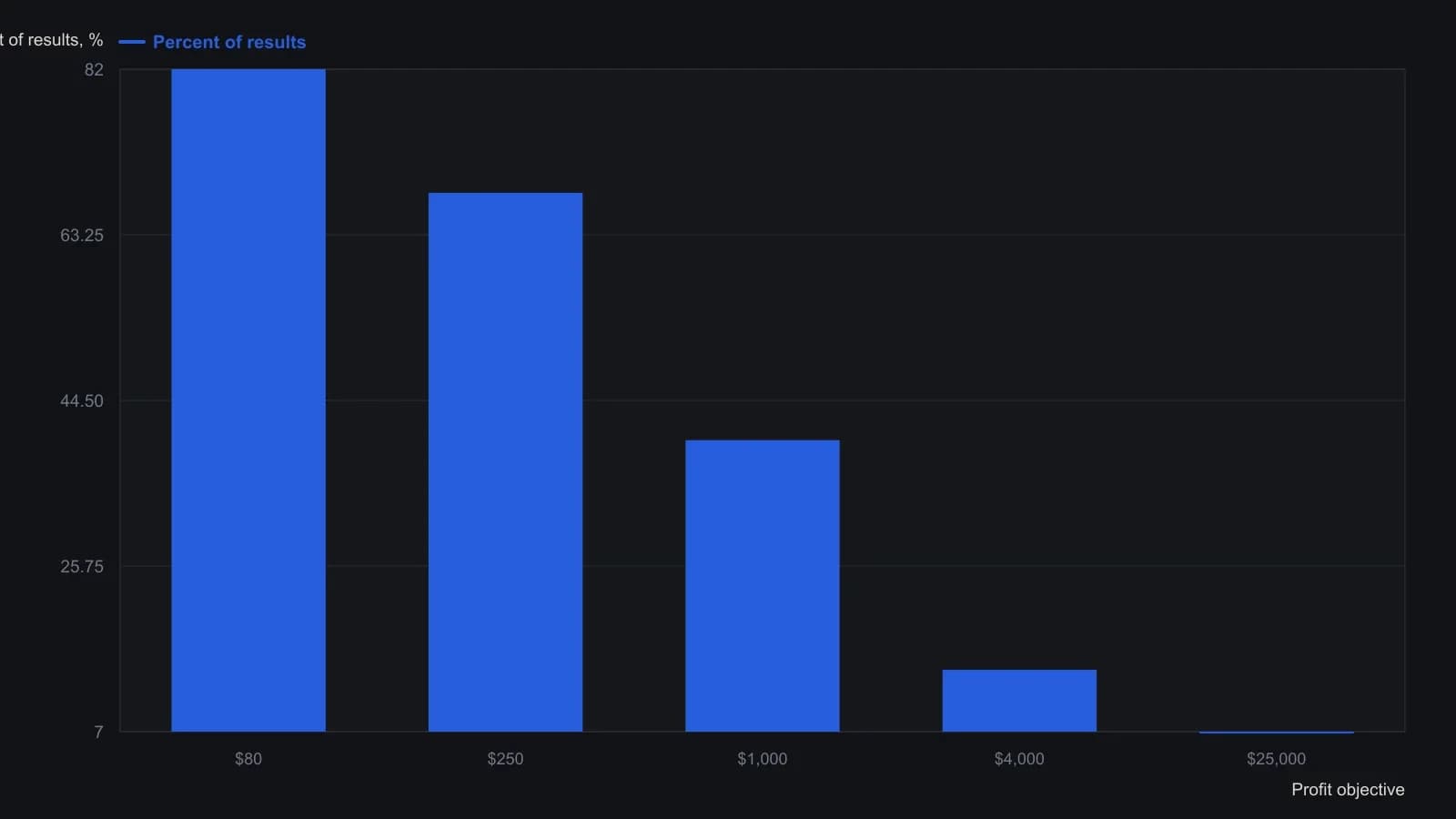
Heights are approximate readings from a rotated magazine scan. The source treats any trade that misses the stated objective as a $500 loss and presents the bars as test data for a 50-day moving-average rule.
All readings on this track · 6 readings
- 1988Name the stop, then decide if the account can pay
- 1988Limited-risk labels versus exposure and ruin
- 1992Risk of ruin and exposure caps as a pre-trade filter
- 1994When standing puts fail the drawdown test
- 2017The minimum-margin habit is not commodity-market risk
- 2018Evaluating a normalized risk index for drawdown and exposure limits