2016issue C0333-40
Trend-aligned option entries and trailing exits
This archive article restates a historical options campaign as one procedure for entry, first profit-taking, a trailing remainder, and sitting out event-risk setups.
- A complete options campaign can be written as one procedure that decides entry, first profit-taking, a trailing remainder, and abstention from event-risk setups.
- Entry rules favor liquid names and confirmed breakouts, then wait for a retest instead of chasing the first gap or the first overbought print.
- Risk is bounded before entry, an initial target removes part of the risk, and a trail can move to break-even so the leftover position can stay with the trend.
- The procedure skips buying options immediately ahead of earnings or similar event-risk gaps because those prices already embed the event and can invalidate a planned stop.
One procedure for the whole campaign
A complete options campaign can be written as one procedure that decides entry, first profit-taking, a trailing remainder, and abstention from event-risk setups.
The rule-based entry is a predefined checklist that says when a trade may start, when it must wait, and when it is skipped. The trailing exit is a stop that is raised after a first profit target so the leftover position can keep following the trend until the move fails.
When a trade may start
Entry rules in the source favor liquid names and confirmed breakouts, then wait for a retest instead of chasing the first gap or the first overbought print.
The same procedure treats persistently overbought oscillator readings as a possible continuation filter when they meet the system’s criteria, not as an automatic short signal. Percent-r rules belong in that role: an overbought or oversold oscillator used as a continuation filter rather than an automatic reversal signal.
Bound the loss before entry
Risk is bounded before entry by a per-trade loss cap, described as ideally 2 percent and not more than 3 percent of the book being traded.
A risk-reward ratio is a pre-entry comparison of how much can be lost versus how much the setup can reasonably return. In this workflow the loss cap is set first so that comparison stays inside a known bound.
DJIA monthly with Acceleration Bands, 2010–2016
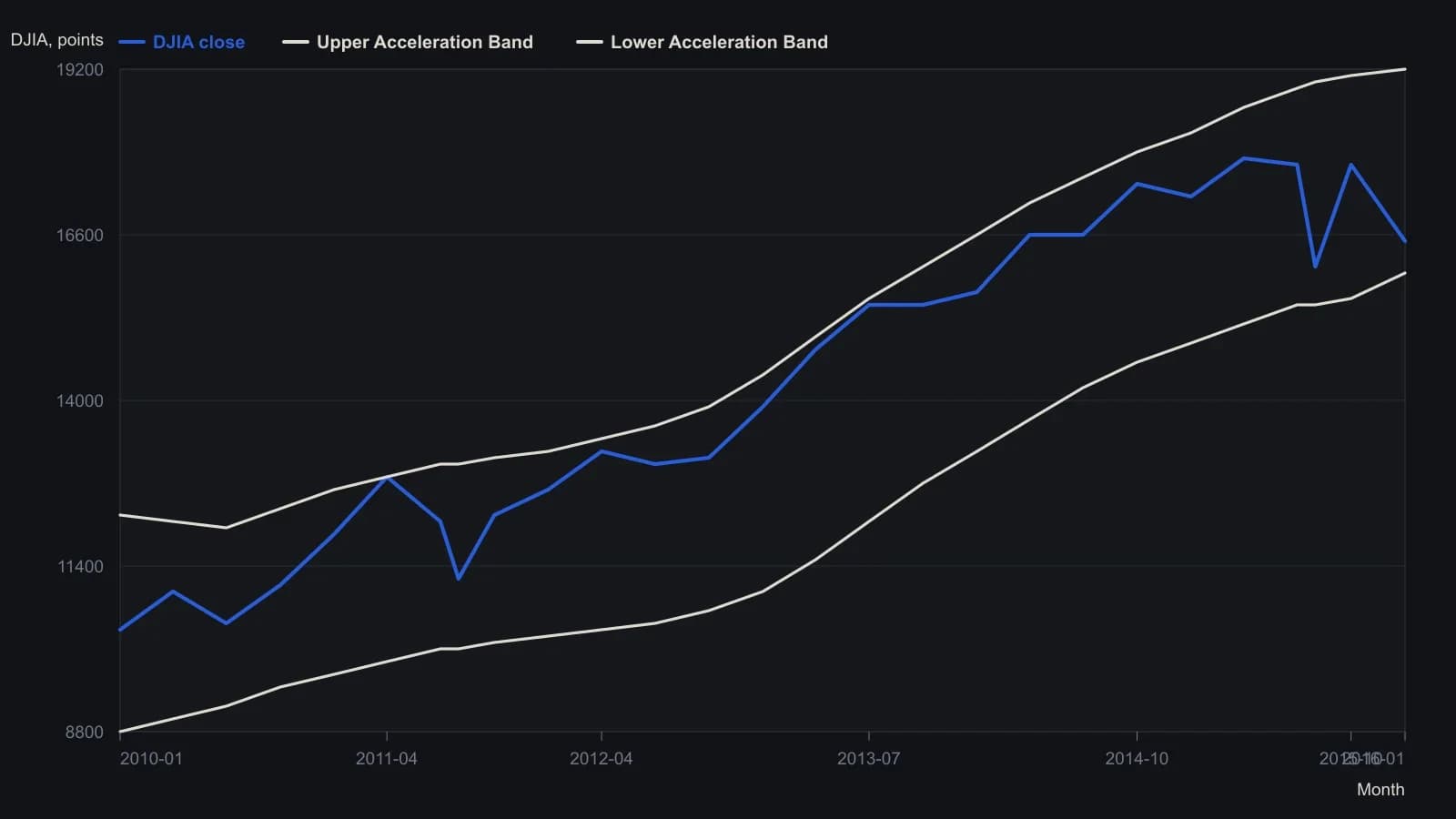
BigTrends Acceleration Bands fixed at 20 periods on monthly DJIA. Digitised from the magazine raster, so levels are approximate.
First target, then a trail
Exit rules combine an initial target that removes part of the risk with a trail that can be moved to break-even so the leftover position can stay with the trend. After the first target, the trailing exit is the rule that keeps the remainder in the move until the trend fails.
When the procedure sits out
The procedure skips buying options immediately ahead of earnings or similar event-risk gaps because those prices already embed the event and can invalidate a planned stop. Sitting out is part of the same checklist, not a separate judgment call.
Defined-risk credit spreads are presented as a way to stay bullish or neutral while the sold option is protected by a cheaper long option beneath it.
All readings on this track · 18 readings
- 1988Constructing a mechanical trend system with independent trailing exits
- 1991Write a staged RSI exit book with trailing stops
- 1993Evaluating filter-trigger trailing exits after breakouts
- 1995Weekly-close breakout entry and trailing exit in Eurodollars
- 1996Evaluating moving-average turn entries and slope exits
- 1997Precommit an equity-risk cap and a profit-retracement exit
- 1998Exit stops before entries
- 1998Exit rules evaluated with a fixed random entry
- 2002Construct the stay-or-flatten decision before entry
- 2006Audit the stop, trail, and risk-reward stack as one procedure
- 2007Building a momentum system with relative strength and trailing exits
- 2013When buy and hold needs a sell rule
- 2013A mechanical trend toolkit that turns screens into one entry-exit procedure
- 2014Is a two-period relative strength index, a channel breakout, and a trailing exit one long-only procedure?
- 2016Trend-aligned option entries and trailing exits
- 2017Monthly three-black candles as a trailing exit
- 2018Evaluating profit-taking and reentry in trend following
- 2020Treat the zigzag threshold as a volatility-scaled construction variable