1995issue C031-5
Weekly-close breakout entry and trailing exit in Eurodollars
A Eurodollar case study specifies a mechanical trading system from daily high, low, and settlement, with weekly settlement as the only decision price. The same two-week extreme starts a long or short, leaves the system flat inside the range, and trails an open position until the opposite Friday close.
- The procedure is fully specified from daily high, low, and settlement. Weekly settlement is the only decision price for both entry and exit.
- A Friday settlement above the prior two-week high starts a long; a settlement below the prior two-week low starts a short. A close between those extremes is abstention.
- An open long or short stays in force until the opposite weekly-close break, so the same two-week extreme is the trailing-exit rule and can reverse the position.
- In 1982-1983 the study recorded 10 winning and 10 losing trades and still described the stretch as profitable because losers were closed quickly and the largest moves were captured.
One weekly close runs the whole loop
The procedure is fully specified from daily high, low, and settlement. Weekly settlement is the last trading day's official close of the week, and it is the only decision price for both entry and exit.
That specification is a mechanical trading system. It converts weekly settlement, the prior two-week extreme, and the contract-roll constraint into long, short, or flat signals without discretionary overrides.
How a Friday settlement starts or waits
The two-week extreme is the highest high or lowest low printed over the two full weeks immediately before the decision week.
A long is initiated only when weekly settlement is above the highest price of the prior two weeks. A short is initiated only when it is below the lowest price of the prior two weeks.
When the weekly close sits between those two-week extremes, the system stays flat or keeps waiting rather than forcing a new position. That wait is abstention: the system does not force a trade without a breakout.
The same break trails and can reverse
An open long or short remains in force until the opposite weekly-close break appears. The opposite weekly-close break of the same two-week extreme closes the open position and may reverse it.
Losers are cut when the market fails the range. Winners stay open while the trend continues. The holding period is the time from a valid weekly-close entry until that opposite break, spanning days to months depending on how long price stays on one side of the two-week range.
June and December contracts only
The case study restricted testing to June and December Eurodollar contracts. It rolled from the June Eurodollar future to the December contract on Friday of the first week of June. After that contract-roll, the same weekly-close rules apply to the new contract. The new contract did not always start with the same side as the old one.
A first-week wait, then a short
On the first weekly close of 1982 the June contract finished inside the prior two-week range, so no trade was taken. The next Friday settlement at 84.19 broke below the two-week low and started a short that was held until a later buy signal.
Equal trade counts and two later regimes
In the 1982-1983 window the study recorded 10 winning and 10 losing trades. It still described the stretch as profitable because losers were closed quickly and the largest moves were captured.
Charted 1993 June and December contracts were used to show a strong trend in the first five months and a cluster of losses in the latter half of the year. The same weekly-breakout loop sat through both regimes.
June 1982 Eurodollar daily closes
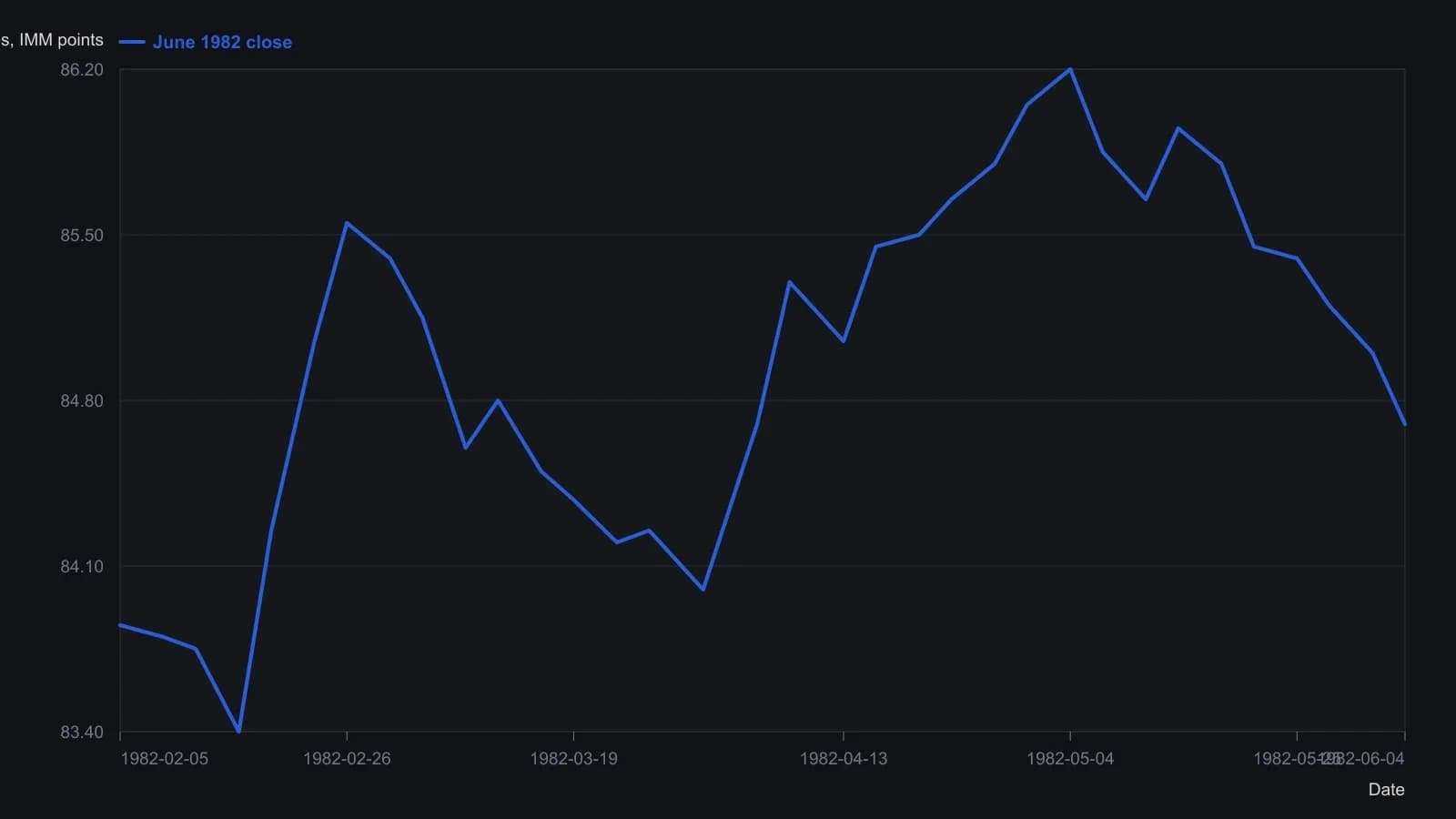
Closes were read off the daily OHLC raster to the nearest 0.05 against a 0.50 printed grid. January 1982 is off this screenshot. Two weekly settlements are taken from the article text rather than the bars.
Built for Eurodollars, not every futures market
The source framed the work as a market-specific mechanical indicator for Eurodollars rather than a single formula meant to fit every futures market, after arguing that short-rate, currency, and grain markets move on different time scales.
All readings on this track · 18 readings
- 1988Constructing a mechanical trend system with independent trailing exits
- 1991Write a staged RSI exit book with trailing stops
- 1993Evaluating filter-trigger trailing exits after breakouts
- 1995Weekly-close breakout entry and trailing exit in Eurodollars
- 1996Evaluating moving-average turn entries and slope exits
- 1997Precommit an equity-risk cap and a profit-retracement exit
- 1998Exit stops before entries
- 1998Exit rules evaluated with a fixed random entry
- 2002Construct the stay-or-flatten decision before entry
- 2006Audit the stop, trail, and risk-reward stack as one procedure
- 2007Building a momentum system with relative strength and trailing exits
- 2013When buy and hold needs a sell rule
- 2013A mechanical trend toolkit that turns screens into one entry-exit procedure
- 2014Is a two-period relative strength index, a channel breakout, and a trailing exit one long-only procedure?
- 2016Trend-aligned option entries and trailing exits
- 2017Monthly three-black candles as a trailing exit
- 2018Evaluating profit-taking and reentry in trend following
- 2020Treat the zigzag threshold as a volatility-scaled construction variable