1990issue C021-7
Recovery sizing as a series procedure
Recovery sizing is written as an open series. Lock the bet unit to the system's typical loss, raise contracts after a loser only when one unit would not close the book, and score the plan by whether a losing streak can exhaust the reserved capital.
- A simple martingale doubles the stake after each loss so one win recoups the open series and a profit equal to the first stake. A complex martingale raises the next stake by a partial step, such as 40 percent, and closes the series when wins surpass losses.
- In a futures setting the bet unit is the system's average loss, not the margin deposit or one contract, because the cash result of a trade rarely equals the margin posted.
- Pyramiding raises contract count on later plays in a losing series so an assumed average win can meet a recovery target equal to the average loss. Count is left unchanged when one unit at that average win would already close the series.
- Risk of ruin is the chance a losing streak consumes the capital reserved for the sizing plan before the series can close. Keeping unused size in reserve, rather than always trading the plan's maximum contract count, is framed as a way to cap that streak.
Write recovery as a series
Instrument or setup selection must precede martingale use. The sizing rule needs a stated odds profile for each play and cannot choose the market.
Once that profile is stated, recovery is written as a series: a book of related plays that stays open until recovered gains surpass the losses already taken.
Simple and complex martingale schedules
A simple martingale doubles the stake after each loss so that one win recoups the open sequence and a profit equal to the first stake.
A complex martingale raises the next stake by a partial step such as 40 percent rather than a full double. It treats each play as part of a series and closes that series when wins surpass losses.
If a carded stake grows too large, it can be split into smaller simultaneous wagers so the book stays inside a size cap.
Lock the bet unit to typical loss
In a futures setting the wager is defined as the system's average loss, not as margin or as one contract, because the cash result of a trade rarely equals the margin posted. That assigned cash risk is the bet unit.
Overt risk is summarized as average dollars won and lost across 100 trades. A stricter wager definition is the average of the three largest losses.
Add contracts only when one unit cannot close the series
Contract count is raised on later plays in a losing series so an assumed average win can close the series at a recovery target equal to the average loss. Count is left unchanged when one unit at that average win would already close the series.
That later increase is pyramiding: a written rule for when size may be added after a loser.
Score the plan by risk of ruin
Risk of ruin is the chance that a losing streak consumes the capital reserved for the sizing plan before the series can close.
Keeping unused size in reserve so contracts rise only after losses is framed as a way to cap the drawdown of a losing streak and lower the chance the account is finished before later wins arrive, compared with always trading the plan's maximum contract count.
Five-trade P&L under four S&P sizing plans
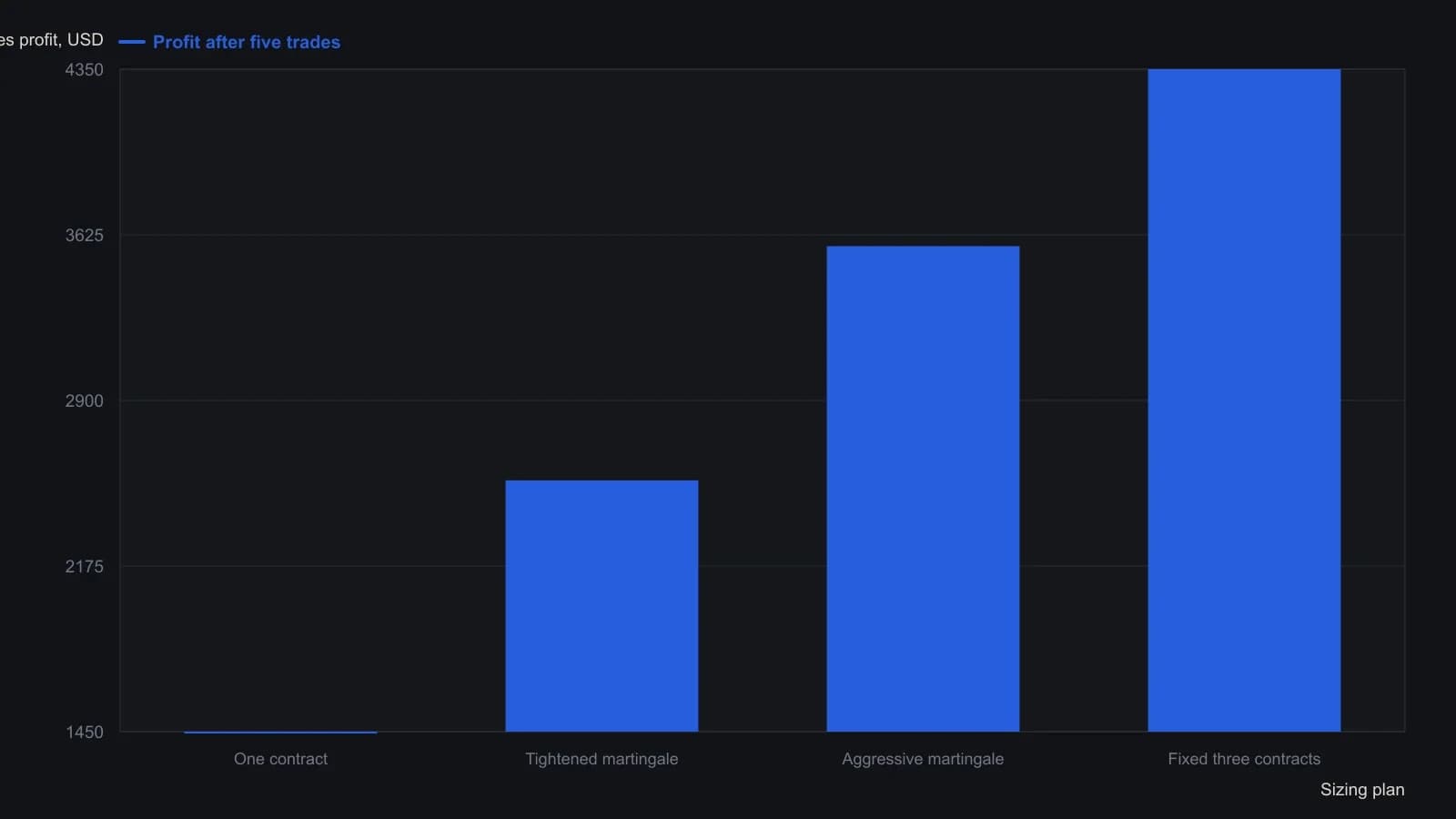
All four closes use one printed sequence: losses of $1,150 and $1,650, then wins of $1,100, $1,575 and $1,575. Peak-loss figures are given only for the aggressive martingale and the always-three book, so they are not plotted.
Hidden risk and the reverse martingale
Hidden risk is the chance that market character changes so the system's measured odds no longer apply. A reverse martingale is proposed as a way to respond to that shift rather than only recover after losses.
Editorial reading
Editorial. TradersWeek reads the archive workflow as a three-part procedure. First lock the bet unit to the system's typical loss, using overt risk or the stricter average of the three largest losses. Next write the rule for when contracts may be added after a loser, raising count only when one unit at the assumed average win would not close the series. Then score the finished plan by risk of ruin: whether a losing streak can exhaust the capital reserved for the schedule before the series can close.
Editorial. The reverse martingale is read here as a response to hidden risk, not as a second recovery schedule.
All readings on this track · 9 readings
- 1988Modified-martingale progression lists and ruin bounds
- 1989Scale-in-on-loss on a tempered-martingale-series with a fixed unit-factor
- 1989Shorter series need fewer recovery hits and raise scale-in cash
- 1990Recovery sizing as a series procedure
- 1990Reverse-martingale pyramiding after clustered wins
- 1993Test Martingale against fixed size before you pyramid
- 1998The runs-test as a contract-sizing gate
- 2004Scale-in on a two-close reversal instead of using a price stop
- 2012Four-level risk sizing when stock margin caps fixed fractions