2006issue C081-3
Audit the stop, trail, and risk-reward stack as one procedure
The archive writes the stop-loss, trailing-exit, and risk-reward ratio as one pre-trade procedure, sized from ordinary range and from measured post-entry travel. Immediate exits, scale-outs, and objectives invented after the fill are the object of the critique.
- A stop-loss belongs on the symbol's ordinary session range and on the chart's entry-exit sequence, not on a fear number the market will not support.
- Stop-loss and trailing-exit rules are written from measured favorable-excursion across a large sample of the method's own trades.
- Immediate exits and scale-outs after a fill are treated as fear-of-loss habits that weaken average win relative to average loss across a series.
- A comfort objective below common travel, paired with a stop left wide for ordinary noise, is described as breaking the planned risk-reward ratio.
One procedure before the fill
The archive criticizes study time spent only on pinpoint entries. Correct stop-loss, trailing-exit, and risk-reward management is treated as more decisive for series results than the entry itself. Those three pieces are written together, before a fill, as one procedure.
A stop-loss is a pre-placed exit that bounds loss if price travels against the position, scaled to the symbol's ordinary session range rather than to a comfort number. A trailing-exit is a written rule that advances the protective stop as price moves in the trade's favor so the remaining size keeps its leverage while open risk shrinks. The risk-reward ratio is the planned relationship between bounded average loss and the favorable distance a method typically allows before the next signal or the session ends.
Size the stop to range and sequence
Traders who work the same symbol on a one-minute chart need a different stop-loss and objective scale than traders on a five-minute chart, because the sequence of entries and exits is different.
A dollar stop-loss that sits inside one index contract's ordinary session range can still sit inside the noise of a related contract whose typical intraday value range is nearly twice as large. Matching the stop to a similar share of each contract's range requires a wider dollar stop on the noisier symbol. Intraday-noise is that ordinary volatility range of a contract inside a session. A stop placed inside that range is treated as too tight for that symbol.
An initial stop-loss chosen purely from fear is described as a setting the market will not support. A stop sized to ordinary volatility and contract dynamics is described as the setting the market can accept.
Measure travel before writing the trail
Measuring how far price typically traveled from entry before the next signal or session end, across a large sample of a method's own trades, is presented as the data needed to write that method's stop-loss and trailing-exit rules.
Favorable-excursion is how far price travels in the intended direction after entry before it reverses, the next signal appears, or the session ends. Those measured paths are what the written stop and the written trail are asked to fit.
How far 100 average ES trades travel from entry
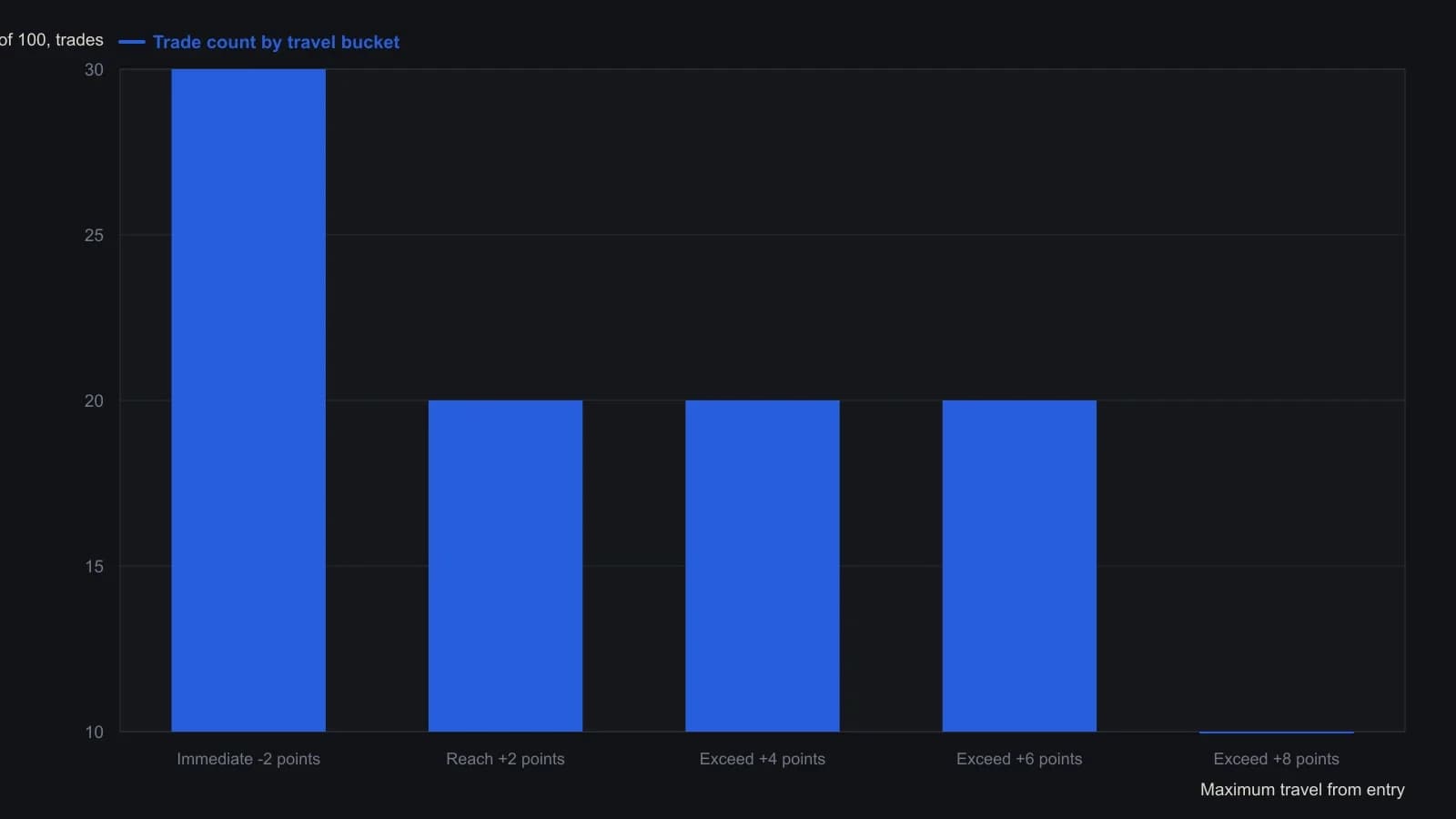
The author calls the scale hypothetical and optimistic; he says the counting process generalizes, not these exact percentages.
Fear after the fill weakens the series
Immediate exits after a fill and partial scale-outs are characterized as fear-of-loss behaviors that weaken the average win relative to the average loss across a series of trades.
A scale-out cuts size into an open gain to relieve anxiety. It is treated here as a weakening of series-level payoff rather than as a risk rule.
Trail the full remaining position
A rule that moves the initial stop-loss to breakeven after a defined favorable move is used to convert a slice of reversing trades into scratches and thereby lower average loss across the mixed group of losers and scratches.
After a larger favorable excursion, trailing the remaining full position to lock a defined open gain is contrasted with flattening a small fixed target on every fill and abandoning full-position leverage on trades that continue. The trail is written so remaining size keeps its leverage while open risk shrinks.
Keep the ratio inside the measured envelope
A profit objective chosen only to end uncertainty can sit well below a method's common favorable travel while the initial stop stays wide enough for ordinary noise, breaking the risk-reward ratio that path is described as offering.
Editorial note: the planned ratio has to live inside that measured envelope. Ordinary noise sets how wide the stop can be. Common favorable-excursion sets how far the method typically allows price to travel before the next signal or the session ends. A comfort target below that travel, left against a noise-wide stop, is the broken pair under review.
All readings on this track · 18 readings
- 1988Constructing a mechanical trend system with independent trailing exits
- 1991Write a staged RSI exit book with trailing stops
- 1993Evaluating filter-trigger trailing exits after breakouts
- 1995Weekly-close breakout entry and trailing exit in Eurodollars
- 1996Evaluating moving-average turn entries and slope exits
- 1997Precommit an equity-risk cap and a profit-retracement exit
- 1998Exit stops before entries
- 1998Exit rules evaluated with a fixed random entry
- 2002Construct the stay-or-flatten decision before entry
- 2006Audit the stop, trail, and risk-reward stack as one procedure
- 2007Building a momentum system with relative strength and trailing exits
- 2013When buy and hold needs a sell rule
- 2013A mechanical trend toolkit that turns screens into one entry-exit procedure
- 2014Is a two-period relative strength index, a channel breakout, and a trailing exit one long-only procedure?
- 2016Trend-aligned option entries and trailing exits
- 2017Monthly three-black candles as a trailing exit
- 2018Evaluating profit-taking and reentry in trend following
- 2020Treat the zigzag threshold as a volatility-scaled construction variable