1992issue C121-6
Risk of ruin and exposure caps as a pre-trade filter
The chance that account equity falls below the minimum needed to keep trading depends on success rate, payoff ratio, and the share of capital exposed. Historical tables treat that share as a choice that can be scored or reduced before a position is opened.
- Ruin is available capital falling below the minimum required to continue trading, and its probability depends on success rate, payoff ratio, and the fraction of capital exposed.
- A closed-form ruin estimate assumes a payoff ratio of 1 and that all capital is exposed. When average wins exceed twice average losses, ruin is estimated by Monte Carlo simulation instead.
- Estimated ruin stays at 1 for payoff ratios of 2 or less when success probability is 0.30 or lower, at every tested exposure. A 0.15 success probability or a 0.50 payoff ratio can still produce assured ruin at a 10% exposure cap.
- The tables can be read to score ruin at a planned exposure or to pick an exposure that meets a target. At 0.55 success and a payoff ratio of 2, 50% exposure maps to 0.289 ruin and 25% exposure maps to 0.082.
What risk of ruin measures
Ruin is defined as available capital falling below the minimum required to continue trading. Risk of ruin is the estimated chance of that outcome. It depends on success rate, payoff ratio, and the fraction of capital exposed.
Payoff ratio is average winning trade divided by average losing trade. An exposure cap is the share of account equity a trader is willing to put at risk before and during a position.
When a closed-form estimate does not apply
The elementary closed-form ruin estimate assumes a payoff ratio of 1 and that all capital is exposed. Under those assumptions, ruin rises with units of capital at risk and falls as the probability of success rises.
When average wins exceed twice average losses, the associated differential equations do not yield a precise closed-form solution. Ruin is then estimated by Monte Carlo simulation, meaning repeated random trials used to estimate ruin when a closed-form formula does not apply.
How the simulation was run
The simulation varies success probability from 0.05 to 0.90, payoff ratios from 1 to 10, and exposure at 100%, 50%, 25%, and 10%. Each parameter set is repeated 100,000 times.
Each simulated round ends when starting capital for that round is lost or grows 100-fold, at which point ruin is treated as negligible. Profits are assumed not to be withdrawn.
Patterns in the ruin tables
Across the tables, estimated ruin stays at 1 for all payoff ratios of 2 or less whenever the success probability is 0.30 or lower, regardless of the four exposure levels tested.
At a 0.65 success probability and a 0.50 payoff ratio, estimated ruin is 1 at every tested exposure. Lowering exposure from 100% to 10% is what allows ruin estimates to fall toward 0.349, 0.125, 0.016, and 0.002 at higher payoff ratios.
A 0.15 success probability can still produce assured ruin even with a payoff ratio of 5 and 10% exposure. A 0.50 payoff ratio can produce assured ruin even at a 0.65 success probability and 10% exposure.
With 10% exposure, estimated ruin falls from 0.608 to 0.033 when success probability rises from 0.35 to 0.45 at a payoff ratio of 2. With 100% exposure, a 0.60 success probability and a payoff ratio of 10 still leave a 0.40 ruin estimate.
Risk of ruin at a 2-to-1 payoff, by capital exposed
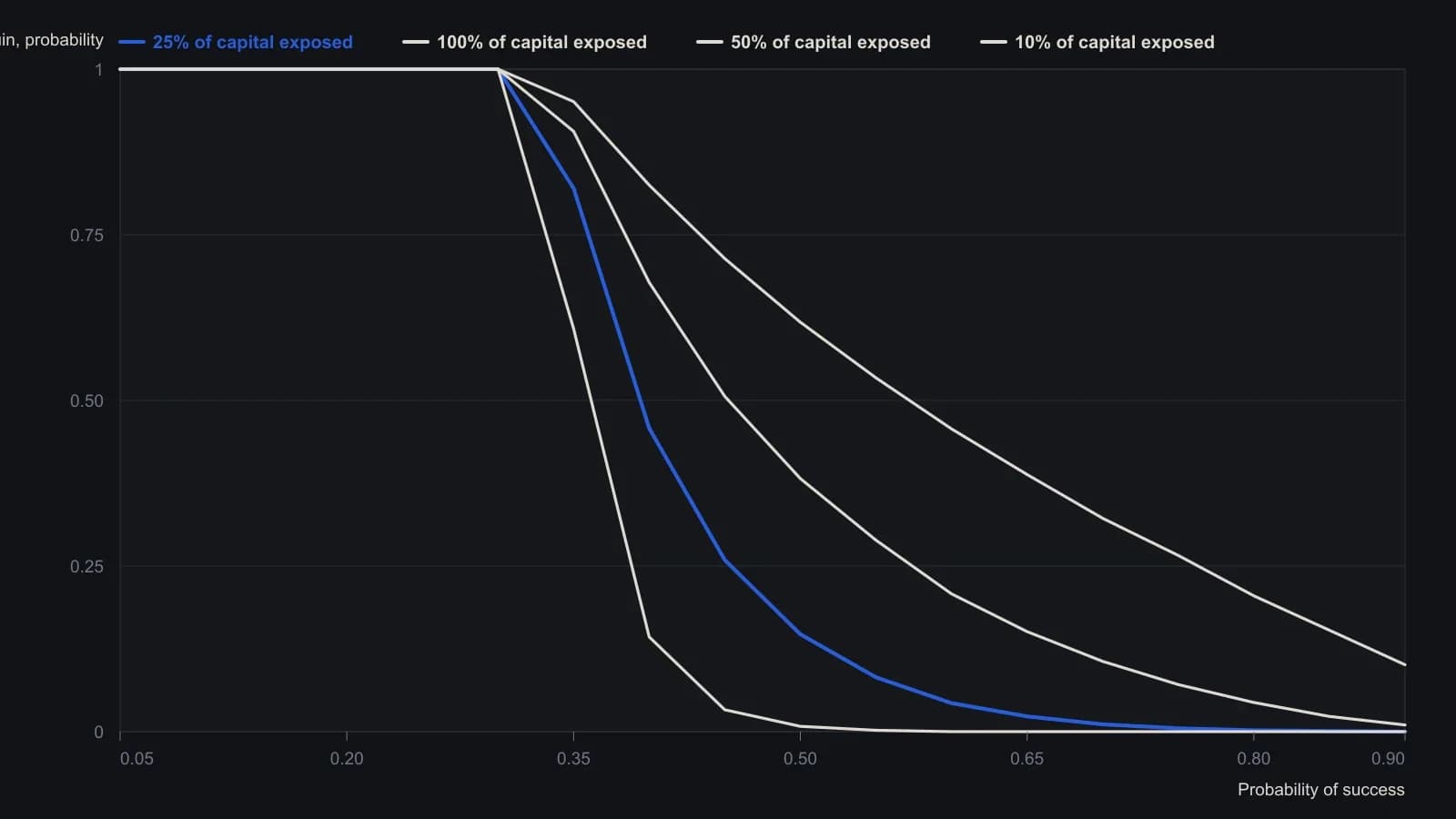
Each cell is the fraction of 100,000 simulated paths that lost starting capital. Paths stopped at ruin or at 100 times starting capital, and profits were not withdrawn. Payoff ratio is held at 2, the column used in the article's worked example of choosing 25 percent exposure instead of 50 percent.
Scoring a planned exposure
The tables can be read either to score ruin at a planned exposure or to pick an exposure that meets a target. At 0.55 success and a payoff ratio of 2, 50% exposure maps to 0.289 ruin and 25% exposure maps to 0.082.
All readings on this track · 6 readings
- 1988Name the stop, then decide if the account can pay
- 1988Limited-risk labels versus exposure and ruin
- 1992Risk of ruin and exposure caps as a pre-trade filter
- 1994When standing puts fail the drawdown test
- 2017The minimum-margin habit is not commodity-market risk
- 2018Evaluating a normalized risk index for drawdown and exposure limits