2007issue C071-4
Evaluating same-day gap rules across price, momentum, and weekday
A historical workflow froze a same-session hold, then asked which price bands, premarket intensity levels, and weekday regimes were allowed to fire before an overnight dislocation was treated as a testable signal.
- Freeze the same-session hold first: enter at the regular open and exit at that day's close before any other slice is judged.
- Use price bands so cheap, mid-priced, and high-priced names are not averaged together.
- Treat premarket percent change and premarket volume as intensity, then ask whether that intensity changes the same-session outcome.
- Split the identical gap rule by weekday and by the broader market cycle instead of treating every calendar day as the same regime.
What the premarket window recorded
Premarket prints were gathered on weekday mornings shortly before the regular 9:30 ET open from 1 February 2006 through 31 July 2006. Those prints included the pre-open price, the prior close, and premarket volume so overnight percent change could be computed.
Overnight percent change is the percentage distance from the prior regular-session close to the latest pre-open price. The premarket window is trading that occurs before the regular United States cash session opens at 9:30 ET.
Gap trading treated the overnight dislocation versus the prior regular-session close as the event a same-session long or short rule may act on.
The same-session hold stays fixed
The procedure under evaluation entered at the regular-session open and exited at that same day's close.
Short entries were restricted to names priced above six dollars.
Price bands on the long side
One long-side slice held premarket volume at 10,000 or more and overnight change at 20 percent or more, then reported results across price bands under 5 dollars, 5 to 10, 10 to 25, 25 to 50, and 50 and above.
A price band is a stock-price slice used so cheap, mid-priced, and high-priced names are not averaged together.
The above-50 overnight-decline cell used a 10 percent change threshold because no 20 percent observations were available in that band.
Overnight declines produced negative average same-session long results in every price band reported.
Premarket change and volume as intensity
Premarket percent change and premarket volume were measured as intensity, then the question was whether that intensity changed the same-session outcome.
Those intensity readings compared 5 to 20 percent versus greater-than-20 percent overnight moves at volume of 10,000 or more, separately for names under 5 dollars and names above 10 dollars.
With overnight change held at 20 percent or more, volume was compared at 10,000 to 100,000 versus above 100,000, and one penny-stock advance cell also used volume above 500,000.
Weekday regimes and a reference index path
The identical gap rule was split by weekday and by the broader market cycle so one overnight move is not treated as if every calendar day is the same regime.
A weekday test shorted both overnight advances and declines in names above 6 dollars with premarket volume of 10,000 and compared those same-session shorts with a short of the open-to-close move in a broad composite index.
That index open-to-close change was used only as a reference path for the evaluation.
The weekday and gap-direction patterns were presented as provisional because the sample covered only a short window that coincided with a declining market cycle.
Weekday short returns on same-session gaps versus NASDAQ
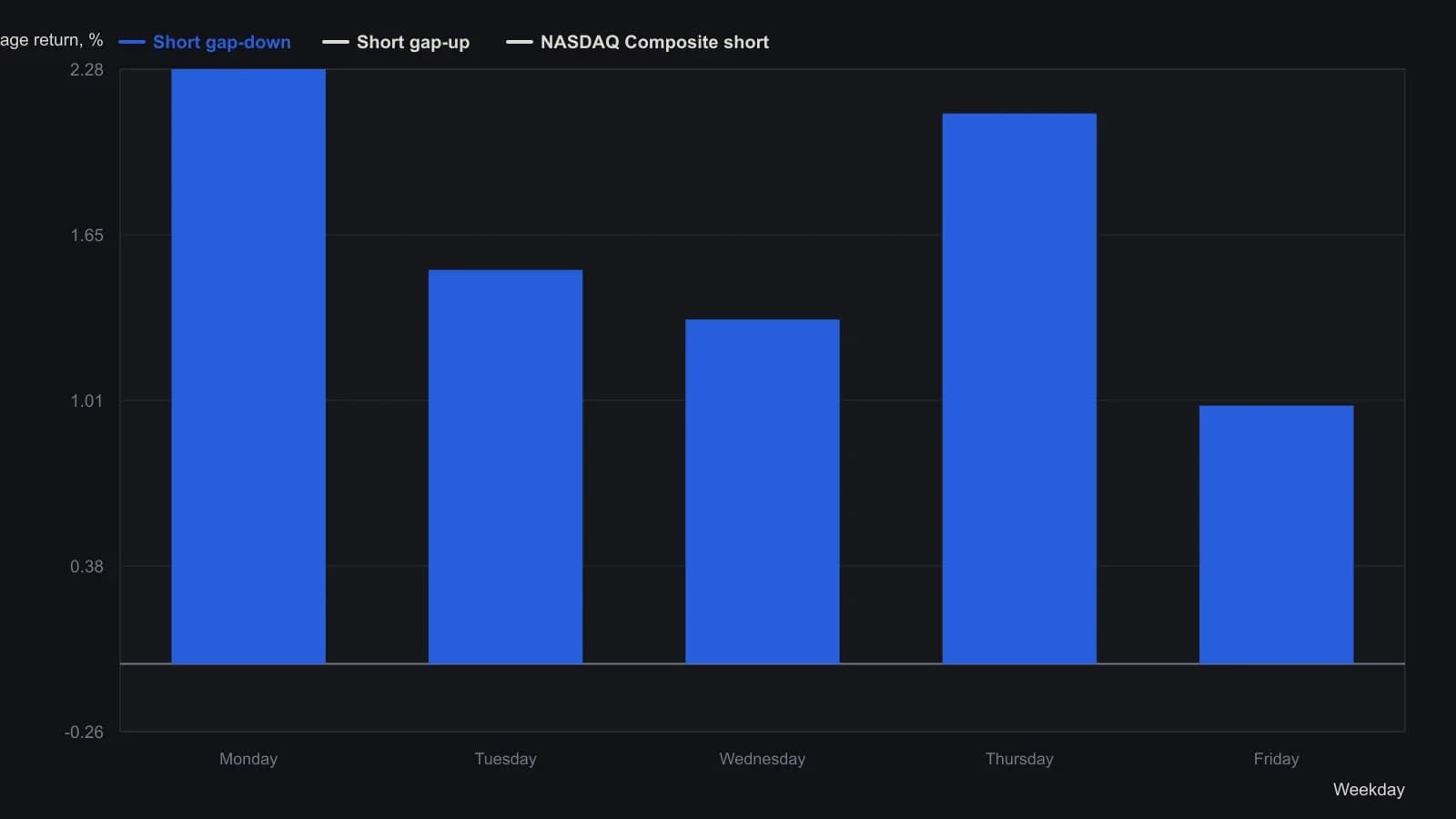
The source locked the hold to the same regular session (enter at the open, exit at the close), required a price above $6 and premarket volume of at least 10,000, and covered only 1 February–31 July 2006, a stretch it described as a market down cycle. Printed figure captions on the two weekday tables are swapped relative to the body text; series here follow the body text, which matches the win-day counts.
All readings on this track · 20 readings
- 1988Constructing short-horizon gap and trailing-stop rules
- 1996Constructing closed rules for spikes, time stops and gap failures
- 1999Opening-gap same-day fade rules
- 1999Evaluating same-session opening-gap rules
- 1999Constructing mechanical gap-fade entry and exit rules
- 2000Constructing opening-gap continuation entry and exit rules
- 2000Gap types as trade hypotheses
- 2003One-day fade-the-gap rules remain unfinished across market climates
- 2003Gap and pivot entry rules with stops written before the fill
- 2007Evaluating gap and lap opens against short-horizon baselines
- 2007Evaluating same-day gap rules across price, momentum, and weekday
- 2011Session gaps as a fade-or-follow drill
- 2015Testing gap continuation breakouts as one procedure
- 2015Downside exhaustion gaps as a ten-session fade procedure
- 2016Constructing a gap-fill long as one entry and exit checklist
- 2016Gap-reversal entry and trailing-stop rules
- 2016Constructing late entries from serial uptrend gaps
- 2017Premarket gap permission with cup breakouts and one tight trail
- 2018Inside-range gap breakout entry and stop rules
- 2020Closing-range breakout after a downside gap