1996issue C041-5
Constructing closed rules for spikes, time stops and gap failures
A construction can compute entry and exit tests on a signal-series and place the resulting positions in a different trade-series. While a position is open, a missing confirming extreme can force a time-stop-reversal, and a gap-failure is specified as an open beyond the prior extreme that closes back through the range-midpoint.
- Entry and exit tests can run on a signal-series while the resulting positions are placed in a different trade-series.
- Failure of the signal-series to print a confirming extreme within a stated window is itself a reverse condition.
- After first entry, an always-in-reversal construction stays positioned by flipping long to short and short to long rather than going flat.
- A gap-failure long opens below the prior low and closes above that day's range-midpoint; a gap-failure short opens above the prior high and closes below it.
Signal-series and trade-series
A construction can compute its entry and exit tests on one series while placing the resulting positions in a different series. The signal-series is the series whose conditions generate entries, exits and stay-in-force tests. The trade-series is the instrument that is actually bought or sold when those tests fire.
Percentage-change-spike and stay-in-force tests
A percentage-change-spike fires when a lookback return crosses a chosen up or down threshold. Lookback length, spike thresholds and the confirmation-bar limit are written as parameters so the whole procedure can be varied in tests.
While long, the signal-series can be required to print a new high within a stated window. Failure to do so is itself a reverse-to-short condition. While short, the signal-series can be required to print a new low within a stated window. Failure to do so is itself a reverse-to-long condition. The confirmation-clock is a running count of bars since the last confirming extreme while a position is open.
Time-stop-reversal and always-in-reversal
A time-stop-reversal is a forced flip when the confirmation-clock exceeds a stated bar limit. Listings implement that stop by reversing when a confirming extreme has not appeared for a stated bar count: 50 bars on both sides in one listing, and more than 44 bars without a new high or more than 36 bars without a new low in another.
After the first position is open, one construction stays continuously positioned by reversing long to short and short to long rather than going flat. That always-in-reversal design does not go flat after first entry.
Gap-failure conditions
A gap-failure is an open beyond the prior day's extreme that then closes back through the midpoint of the current day's range. The range-midpoint is the halfway point of the session high and low, used to classify the close as upper-half or lower-half.
A gap-failure long is specified as an open below the prior low together with a close above that day's high-low midpoint. A gap-failure short is specified as an open above the prior high together with a close below that day's high-low midpoint.
S&P 500 with market-thrust indicators, Mar 1995–Feb 1996
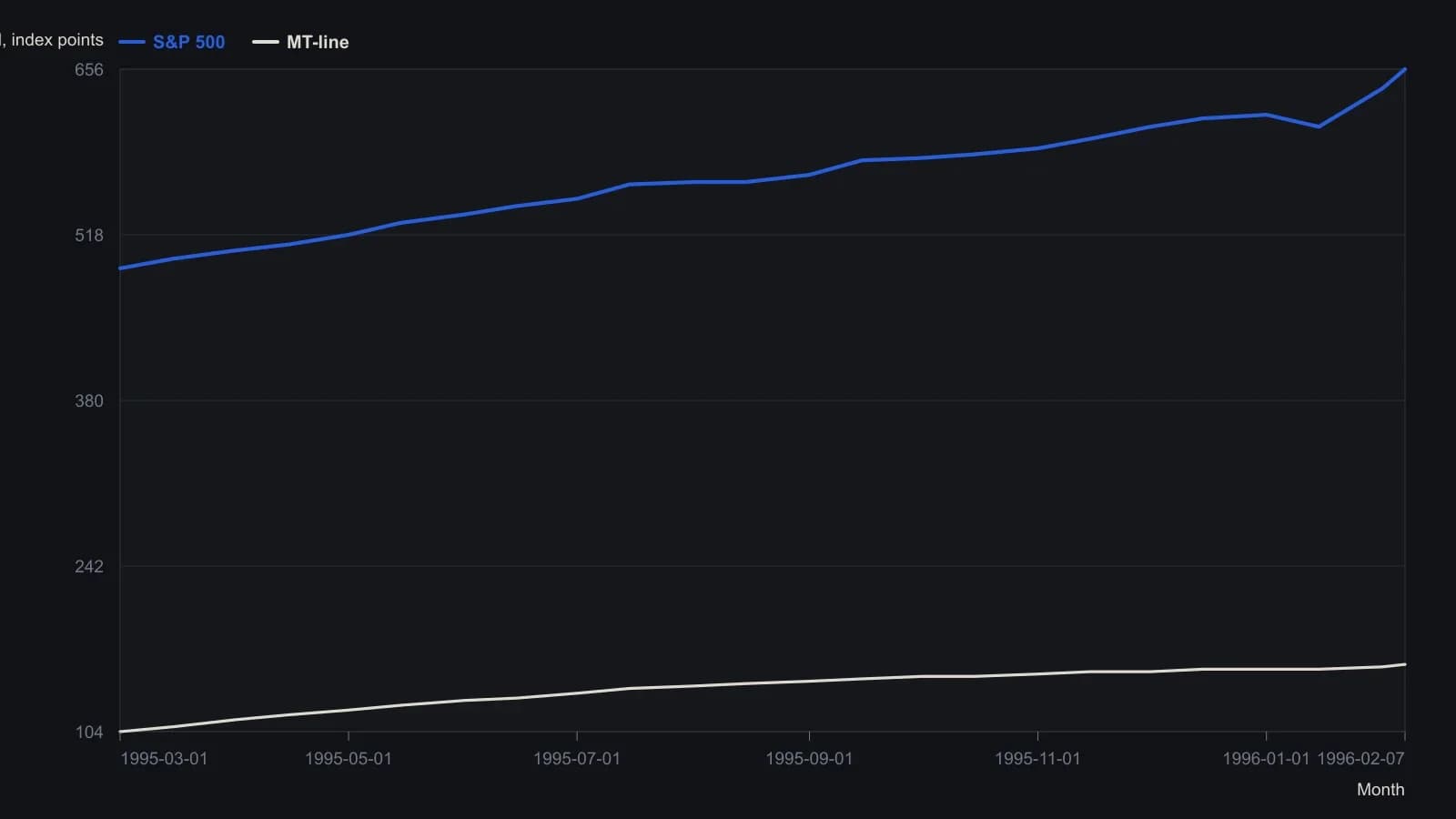
Daily traces were sampled about twice a month from a low-resolution raster. Market thrust has no readable scale on the figure and is omitted. Oscillator readings are approximate to the nearest 5 units; S&P 500 to the nearest 5 points; MT-line to the nearest 2 units.
All readings on this track · 20 readings
- 1988Constructing short-horizon gap and trailing-stop rules
- 1996Constructing closed rules for spikes, time stops and gap failures
- 1999Opening-gap same-day fade rules
- 1999Evaluating same-session opening-gap rules
- 1999Constructing mechanical gap-fade entry and exit rules
- 2000Constructing opening-gap continuation entry and exit rules
- 2000Gap types as trade hypotheses
- 2003One-day fade-the-gap rules remain unfinished across market climates
- 2003Gap and pivot entry rules with stops written before the fill
- 2007Evaluating gap and lap opens against short-horizon baselines
- 2007Evaluating same-day gap rules across price, momentum, and weekday
- 2011Session gaps as a fade-or-follow drill
- 2015Testing gap continuation breakouts as one procedure
- 2015Downside exhaustion gaps as a ten-session fade procedure
- 2016Constructing a gap-fill long as one entry and exit checklist
- 2016Gap-reversal entry and trailing-stop rules
- 2016Constructing late entries from serial uptrend gaps
- 2017Premarket gap permission with cup breakouts and one tight trail
- 2018Inside-range gap breakout entry and stop rules
- 2020Closing-range breakout after a downside gap