2000issue C091-5
Gap types as trade hypotheses
An opening gap leaves a price area with no trades when a session opens beyond the prior high or low. Gap analysis classifies that hole by context, then gap trading and a stop-loss order turn the class into a testable procedure rather than one automatic trade.
- An opening upgap opens above the prior session high, and an opening downgap opens below the prior session low, leaving a price area with no trades.
- Common, breakaway, runaway, and exhaustion gaps describe different market conditions, so the same hole is not a single trade.
- Overnight news, earnings, or other events can jump through a resting stop-loss order and produce a larger loss than the planned stop distance.
- Gap frequency and usefulness are market-specific, so rules should be tested per market rather than assumed to transfer.
Classify the opening first
An opening upgap is a session that opens above the prior session high. An opening downgap is a session that opens below the prior session low. Either case leaves a price area with no trades.
Editorial reading: treat the opening as a classified market condition before it becomes an order. Gap analysis asks what kind of hole appeared. Gap trading then attaches entry, exit, and abstention rules. A stop-loss order bounds the loss if that class is wrong. The same price hole is not handled the same way in a range, a breakout, a trend continuation, or a late-trend climax.
Four conditions, four hypotheses
Common gaps appear often inside trading ranges. They are usually narrow, generally fill as prices later trade through the hole, and rarely mark a major regime shift.
A relatively wide gap is often treated as an overreaction or an after-hours liquidity artifact. Some traders fade it by selling an upgap on the open in anticipation of a fill or a calmer session.
A breakaway gap leaves a congestion range on rising volume and volatility and then functions as support or resistance. In the historical workflow, that vacated edge was treated as a durable level for placing a stop-loss order.
Runaway gaps appear mid-trend as consecutive spikes when late participants pay up after a failed or one-day pullback. They may later fill within a few weeks even while prices keep making new highs or lows in the short term.
An exhaustion gap is a wide, high-volume opening hole near the end of a strong trend. It is typically not followed by new highs or lows, often fades within a few days, and was used as a reversal setup when the session also failed to follow through.
Runaway gaps on September 2000 Australian dollar futures
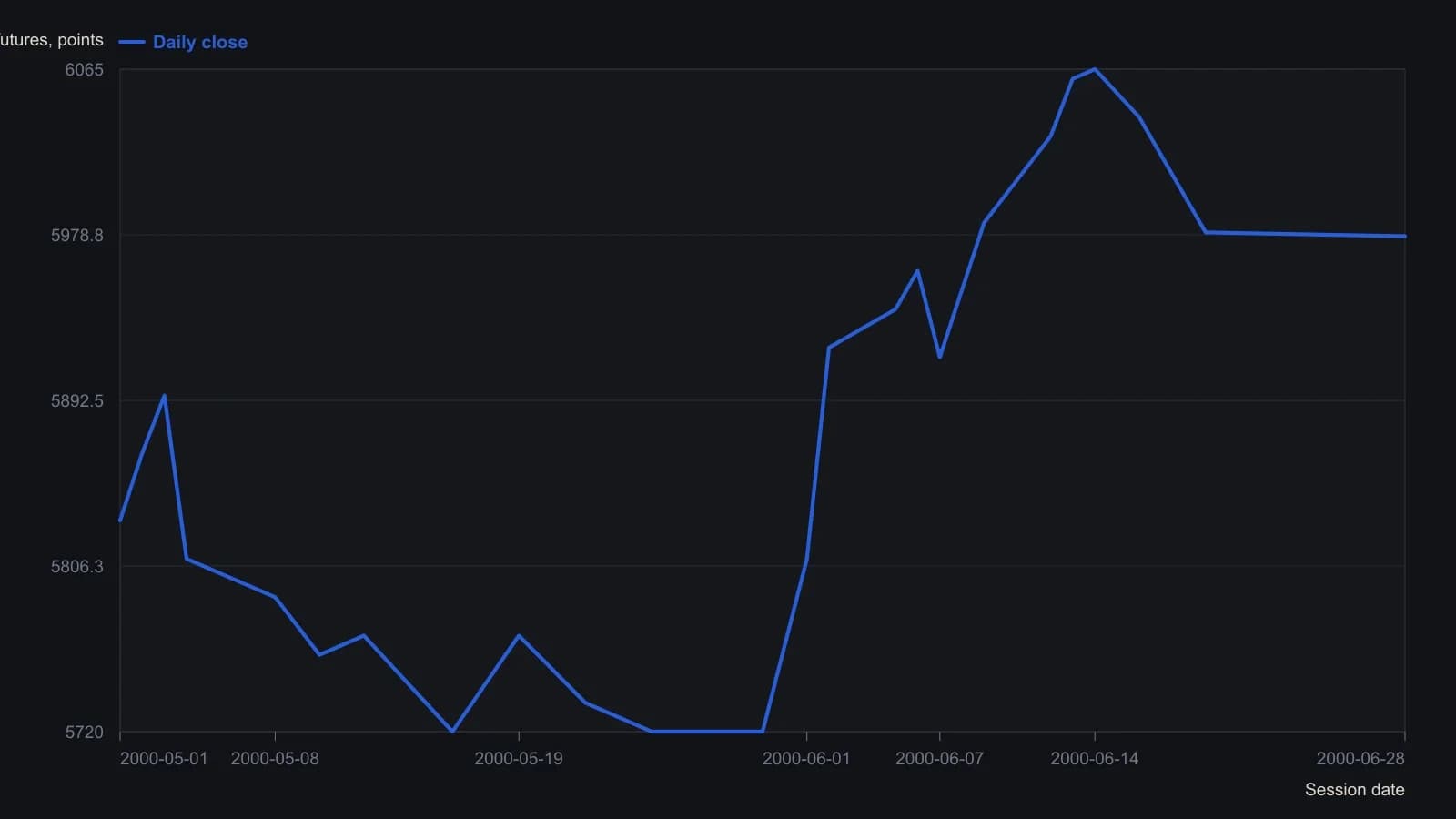
Closes are approximate readings against 100-point gridlines and are rounded to the nearest 5 points, except the printed 28 June close of 5978. A close line understates true gap width, which is open versus the prior session range.
Attach the procedure after the class
Editorial reading: classification is not the trade. After gap analysis names the condition, gap trading is a separate procedure with its own entry, exit, and abstention rules, and a stop-loss order is sized to that hypothesis rather than to the mere fact that a hole exists.
A narrow common gap inside a range, a breakaway from congestion, a runaway continuation, and a late-trend exhaustion gap therefore imply different follow-through tests. The historical workflow used the breakaway edge as a durable bound for the stop-loss order, while still leaving the overnight-jump problem in place: a resting stop can be passed at the next open, and the loss can exceed the planned stop distance.
Test the rules in the market that produced them
Gap frequency and usefulness are market-specific. Some markets gap often enough that the event is routine and less informative. Others almost never gap. Rules should be tested per market rather than assumed to transfer.
All readings on this track · 20 readings
- 1988Constructing short-horizon gap and trailing-stop rules
- 1996Constructing closed rules for spikes, time stops and gap failures
- 1999Opening-gap same-day fade rules
- 1999Evaluating same-session opening-gap rules
- 1999Constructing mechanical gap-fade entry and exit rules
- 2000Constructing opening-gap continuation entry and exit rules
- 2000Gap types as trade hypotheses
- 2003One-day fade-the-gap rules remain unfinished across market climates
- 2003Gap and pivot entry rules with stops written before the fill
- 2007Evaluating gap and lap opens against short-horizon baselines
- 2007Evaluating same-day gap rules across price, momentum, and weekday
- 2011Session gaps as a fade-or-follow drill
- 2015Testing gap continuation breakouts as one procedure
- 2015Downside exhaustion gaps as a ten-session fade procedure
- 2016Constructing a gap-fill long as one entry and exit checklist
- 2016Gap-reversal entry and trailing-stop rules
- 2016Constructing late entries from serial uptrend gaps
- 2017Premarket gap permission with cup breakouts and one tight trail
- 2018Inside-range gap breakout entry and stop rules
- 2020Closing-range breakout after a downside gap