2016issue C0745
Constructing late entries from serial uptrend gaps
A missed first opening is a construction problem, not a chase. Later upward gaps become a swing-entry hypothesis only after chart scale, a serial-gap-sequence, and a measured-buy-stop are written as one procedure.
- A serial-gap-sequence is two or more upward gaps, spaced several days apart, whose later gap-up prices stay higher than earlier ones inside one continuous uptrend.
- A close-only-gap qualifies on an opening above the prior session close; clearing the prior session high is not required.
- The planned entry is any day after the second or third gap-up day, using a measured-buy-stop at least $0.50 above the current 15-day high.
- Gap-trading pairs that trigger with a $2 maximum initial and trailing stop so the late long is one testable procedure.
A missed first opening is a construction problem
The specified pattern is constructed from two or more upward price-action gaps that appear several days apart inside an existing uptrend. That construction can still be written after the first opening has already printed.
Editorial reading: a missed first opening is the start of a construction problem, not a chase. Later upward gaps become a swing-entry hypothesis only after the chart scale, the gap count, the uptrend order, and the measured breakout trigger are written as one falsifiable procedure.
How a serial-gap-sequence is built
Gap-analysis reads two or more upward openings, spaced several days apart, as a single price-structure condition inside an existing uptrend. The result is a serial-gap-sequence: at least two upward gaps whose later gap prices remain higher than earlier ones inside one continuous uptrend.
The gap series must sit in that continuous uptrend, with later gap-up prices sequentially higher than earlier ones.
Chart scale and the close-only-gap
The specified scan uses 15-day, 15-minute stock charts on issues priced from $20 to $70 a share, with a high-low range of at least 10 percent. Those bounds fix the window and the kind of stock before any late entry is defined.
A qualifying gap is a close-only-gap: an opening above the prior session close, even when it does not clear the prior session high. A gap above the prior session high is not required.
The later breakout and the gap-trading stop
The planned entry session is any day after the second or third gap-up day, at a new-high breakout. Breakout means a later push through a defined high after the gap series, used to confirm that the same long hypothesis is still live.
The specified trigger is a measured-buy-stop: a buy-stop at least $0.50 above the gap-up day's high, described as $0.50 above the current 15-day high. Entry therefore requires a further breakout, not a fill at the gap itself.
Gap-trading is the complete entry and risk procedure that waits for a second or later uptrend gap, then uses that buy-stop and a fixed-dollar stop. The procedure pairs the measured-buy-stop with a $2 maximum initial and trailing stop on stock swing trades.
The construction treats repeated uptrend gaps as a concentrated pre-market buying condition and treats a later breakout above the gap series as the testable continuation signal. Editorial reading: the late long is live only when those pieces are specified together.
MDVN 15-minute price, late March–mid April 2016
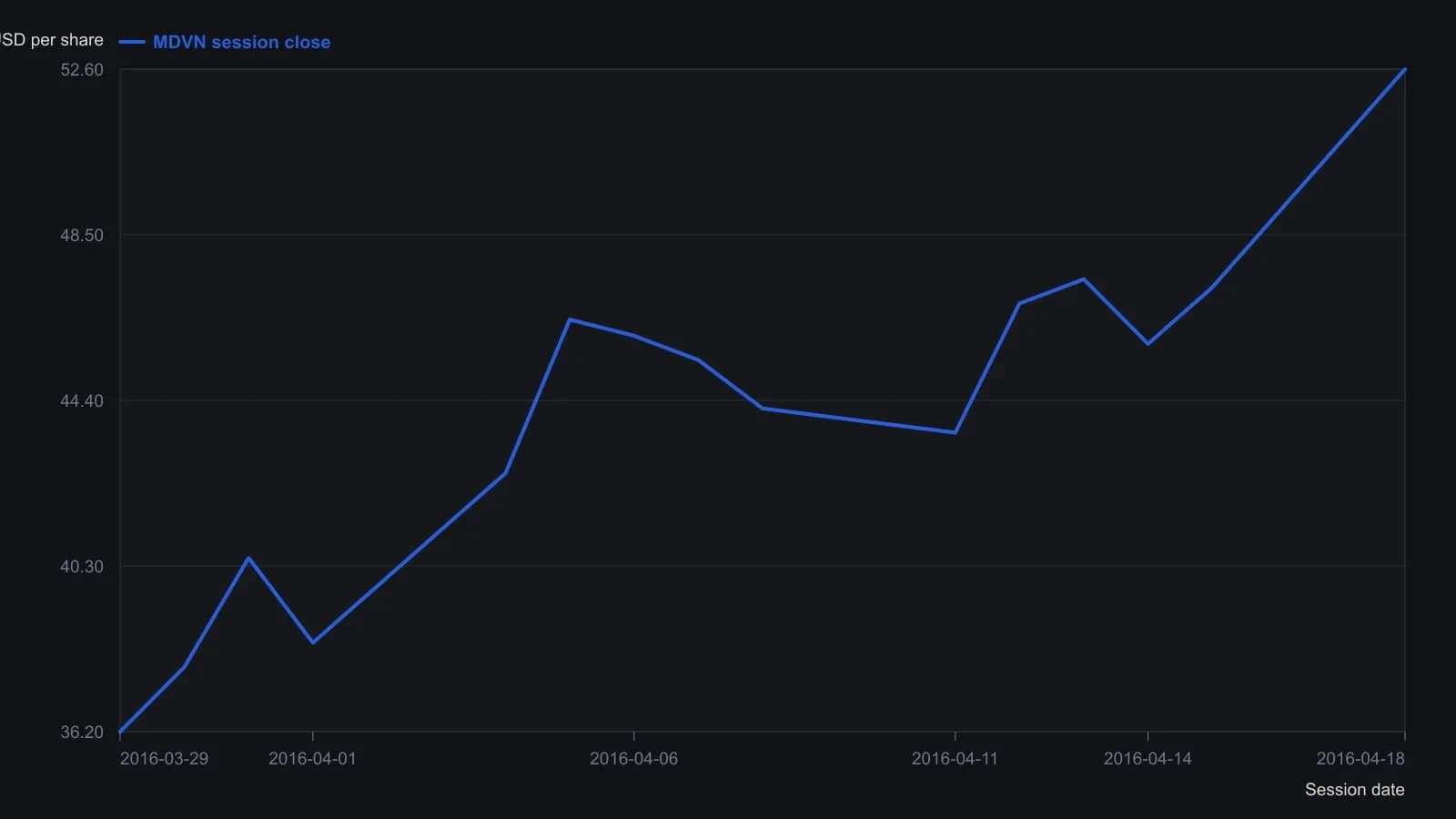
OHLC bars have no printed table. Session closes were sampled from the raster against the labeled $35–$55 scale; values are approximate to about $0.50. Volume pane was not digitized. The $50.50 trigger is the only exact figure the article states.
All readings on this track · 20 readings
- 1988Constructing short-horizon gap and trailing-stop rules
- 1996Constructing closed rules for spikes, time stops and gap failures
- 1999Opening-gap same-day fade rules
- 1999Evaluating same-session opening-gap rules
- 1999Constructing mechanical gap-fade entry and exit rules
- 2000Constructing opening-gap continuation entry and exit rules
- 2000Gap types as trade hypotheses
- 2003One-day fade-the-gap rules remain unfinished across market climates
- 2003Gap and pivot entry rules with stops written before the fill
- 2007Evaluating gap and lap opens against short-horizon baselines
- 2007Evaluating same-day gap rules across price, momentum, and weekday
- 2011Session gaps as a fade-or-follow drill
- 2015Testing gap continuation breakouts as one procedure
- 2015Downside exhaustion gaps as a ten-session fade procedure
- 2016Constructing a gap-fill long as one entry and exit checklist
- 2016Gap-reversal entry and trailing-stop rules
- 2016Constructing late entries from serial uptrend gaps
- 2017Premarket gap permission with cup breakouts and one tight trail
- 2018Inside-range gap breakout entry and stop rules
- 2020Closing-range breakout after a downside gap