2016issue C0449-55
Gap-reversal entry and trailing-stop rules
A long is considered only after a 10 percent gap down and a first-hour lift above the session low. The coded entry is a buy-stop, new entries stop after 10:30, and a 40-cent trailing stop is set with the entry.
- A long is considered only when the open is at least 10 percent below the prior close and price then lifts a fixed amount above the session low during the first hour.
- The coded long entry is a stop at the session low plus 50 cents, not a market order at the open.
- New entries are disallowed after 10:30, so the first-hour window is an explicit abstention rule.
- Once a position is open, a 40-cent trailing stop ratchets with price and is set as part of the same procedure as the entry.
The gap filter and the first-hour lift
The procedure only considers a long after the open is at least 10 percent below the prior close and price then lifts a fixed amount above the session low during the first hour.
The coded buy-stop
The coded long entry is a stop at the session low plus 50 cents, not a market order at the open. Rule-based entry waits for that buy-stop rather than buying the gap at the open.
The cutoff after 10:30
New entries are disallowed after 10:30. The first-hour window is an explicit abstention rule rather than an informal guideline.
The trailing stop set with the entry
Once a position is open, the exit is a 40-cent trailing stop that ratchets with price and is set as part of the same procedure as the entry.
Four candidates from a same-day scan
A same-day scan of Russell 3000 names between 20 and 70 that gapped down at least 10 percent produced four candidates, each entered with a 50-cent buy-stop above the low.
Those four simulated fills split evenly: two closed with gains near 5 to 5.9 percent and two with losses near 3.8 to 4.8 percent when 5 percent profit-target and stop-loss orders were attached to the entry.
Four same-day gap-down names and their simulated returns
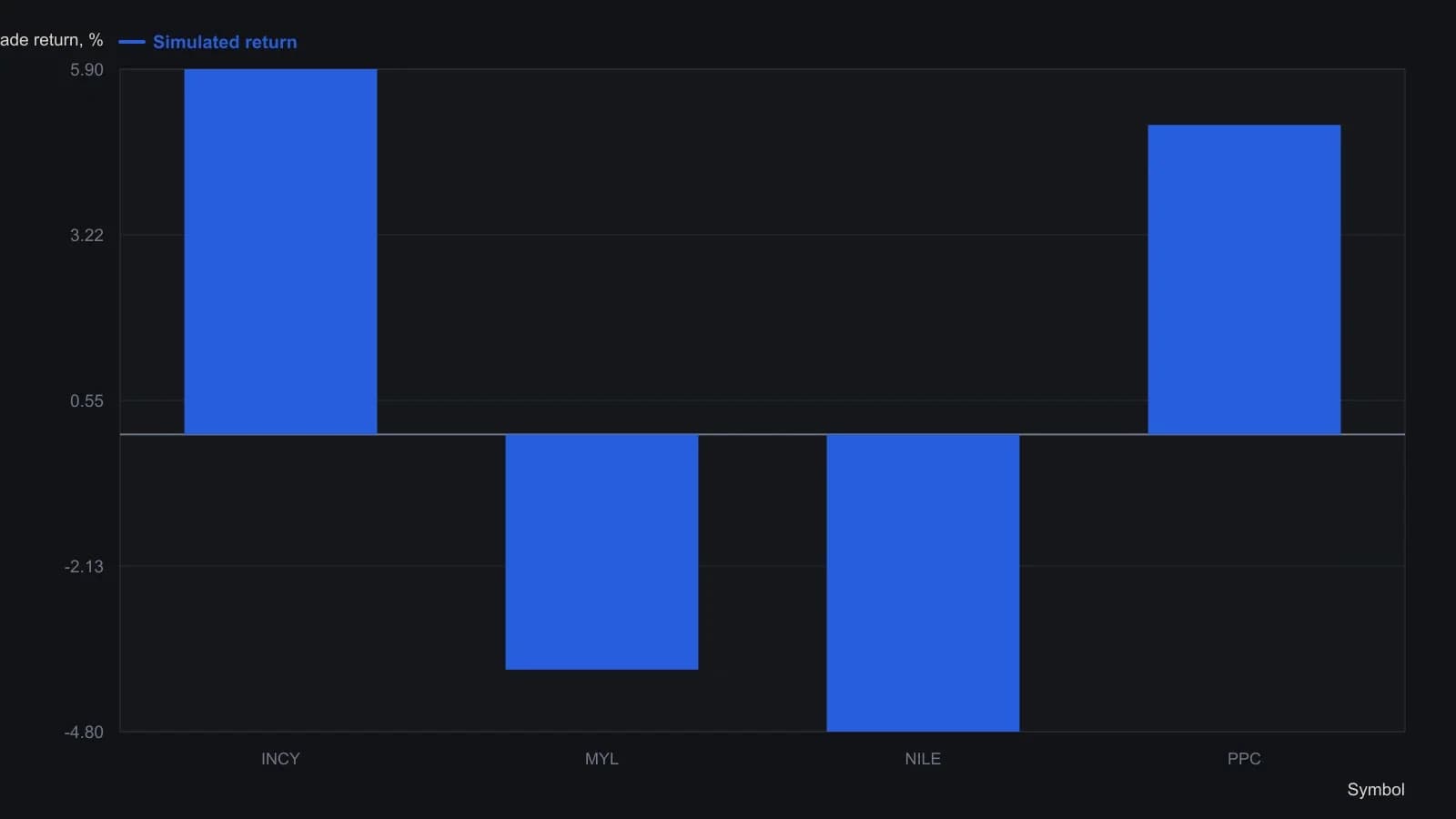
The TC2000 desk tied a 5 percent profit target and a 5 percent stop to the buy-stop instead of the article’s 40-cent trailing stop, and it paused those exits until the buy filled.
All readings on this track · 20 readings
- 1988Constructing short-horizon gap and trailing-stop rules
- 1996Constructing closed rules for spikes, time stops and gap failures
- 1999Opening-gap same-day fade rules
- 1999Evaluating same-session opening-gap rules
- 1999Constructing mechanical gap-fade entry and exit rules
- 2000Constructing opening-gap continuation entry and exit rules
- 2000Gap types as trade hypotheses
- 2003One-day fade-the-gap rules remain unfinished across market climates
- 2003Gap and pivot entry rules with stops written before the fill
- 2007Evaluating gap and lap opens against short-horizon baselines
- 2007Evaluating same-day gap rules across price, momentum, and weekday
- 2011Session gaps as a fade-or-follow drill
- 2015Testing gap continuation breakouts as one procedure
- 2015Downside exhaustion gaps as a ten-session fade procedure
- 2016Constructing a gap-fill long as one entry and exit checklist
- 2016Gap-reversal entry and trailing-stop rules
- 2016Constructing late entries from serial uptrend gaps
- 2017Premarket gap permission with cup breakouts and one tight trail
- 2018Inside-range gap breakout entry and stop rules
- 2020Closing-range breakout after a downside gap