2015issue C0916-19
Testing gap continuation breakouts as one procedure
The archive allows a long gap continuation only after a multiweek uptrend, only on a minor-gap, and only through a buy-stop above a defined high. Editorial note: the trend filter, size cap, timed trigger, abstention clause, and add-to-winner rule are written so they can be tested as one procedure.
- A long gap continuation is allowed only after a multiweek uptrend. A consolidating or downtrending chart is treated as a no-trade.
- Continuation entries are limited to a minor-gap of no more than 10 percent of the prior close and are taken with a buy-stop above the gap-day high or a two-day high, not at the open.
- A premarket-filter can delay a new long until price makes a new high that includes the overnight extreme, or it can force an open swing to be sold on the first loss of support.
- An already-open winning long may be increased on later gap continuations. Adds stop at the first pullback or consolidation, and the position is exited on the first loss of support after a bearish reversal candle.
Write the clauses as one procedure
The archive treats gap-trading as same-direction follow-through after an opening discontinuity, accepted only when later confirmation and size filters also fire. A long is admitted only when price is already above the prior day’s high.
Editorial note: the trend filter, the gap-size cap, the timed breakout trigger, the abstention clause, and the add-to-winner rule belong in one written procedure so they can be tested together, not judged after a move has already run.
Trend filter and the no-trade
A long gap continuation is allowed only after a multiweek uptrend. A consolidating or downtrending chart is treated as a no-trade.
High-volume close as a lead condition
A high-volume-close is a session that finishes at the day’s high on unusually large volume and is treated as a lead condition for a next-session gap. A multi-day volume peak inside an uptrend is given the same reading.
A high-volume midday or late-day breakout is treated as a setup for a next-session same-direction gap continuation and is traded in the direction of the first breakout.
Minor-gap size and the buy-stop
Continuation entries are limited to a minor-gap, an opening jump of no more than 10 percent of the prior close. Larger openings fall outside the filter.
The breakout-system is a stop-entry that waits for price to clear a defined high, including the gap-day high or a two-day high, rather than buying the open itself. High volume on the gap day is used as confirmation that a later-session entry may be placed with a buy-stop 0.50 to 1.00 above that day’s high.
When a gap of at most 10 percent also makes a two-day high, the day-session trigger is a buy 0.20 above the gap high, watched mainly from 09:35 to 10:15 ET. A buy-stop is a resting order placed a fixed increment above a reference high so the entry occurs only if the breakout continues.
Premarket filter
The premarket-filter is a check of overnight direction and shape. A bearish premarket trend or cup delays a new long until price makes a new high that includes the premarket extreme. An open swing that then prints that bearish shape is sold on the first loss of support.
Stops, exit, and adding to a winner
The plan uses small predefined stops of 0.40 on day trades and 1.50 to 2.00 on swing trades for names in the 20 to 70 range. The long is exited on the first loss of support after a bearish reversal candle.
Scale-in-position means adding to an already-open winning long when a later gap continuation prints, and stopping the adds at the first pullback or consolidation.
SINA daily share price through the June 2015 gap continuation
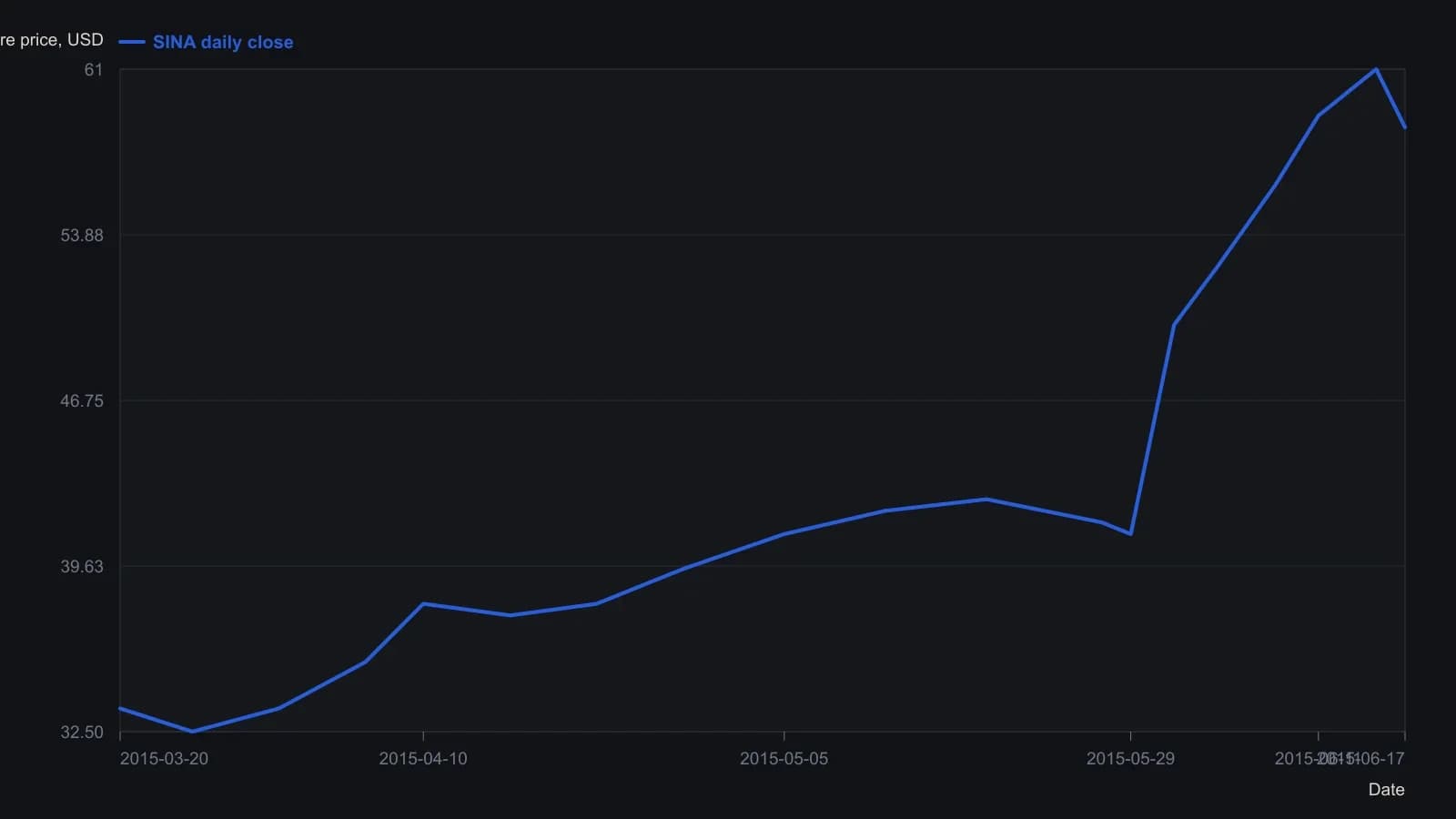
The source prints candlesticks, not a price table. Intervening closes are approximate to the nearest half-dollar and omit wicks.
All readings on this track · 20 readings
- 1988Constructing short-horizon gap and trailing-stop rules
- 1996Constructing closed rules for spikes, time stops and gap failures
- 1999Opening-gap same-day fade rules
- 1999Evaluating same-session opening-gap rules
- 1999Constructing mechanical gap-fade entry and exit rules
- 2000Constructing opening-gap continuation entry and exit rules
- 2000Gap types as trade hypotheses
- 2003One-day fade-the-gap rules remain unfinished across market climates
- 2003Gap and pivot entry rules with stops written before the fill
- 2007Evaluating gap and lap opens against short-horizon baselines
- 2007Evaluating same-day gap rules across price, momentum, and weekday
- 2011Session gaps as a fade-or-follow drill
- 2015Testing gap continuation breakouts as one procedure
- 2015Downside exhaustion gaps as a ten-session fade procedure
- 2016Constructing a gap-fill long as one entry and exit checklist
- 2016Gap-reversal entry and trailing-stop rules
- 2016Constructing late entries from serial uptrend gaps
- 2017Premarket gap permission with cup breakouts and one tight trail
- 2018Inside-range gap breakout entry and stop rules
- 2020Closing-range breakout after a downside gap