2015issue C1224-27
Downside exhaustion gaps as a ten-session fade procedure
A downside-gap is treated as a long fade only when a downtrend-gate and an above-average gap-size are both true, and only if the long can be placed, refused, or expired inside a ten-session clock.
- A predicted-exhaustion-gap exists only when the downtrend-gate is already open and gap-size is wider than that stock's own average gap.
- The long is the first available price between the gap-open and the range-derived-stop, unless the session already opens through that stop.
- The entry-window is the first five sessions; an unfilled setup is withdrawn, the entry session cannot be an exit, and a time-stop closes any still-open trade at the tenth session's close.
- A range-ratio-filter ranks names by upper-to-lower range ratio so that stocks whose typical post-gap move is much larger to the downside are treated as poor long-fade candidates.
What the recorded workflow tests
The archive records a long-fade workflow built around a downside-gap. A downside-gap is a session whose entire price range sits below the prior session low. Gap-size is the percent distance from that prior low to the current open.
The same workflow also states when a long may not be attempted, when an unfilled setup is withdrawn, and when a still-open trade must end. Editorial: those abstention and expiry rules belong in the same procedure as the entry rule.
How a predicted-exhaustion-gap is defined
A name is classified as downtrending after a decline of more than 20 percent from a prior high. It remains in that class until a 20-percent advance from the downtrend low. That classification is the downtrend-gate.
A predicted-exhaustion-gap requires two conditions at once. The name is already inside the downtrend-gate, and the gap is wider than the same stock's average gap size.
How the long is priced from the gap-open
The gap-open is the reference for both protective and objective geometry. The range-derived-stop is placed 1.5 times the stock's typical lower range below that open. The long is the first available price between the gap-open and that stop, unless the session already opens through the stop.
The range-derived-target is placed one typical upper-range distance above the gap-open. Both distances use that stock's own 10-session range statistics.
The entry-window and the time-stop
The holding period is 10 sessions. Entry is allowed only in the entry-window, which is the first five of those sessions. An unfilled setup is withdrawn. No exit is allowed on the entry session. Any still-open trade is closed at the tenth session's close. That mandatory close is the time-stop.
A new entry is allowed only when no position is already held.
How names are ranked before comparison
Names whose typical move after gaps is much larger to the downside than to the upside are treated as poor long-fade candidates. The historical run ranked the universe by upper-to-lower range ratio before portfolio comparison. That ranking is the range-ratio-filter.
Scope of the historical run
The historical run applied these rules to 1,816 listed names over the 10 years beginning 1 September 2004 and produced 36,872 trades.
Cumulative profit and loss by range-ratio portfolio
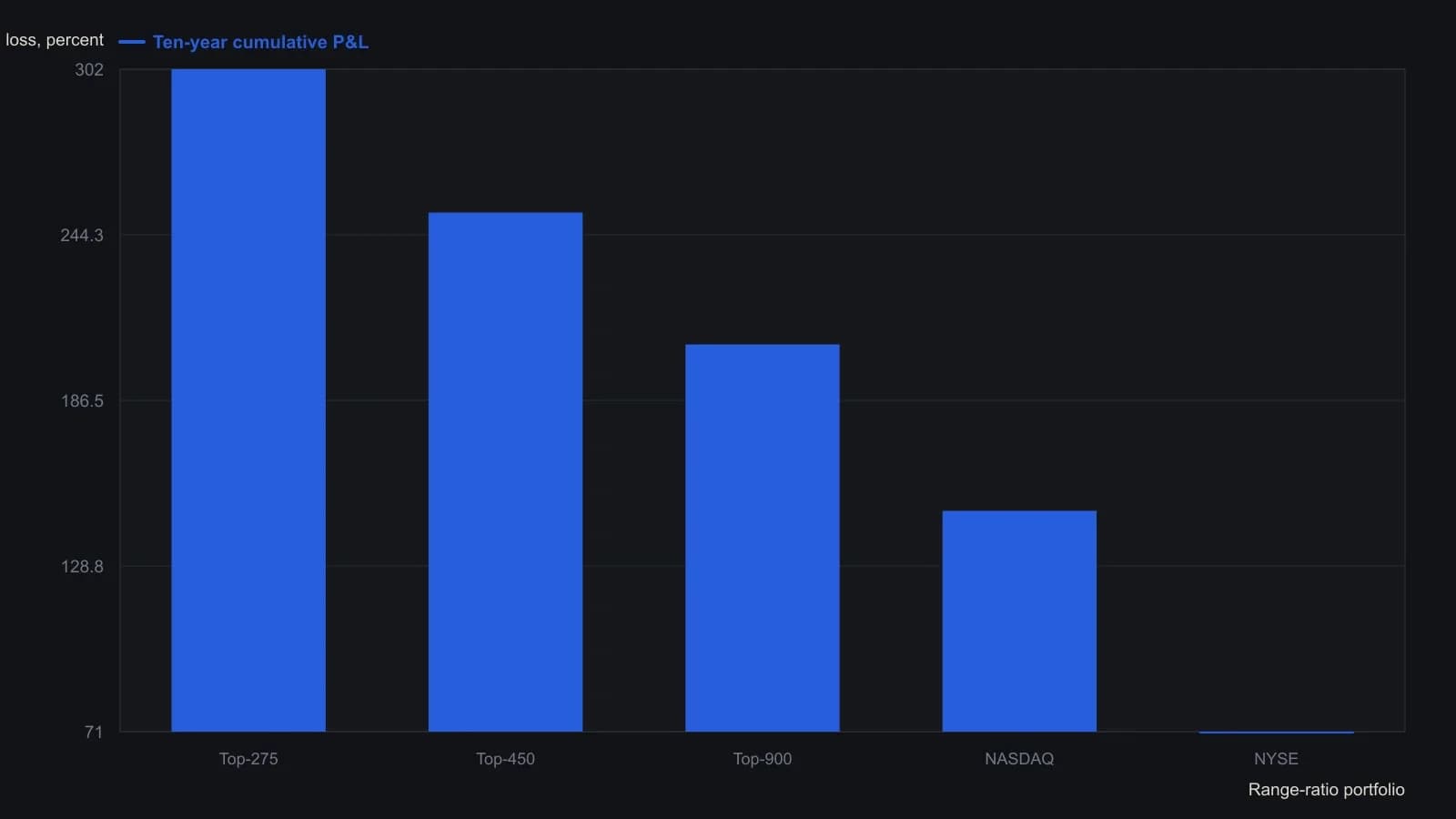
The three strategy books are the 275, 450 and 900 names with the highest upper-to-lower range ratios among 1,816 NYSE and NASDAQ stocks, tested from 1 September 2004 to 1 September 2014 with a ten-session clock. The index figures are the same-window buy-and-hold totals, not the gap strategy.
All readings on this track · 20 readings
- 1988Constructing short-horizon gap and trailing-stop rules
- 1996Constructing closed rules for spikes, time stops and gap failures
- 1999Opening-gap same-day fade rules
- 1999Evaluating same-session opening-gap rules
- 1999Constructing mechanical gap-fade entry and exit rules
- 2000Constructing opening-gap continuation entry and exit rules
- 2000Gap types as trade hypotheses
- 2003One-day fade-the-gap rules remain unfinished across market climates
- 2003Gap and pivot entry rules with stops written before the fill
- 2007Evaluating gap and lap opens against short-horizon baselines
- 2007Evaluating same-day gap rules across price, momentum, and weekday
- 2011Session gaps as a fade-or-follow drill
- 2015Testing gap continuation breakouts as one procedure
- 2015Downside exhaustion gaps as a ten-session fade procedure
- 2016Constructing a gap-fill long as one entry and exit checklist
- 2016Gap-reversal entry and trailing-stop rules
- 2016Constructing late entries from serial uptrend gaps
- 2017Premarket gap permission with cup breakouts and one tight trail
- 2018Inside-range gap breakout entry and stop rules
- 2020Closing-range breakout after a downside gap