1999issue C111-3
Evaluating same-session opening-gap rules
Opening-gap can be written as a same-session procedure with one percentage trigger, a forced side, a same-session-exit, and a no-trade-band. Editorial reading: the evaluation question is whether those four pieces stay identical when the rule is restated on different platforms, not whether any historical path looks attractive.
- Opening-gap is the percentage distance between the current session open and the prior session close, computed as 100 times the current open minus the prior close, divided by the prior close.
- Default inputs treat a reading of 1 or more as a gap-up-short setup and a reading of -1 or less as a gap-down-long setup, while the no-trade-band contributes no position and a same-day rule result of zero.
- Same-session-exit flattens a taken position at the gap-day close, so the mechanical holding period runs from that open to that close.
- When a platform cannot encode the procedure as a native system, the same rules can still be inspected as a cumulative-profit-series.
Four pieces of the same-session procedure
Editorial reading: treat opening-gap as a complete same-session procedure rather than as a chart pattern. The four pieces are one percentage trigger, a forced side, an automatic close, and an explicit no-trade-band. The evaluation question is whether those four pieces stay identical when the rule is restated on different platforms, not whether any historical path looks attractive.
How opening-gap chooses a side
Opening-gap is the percentage distance between the current session open and the prior session close. It is computed as 100 times the current open minus the prior close, divided by the prior close.
Default inputs treat a reading of 1 or more as a gap-up-short setup and a reading of -1 or less as a gap-down-long setup. Gap-up-short sells short when opening-gap meets or exceeds a positive percentage threshold. Gap-down-long buys when opening-gap meets or falls through a negative percentage threshold.
A session whose gap stays inside those two thresholds contributes no position and a same-day rule result of zero. That interior range is the no-trade-band.
Session result, exit, and holding period
On a taken gap-up day the same-session result is open minus close. On a taken gap-down day it is close minus open.
The mechanical holding period runs from the gap-day open to that session close, with the exit written as an always-true next-close or market-close condition. Same-session-exit is the requirement to flatten the gap-day position at that session close.
Opening-gap P&L on General Electric by trade side
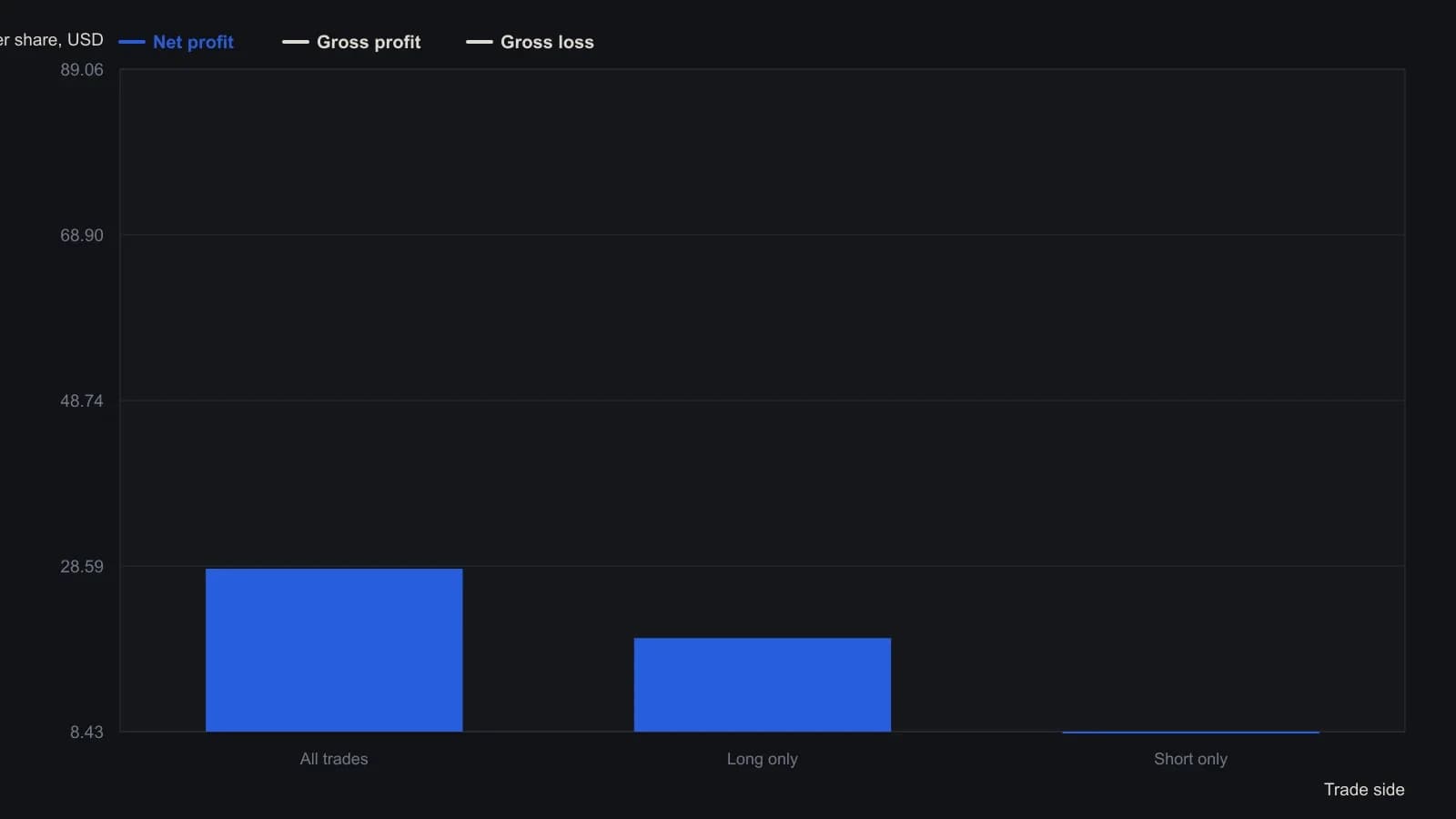
One-share NeuroShell restatement of Reverre’s rule with a 1 percent gap trigger and a same-session exit at the close. Over this window the stock itself rose from 48.813 to 113.688, so the 28.25 dollar net is not an outperformance claim. Printed win and loss counts leave three trades unclassified.
Restating the procedure when a native system is unavailable
When a platform cannot encode the procedure as a native system, the same rules can still be inspected as a running cumulative-profit-series. Editorial reading: that series is a restatement check, not a verdict on attractiveness.
A session diagnostic can mark a losing day versus a profitable day and place that mark at the high after a gap-up-short and at the low after a gap-down-long.
Next-session open working prices can be precomputed from the last close by scaling it by 0.99 for a long limit and by 1.01 for a short limit. Open-limit-preview is that next-session working price, computed from the last close so a gap-side entry can be staged before the open.
One procedure on more than one series
The same gap formula and threshold pair can be applied across an index basket and individual names so one procedure is evaluated on more than one series.
All readings on this track · 20 readings
- 1988Constructing short-horizon gap and trailing-stop rules
- 1996Constructing closed rules for spikes, time stops and gap failures
- 1999Opening-gap same-day fade rules
- 1999Evaluating same-session opening-gap rules
- 1999Constructing mechanical gap-fade entry and exit rules
- 2000Constructing opening-gap continuation entry and exit rules
- 2000Gap types as trade hypotheses
- 2003One-day fade-the-gap rules remain unfinished across market climates
- 2003Gap and pivot entry rules with stops written before the fill
- 2007Evaluating gap and lap opens against short-horizon baselines
- 2007Evaluating same-day gap rules across price, momentum, and weekday
- 2011Session gaps as a fade-or-follow drill
- 2015Testing gap continuation breakouts as one procedure
- 2015Downside exhaustion gaps as a ten-session fade procedure
- 2016Constructing a gap-fill long as one entry and exit checklist
- 2016Gap-reversal entry and trailing-stop rules
- 2016Constructing late entries from serial uptrend gaps
- 2017Premarket gap permission with cup breakouts and one tight trail
- 2018Inside-range gap breakout entry and stop rules
- 2020Closing-range breakout after a downside gap