1996issue C061-5
Employment-release direction as a later-month persistence test
A Treasury bond futures rule locked direction to the employment-release settlement, held that position on a later calendar-month-hold, and then asked a coin-flip random-direction-control whether the event-day close was doing work the remaining reports of the month would not have done on their own.
- Over an eight-year sample, Treasury bond futures had a larger average event-day-range on employment-report release days (44 ticks) than on producer-price (36), retail-sales (33), or consumer-price (32) release days.
- Settlement-entry used the employment-release close only: a lower close started a short and a higher close started a long. The test did not forecast that session or score the print against expectations.
- Two calendar-month-hold exits were compared, a mid-month close after about half of the remaining monthly reports and a last-business-day close after the remaining reports.
- A random-direction-control repeated the same month-end hold 1,500 times with a fair coin, then placed the employment-day rule's average in that frequency distribution.
A later clock for the first report of the month
The archive procedure did not try to trade the employment print itself. It waited for settlement-entry at the official close of the release session, took the observed close direction as the position, and then used a calendar-month-hold so the exit sat on a later business day in the same month.
Editorial. TradersWeek treats that sequence as an unfinished-information-test. The monthly employment calendar is read here as a classroom for unfinished information: lock a bond position to the release-session close, hold it on a later calendar clock through the rest of the month's reports, and only then ask whether that event-day direction is doing work the calendar alone would not.
Employment days and event-day-range
Over an eight-year sample, Treasury bond futures had a larger average daily range on employment-report release days (44 ticks) than on producer-price (36), retail-sales (33), or consumer-price (32) release days. That comparison uses event-day-range, the futures session high-to-low width on a scheduled data-release date, to rank how violently the contract typically trades across different reports.
Settlement-entry and the two calendar holds
The procedure entered at the employment-release settlement. A lower close started a short and a higher close started a long. Because the fill is settlement-entry, the rule does not claim to have traded the print itself.
Two calendar-month-hold exits were compared. One was a mid-month close after about half of the remaining monthly reports. The other was a last-business-day close after the remaining reports. Neither exit used a price target or a protective stop.
The shifted-continuous-series and the coin-flip control
The simulation used eight years of rollover-adjusted continuous Treasury bond futures. That path is a shifted-continuous-series: a back-adjusted futures splice that removes rollover gaps so a multi-year simulation can treat successive contracts as one price path. The run used one contract, placed no stop orders, and excluded slippage, commissions, and fees.
A random-direction-control repeated the same month-end hold 1,500 times on that eight-year series, assigning long or short by a fair coin instead of the employment-day close. The control keeps the same entry date and exit date. Significance was assessed by placing the employment-day rule's average result in the frequency distribution of those 1,500 random-direction averages.
Editorial reading
Editorial. The archive facts describe the historical workflow only. TradersWeek's reading is that the employment session is used as a direction stamp, not as a forecast of the print, and that the later calendar clock is what turns the rest of the month into a test of unfinished information. The coin-flip control is the piece that asks whether event-day direction is doing work the calendar alone would not.
Random-direction control: average profit per trade across 1,500 coin-flip samples
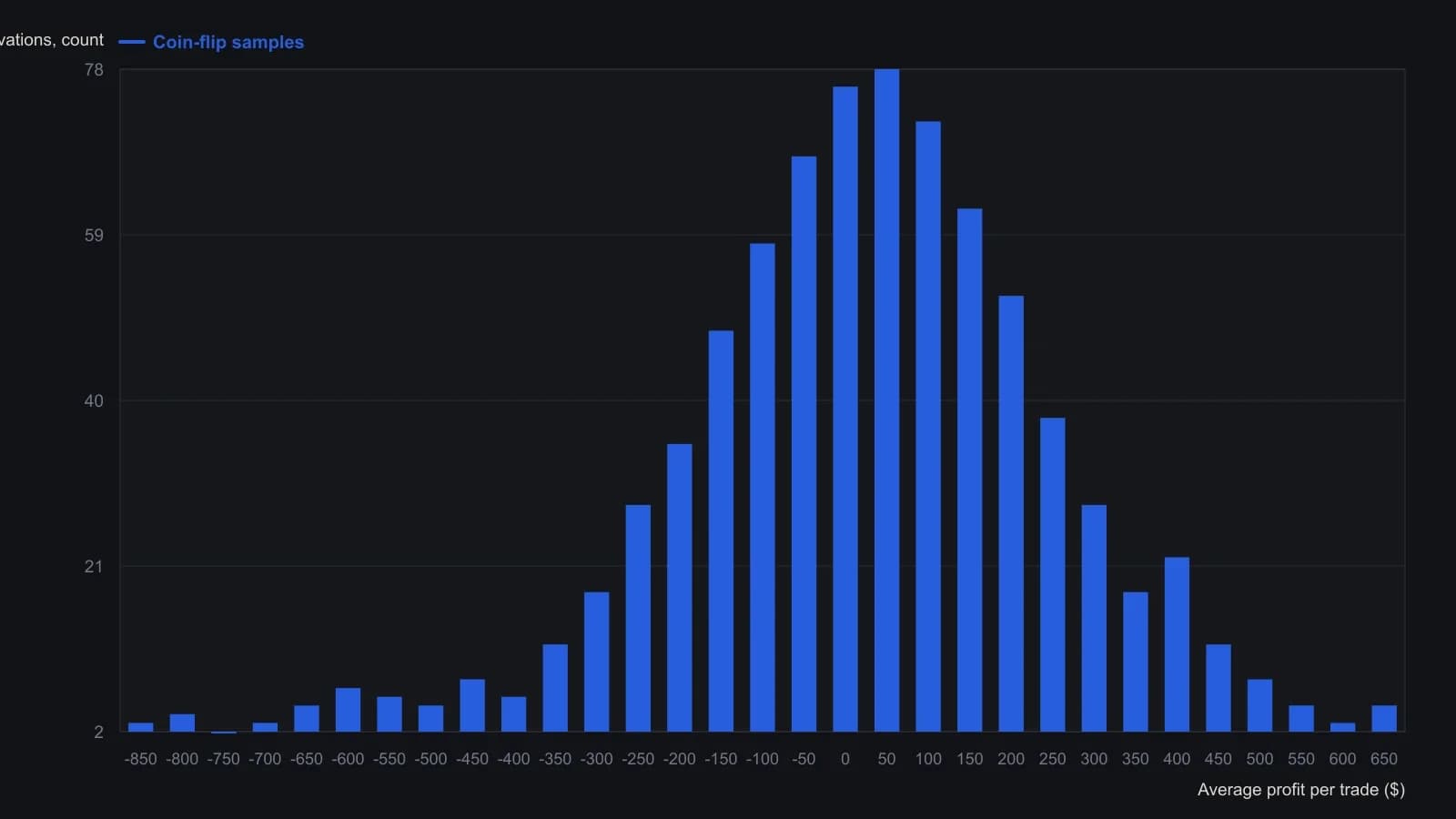
Same eight-year shifted T-bond series and last-business-day exit as the employment rule; direction was a fair coin instead of the employment-session close. No stops; one contract; slippage and commissions excluded. Bin heights are approximate readings of the raster.