1995issue C031-3
Three setup gates and a session-count clock complete a long bottom
Editorial reading: a visual bottom is unfinished construction until the same mechanical procedure names three yes-or-no setup gates, the exact fill bar, and a session-count clock that ends the trade without a price target.
- A long entry can be written as three concurrent checks: the close exceeds the open by a point threshold, the bar high-low range exceeds a second point threshold, and a D-day low has printed within the last five bars.
- The fill may be taken on the setup-bar close, or a one-bar fill-offset can move execution to the following close.
- After entry, a time-stop can close the long after a user-set number of bars; on a daily series that session-count is trading sessions, not calendar days.
- If opens are missing, the prior close can stand in for the open, and each point threshold must match the market's minimum price increment.
A picture of a low is not yet a setup
Editorial reading: treat a visual bottom as unfinished construction until the same mechanical procedure names three yes-or-no setup gates, the exact fill bar, and a session-count clock that ends the trade without a price target.
The archive writes the long as one mechanical procedure. Entry, abstention, and exit belong in the same coded package so the whole sequence can be tested together.
Three concurrent long-entry gates
A long entry can be written as three checks that must all be true at the same time. The close must exceed the open by a chosen point threshold. The bar's high-low range must exceed a second point threshold. A D-day low must have printed within the last five bars.
The D-day check is true when the lowest low of a D-bar window occurred no more than five bars earlier, or when an N-day low appears inside a five-bar maximum window. That five-bar recency is the depth condition in the setup.
The setup bar is the bar on which every long-entry check first becomes true. Until every check is true, there is no setup bar.
The procedure must name the fill bar
The fill may be taken on the close of the setup bar. The three checks may instead be lagged one bar so the fill occurs on the following close. That one-bar lag is the fill-offset.
The procedure has to state which of those two closes is the fill.
A session-count clock ends the long
After entry, the long can be closed when a user-set number of bars have elapsed since the fill. The holding period then sits in the same procedure as the gates.
That exit is a time-stop. It closes the position after a fixed number of bars since entry rather than at a price objective.
On a daily series the elapsed-bar exit counts trading sessions, not calendar days. Session-count is the number of trading bars since the fill.
One coded exit closes the long when the current bar index equals the entry index plus 23. That is a 23-session time stop.
What the coded package still has to specify
If open prices are unavailable, the prior close can stand in for the open when testing the close-versus-open threshold.
A coded example specified long-only entry and exit and left any short-side rules unspecified.
Point thresholds must be scaled to the market's minimum price increment so a coded point matches a tradable tick.
Profit versus days held for the SPX1 bottom-fishing test
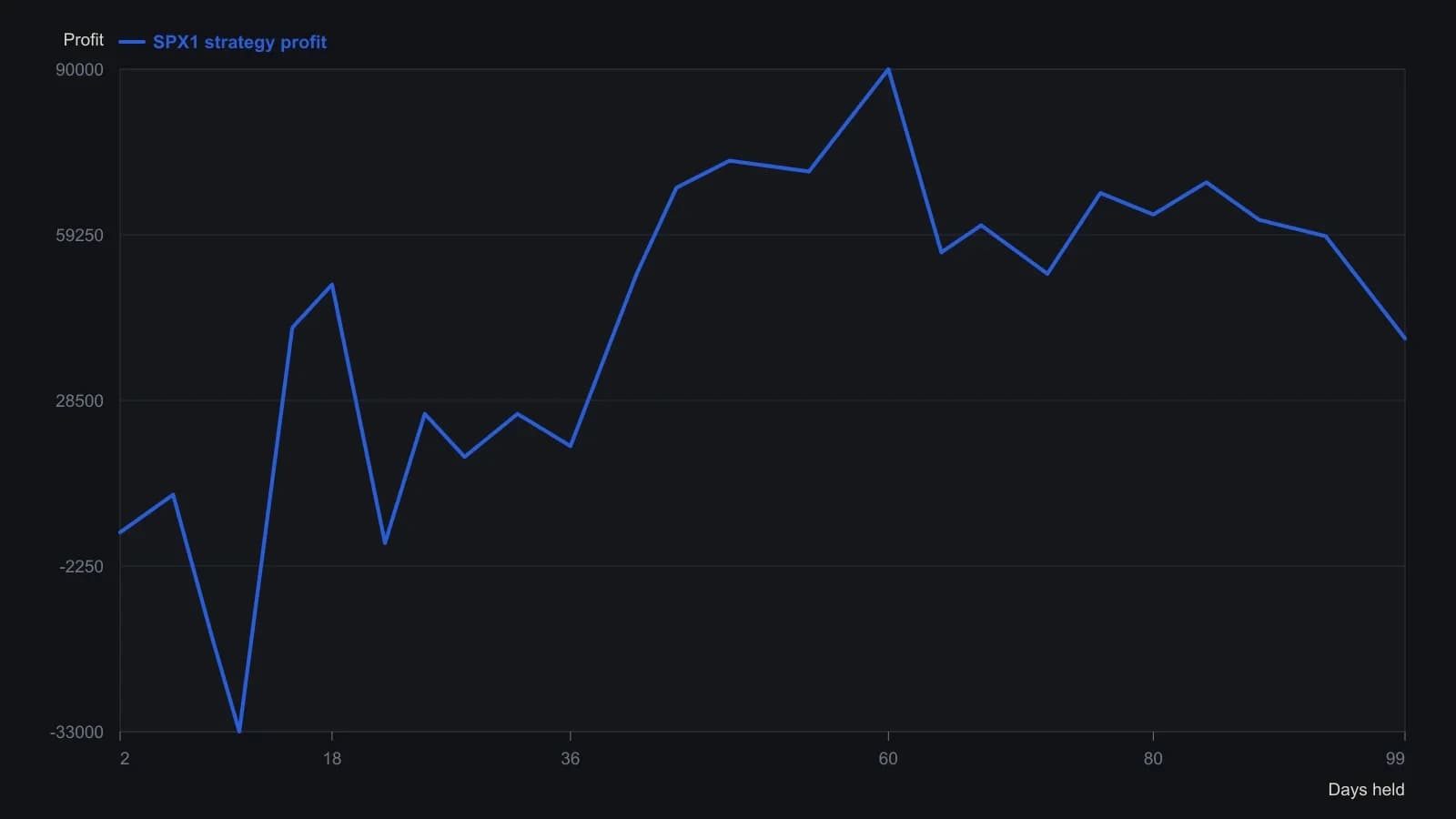
Digitized from the labeled TechniFilter raster (issue SPX1, strategy SPX1). Y readings are approximate to the nearest thousand against 15,355-unit ticks. The column text mentions a 2-to-443-day sweep while the printed frame is labeled 2 through 93. Longer holds look better because the S&P 500 rose from about 115 in April 1982 to about 465 in November 1994; Chande’s original 2-to-30-day test had named 23 sessions as the working clock.
All readings on this track · 15 readings
- 1989Preflight checklist, time-stops, and stand-aside rules
- 1991Parameter windows for averages, option overlays and time stops
- 1995Three setup gates and a session-count clock complete a long bottom
- 1995Evaluating index futures OHLC reversals with RSI and time stops
- 1995A weekly two-close breakout and an eight-week time stop
- 2000Constructing breakout entry rules and time stops
- 2004Constructing action-reaction swing targets and time stops
- 2005Constructing breakout entries with trailing and time stops
- 2006Evaluating a restrictive range entry with a timed exit
- 2008Evaluating point-and-figure column breaks with time stops
- 2011Intraday gold swing with a daily entry limit, a time-stop, and a fixed stop-loss
- 2012Last-hour entries with a book-level loss bound and a next-open time stop
- 2015Precommit stop-loss, trailing-stop, and time-stop rules before entry
- 2018Auditing rank-rotation tests for time-stop and slot rules
- 2019Confirmation-first pyramiding with price and time stops