1995issue C111-17
A weekly two-close breakout and an eight-week time stop
This archive case study writes T-bond and yen futures as one weekly-close procedure: two consecutive closes outside the prior week's range create the entry, then an eight-week time stop, a protective close, a reverse, or a same-direction re-signal decides what happens next.
- A buy requires two consecutive weekly closes above the prior week's high, and a sell requires two consecutive weekly closes below the prior week's low.
- The default exit is a time stop after eight weeks, unless a protective weekly close, an opposite two-week signal, or a same-direction signal on weeks seven and eight changes the plan.
- A mechanical plan specifies when to exit or reverse, so an open position does not have to be second-guessed after the entry is taken.
- Concentrate on a few markets whose weekly character is understood. The same two-close signal is not expected to transfer cleanly to markets such as silver or soybeans.
A weekly two-close signal
The archive writes a T-bond and yen futures plan from weekly high, low, and close only. Two consecutive weekly closes above the prior week's high are a buy. Two consecutive weekly closes below the prior week's low are a sell.
The entry is a fully specified weekly-close procedure. A long or short signal is issued only when two consecutive weekly closes print beyond the prior week's high or low, with no chart-pattern judgment. The weekly range-break then follows those two closes and manages the resulting position with the same weekly-close rules.
An eight-week default with three exceptions
The default exit is a time stop after eight weeks. That holding limit closes the position unless a protective weekly close, an opposite signal, or a same-direction re-signal at weeks seven and eight changes the plan.
The three written exceptions are specific. A weekly close through the entry pair's extreme flattens the trade. An opposite two-week close signal reverses the position. A same-direction signal on weeks seven and eight restarts the eight-week clock.
The T-bond long and its protective close
In the worked T-bond example, weeks with closes of 99-16 and 104-20 each exceed the prior week's high, so the long is taken at 104-20. The trade is flattened if a later weekly close prints below 88-00, the lowest price of the two signal weeks.
The yen walk-through uses every exception
The 1982 yen walk-through shows all three time-stop exceptions. A buy is taken at 0.4713. After two weaker weekly closes the position reverses to short at 0.4625. A sell signal at the eighth week keeps the short open and restarts the clock.
Why eight weeks is preferred
The eight-week default is presented as the preferred holding period after a fundamental-driven entry, on the view that later participants have already joined and the move then tends to stall or reverse. Five-week and ten-week exits are described as workable but inferior.
Write the plan without pattern judgment
The author argues that systems should be written without discretionary pattern judgment and must be tested across both volatile and quiet historical regimes. Many breakout rules that looked profitable in late-1970s and early-1980s volatility produced large losses in early-1990s quiet markets.
Market selection is treated as part of the procedure. Concentrate on a few markets whose character is understood rather than applying one breakout rule across all futures, and do not expect the same weekly two-close signal to transfer cleanly to markets such as silver or soybeans.
A mechanical plan is valued because it specifies when to exit or reverse, removing the need to second-guess an open position after the entry signal has already been taken.
Yearly return of the weekly two-close T-bond and yen book
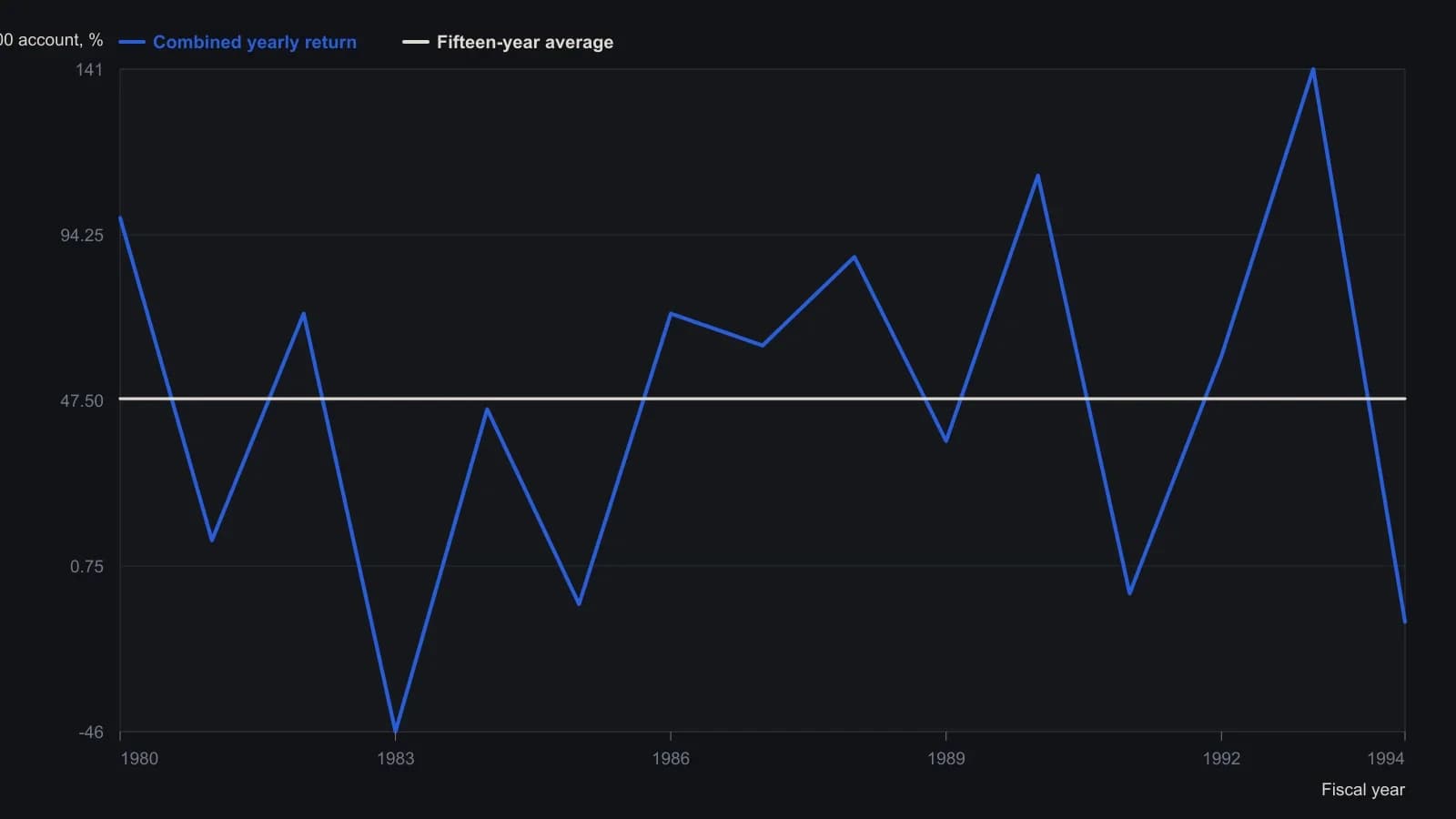
The spreadsheet header says all figures are rounded off, so these are the printed yearly returns rather than unrounded account math. Commission is fixed at $75 in the table. The default exit is eight weeks, with a protective weekly close, a reverse signal, or a same-direction re-signal allowed to end or restart the trade.
All readings on this track · 15 readings
- 1989Preflight checklist, time-stops, and stand-aside rules
- 1991Parameter windows for averages, option overlays and time stops
- 1995Three setup gates and a session-count clock complete a long bottom
- 1995Evaluating index futures OHLC reversals with RSI and time stops
- 1995A weekly two-close breakout and an eight-week time stop
- 2000Constructing breakout entry rules and time stops
- 2004Constructing action-reaction swing targets and time stops
- 2005Constructing breakout entries with trailing and time stops
- 2006Evaluating a restrictive range entry with a timed exit
- 2008Evaluating point-and-figure column breaks with time stops
- 2011Intraday gold swing with a daily entry limit, a time-stop, and a fixed stop-loss
- 2012Last-hour entries with a book-level loss bound and a next-open time stop
- 2015Precommit stop-loss, trailing-stop, and time-stop rules before entry
- 2018Auditing rank-rotation tests for time-stop and slot rules
- 2019Confirmation-first pyramiding with price and time stops