2015issue C0143-53
Yearly at-the-money covered calls on a dividend basket
This archive case sold one-year at-the-money calls against a high-yield equity basket, one contract for every 100 shares, while still allowing dividends from the long stock. Editorial reading: fix that overlay first, then decide whether a correlated hedge stays optional or is never attached.
- Covered call writing here means owning the shares and accepting a time-limited obligation to deliver them at a fixed strike.
- The case sold one-year at-the-money calls, one contract for every 100 shares, and still allowed dividends from the long stock.
- Sold calls were framed as a cushion against a decline, with the trade-off that the overlay limits participation when the names rally strongly.
- A market, sector, industry, or peer hedge can stay off until needed, because both legs can move against the position and spread prices can move adversely.
What the overlay fixed first
A covered call is described as owning the shares while accepting a time-limited obligation to deliver them at a fixed strike. This case study used Covered call writing with one-year at-the-money calls. An at-the-money strike sits at or nearest the current price of the underlying. Those contracts were chosen because they were described as carrying the most time premium versus the stock price. Time premium is the portion of an option price that comes from remaining life rather than intrinsic value.
The illustrated overlay sold one at-the-money call for every 100 shares held and still allowed dividends from the long stock. Sold calls were framed as a cushion against a decline. The same overlay limits participation in years when the names rally strongly.
When a hedge stays optional
Hedging strategy for a long stock or basket can use a market, sector, or industry fund or a peer name. A sector fund was treated as broader cover. A peer or industry name was treated as more correlated cover.
Repeating mid-month and month-end payroll-related flows, and news that is expected to lift one name versus a broad hedge, were treated as reasons to stay long and add the hedge only if needed. A hedge can fail or compound losses if both legs move against the position, and spread prices can move adversely.
Income filters and related spreads
A buy-and-hold owner can sell a call against shares already held. That Option income strategy treated out-of-the-money and overpriced contracts, plus a view of remaining time decay, as filters for the overlay. An out-of-the-money call strike sits above the current underlying price.
Combining an option purchase with an option sale produces a spread that is a credit when cash is received and a debit when cash is paid. A credit spread leaves cash in the account when opened. A debit spread takes cash out of the account when opened.
Quarter-point strike listings in some metals can split volume across many contracts and leave each option thinly traded with a wide bid-ask that is hard to overcome.
Modeled premium path of the ACM December 35 call
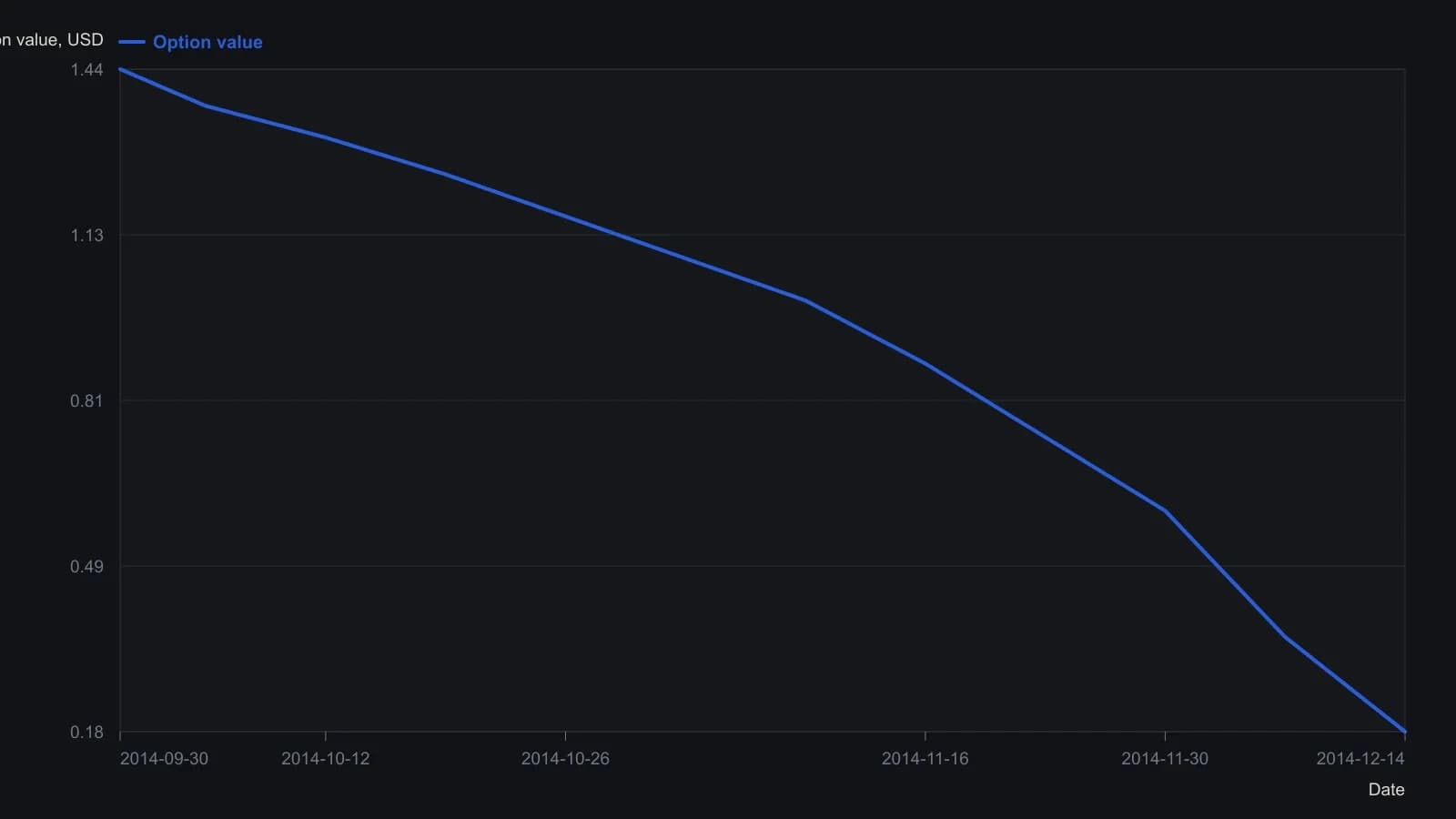
The platform holds the underlying at 33.75 dollars and implied volatility at 31.09 percent, so the path is a model at fixed spot and vol, not a live mark-to-market. Expiration is 20 December 2014.
All readings on this track · 23 readings
- 1982Basis-managed hedges and related market substitutes
- 1990Options as insurance unless the process is complete
- 1996A price-weighted technology index as a hedge and sector proxy
- 2002Single-stock futures as a month, margin, and hedge overlay
- 2004Listed volatility futures as a portfolio volatility hedge
- 2006Customized commodity hedges for bond and equity portfolios
- 2007Use of capital for overnight pairs and hedge layers
- 2007Opening auctions, limit envelopes, and overnight hedges
- 2008A two-gate intermarket test for equity bear hedges
- 2010Gold futures after a large setback: cluster risk and hedge timing
- 2011Partial commodity hedges, seasonal timing, and option income
- 2011Commodity-linked shares are a wrapper, a performance-bond, and a hedge-design problem
- 2012Hedging an open bull vertical
- 2012Construct a two-pair and three-pair hedge rule book
- 2014Equity and SPY stress pairs with a scaled index hedge
- 2015Yearly at-the-money covered calls on a dividend basket
- 2015Pair hedge to hold a valid idea through noise
- 2015Unused peer hedge after an ATR-qualified pair entry
- 2016Continuous index hedges fail the annual cost test
- 2016A VIX overlay as three stacked constraints
- 2018Late-cycle index overlay to keep equity dividends
- 2019Treat a bear-market hedge as a regime switch
- 2019Hedged pairs as game-theory payoffs