2014issue C0356
Equity and SPY stress pairs with a scaled index hedge
A pairs construction compares one equity with SPY as the market proxy. The same stress indicator can mark a relative oversold buy, a relative-advantage exit, and the scaled index hedge that lets the stock, the index, and the hedged combination be read together.
- Pair a single equity with SPY as the market proxy and treat a relative oversold reading as the buy condition.
- Use the same stress reading to detect when the equity no longer holds a relative advantage, and treat that loss as one of three exit triggers.
- Control overall risk by scaling into index trades that hedge the equity transaction.
- Show the stock, the index, and the hedged combination as three related profit-and-loss series, with the stress series plotted beside SPY and HES.
A stock and a market proxy
A pairs construction compares a single equity with a market proxy represented by SPY and treats a relative oversold reading as a buy condition.
The market proxy is a broad index vehicle used as the second leg of the pair. The stress indicator is the relative reading that compares the equity with that proxy to mark when the stock is stretched or no longer advantaged.
The same reading opens and closes the equity
The same stress reading is used to detect when the equity no longer holds a relative advantage versus the market.
Loss of that relative advantage is specified as one of three exit triggers for the equity holding. The relative-advantage exit fires when the equity no longer stands favorably versus the market proxy.
Hedge in stages and read three series
Overall risk is controlled by scaling into index trades that hedge the equity transaction. The scaled index hedge is an offsetting index position increased in stages to limit net exposure of the equity trade.
A profit-and-loss layout can present the stock, the index, and the hedged combination as three related series. The hedged combination is the joint profit-and-loss of the equity position and its index hedge.
A sample construction plots the stress series beside SPY and the equity HES.
Profit and loss for HES, SPY, and the hedged combination
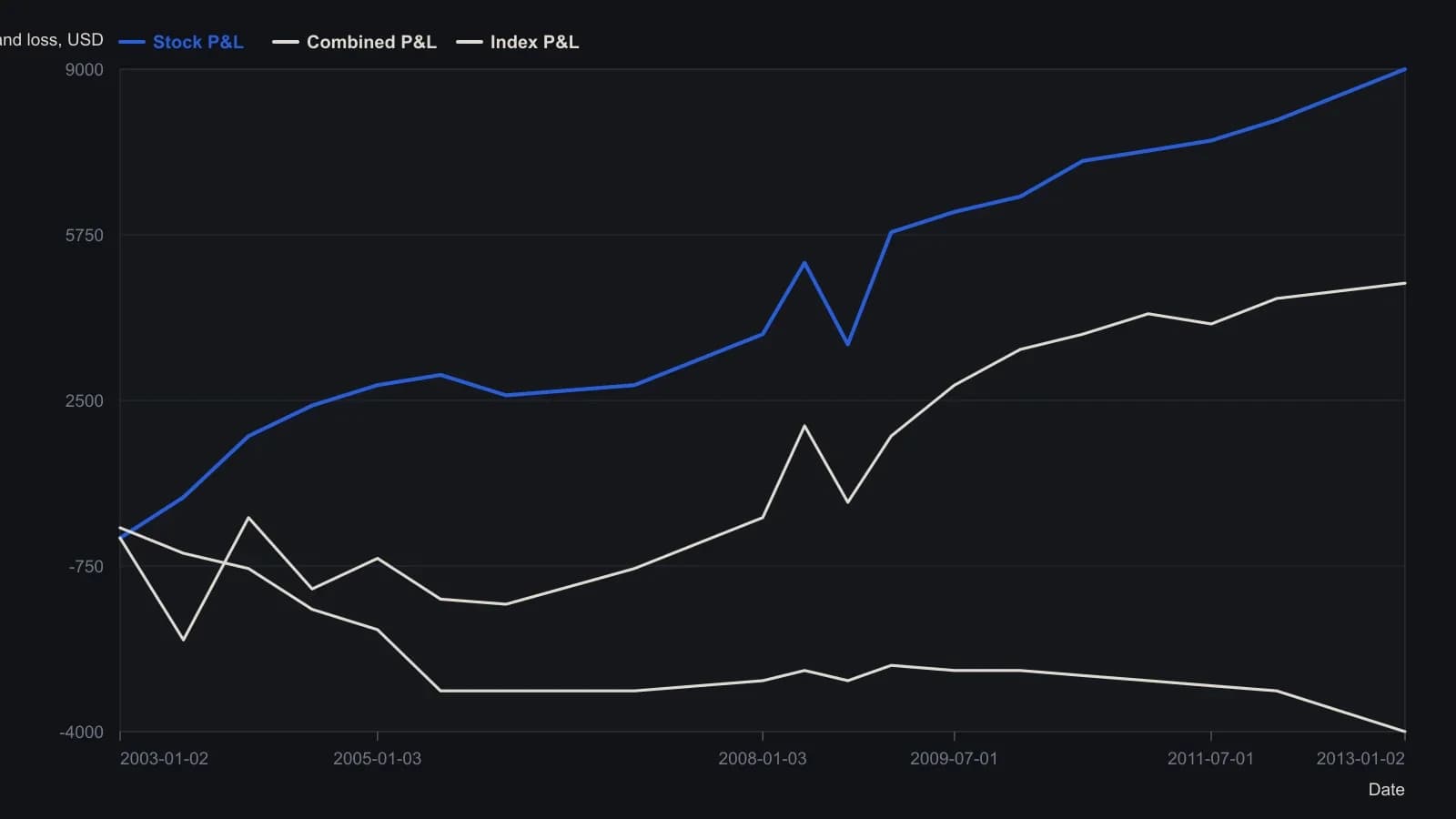
Approximate readings from the raster, rounded to the nearest hundred dollars. The source workbook used a $5,000 investment, $8 commission, a 10 percent stop, and a 50 percent hedge ratio.
All readings on this track · 23 readings
- 1982Basis-managed hedges and related market substitutes
- 1990Options as insurance unless the process is complete
- 1996A price-weighted technology index as a hedge and sector proxy
- 2002Single-stock futures as a month, margin, and hedge overlay
- 2004Listed volatility futures as a portfolio volatility hedge
- 2006Customized commodity hedges for bond and equity portfolios
- 2007Use of capital for overnight pairs and hedge layers
- 2007Opening auctions, limit envelopes, and overnight hedges
- 2008A two-gate intermarket test for equity bear hedges
- 2010Gold futures after a large setback: cluster risk and hedge timing
- 2011Partial commodity hedges, seasonal timing, and option income
- 2011Commodity-linked shares are a wrapper, a performance-bond, and a hedge-design problem
- 2012Hedging an open bull vertical
- 2012Construct a two-pair and three-pair hedge rule book
- 2014Equity and SPY stress pairs with a scaled index hedge
- 2015Yearly at-the-money covered calls on a dividend basket
- 2015Pair hedge to hold a valid idea through noise
- 2015Unused peer hedge after an ATR-qualified pair entry
- 2016Continuous index hedges fail the annual cost test
- 2016A VIX overlay as three stacked constraints
- 2018Late-cycle index overlay to keep equity dividends
- 2019Treat a bear-market hedge as a regime switch
- 2019Hedged pairs as game-theory payoffs