2016issue C0526
A VIX overlay as three stacked constraints
TradersWeek editorial reading: a long VIX sleeve is portfolio context only after three checks. The short-call strike caps a long VIX-futures stance. A listed note must follow a daily front-to-second-month weight path. The archive places that sleeve next to a long equity holding only because the equity index and the VIX are shown as negatively related.
- A long VIX futures position paired with short out-of-the-money VIX calls is a directional volatility stance whose further gain is limited at the short-call strike.
- Ten 100-multiplier VIX calls match one 1,000-multiplier VIX future, and monthly options expire with the related futures and settle to the VIX special opening quotation.
- A listed volatility note is a daily-changing weighted average of the first- and second-month VIX futures and also exposes the holder to the note issuer's credit.
- A 31 July 2015 to 12 February 2016 comparison presents the equity index and the VIX as negatively related, so a long equity holding is shown with a long volatility note as the overlay sleeve.
The archive constructs a long VIX futures position combined with short out-of-the-money VIX calls. That pairing is a directional volatility stance whose further gain is limited at the short-call strike.
The short strike caps further gain
The worked case bought April VIX futures on 19 February 2016 at 22.75 and sold 35-strike April VIX calls that collected 0.90 of premium per option.
Because the futures multiplier is 1,000 and the option multiplier is 100, the example shorts ten call contracts against one futures contract.
Ignoring call premium, the constructed net result is capped at 12,250, equal to 35 minus 22.75, times 1,000. Scenario futures prints of 40 and 45 leave that same net after option-exercise losses of 5,000 and 10,000.
Shared expiry and special opening quotation
Monthly VIX options expire on the same day as the related futures, settle to the VIX special opening quotation, and use a 100 multiplier.
Daily weights leave the front contract
From 20 January 2016 through 16 February 2016, tabulated weights on the February and March VIX futures shift from 94.90 percent and 5.10 percent to 0 percent and 100 percent as the front contract rolls off.
A listed volatility note is described as a daily-changing weighted average of the first- and second-month VIX futures. Unlike a futures contract, the note also exposes the holder to the note issuer's credit.
The inverse is why the sleeve sits beside equities
A 31 July 2015 to 12 February 2016 comparison presents the equity index and the VIX as negatively related, so a long equity holding is shown with a long volatility note as the overlay sleeve.
TradersWeek editorial reading: that negative relation is the only intermarket reason the sleeve belongs next to the long index holding. The covered-call cap and the forced roll path still have to hold, or the sleeve is not yet portfolio context.
Front-month VIX weight rolls into the March contract
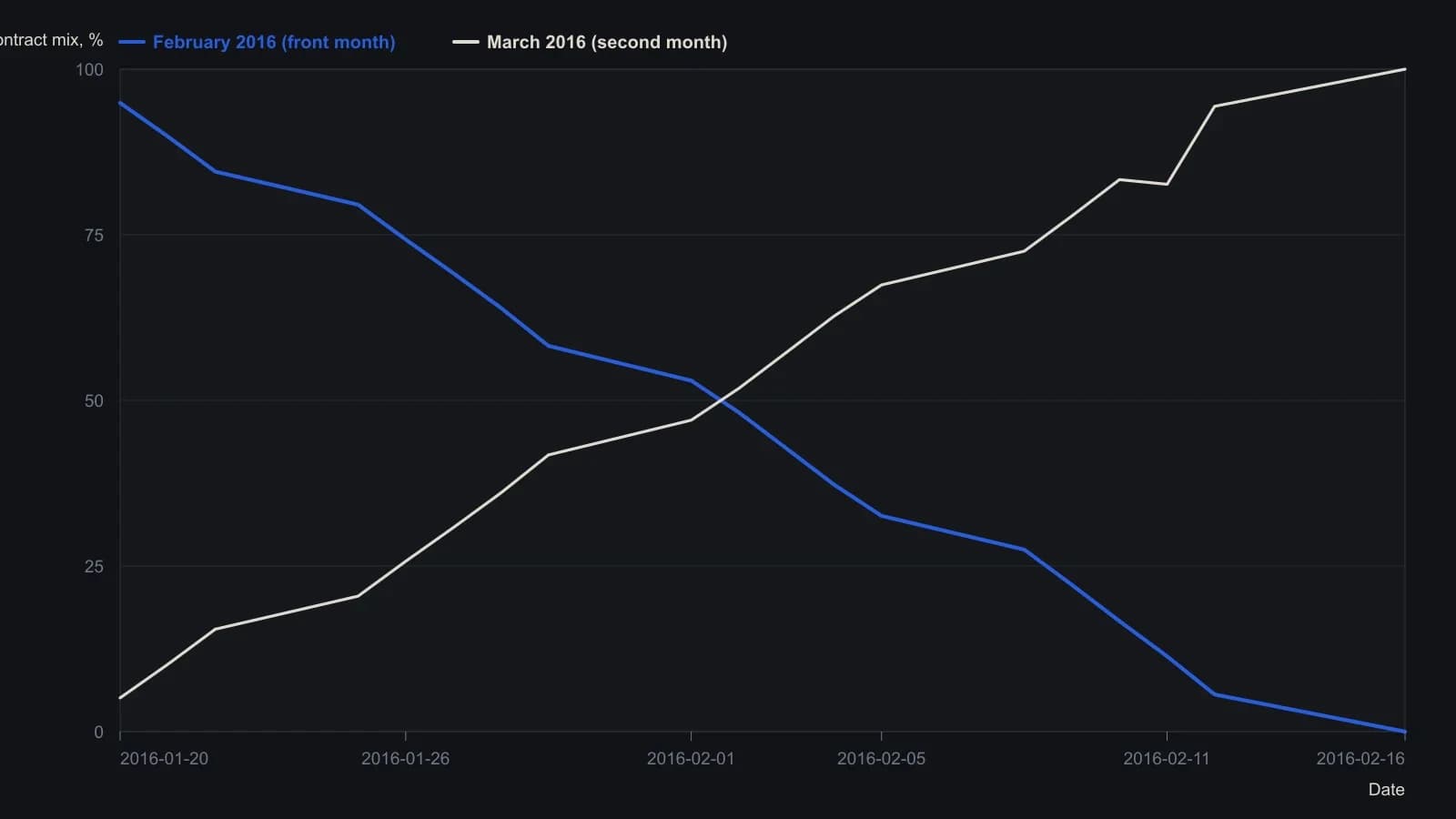
On 11 February the printed F1 and F2 weights sum to 94 percent rather than 100 percent; both figures are left as published.
All readings on this track · 23 readings
- 1982Basis-managed hedges and related market substitutes
- 1990Options as insurance unless the process is complete
- 1996A price-weighted technology index as a hedge and sector proxy
- 2002Single-stock futures as a month, margin, and hedge overlay
- 2004Listed volatility futures as a portfolio volatility hedge
- 2006Customized commodity hedges for bond and equity portfolios
- 2007Use of capital for overnight pairs and hedge layers
- 2007Opening auctions, limit envelopes, and overnight hedges
- 2008A two-gate intermarket test for equity bear hedges
- 2010Gold futures after a large setback: cluster risk and hedge timing
- 2011Partial commodity hedges, seasonal timing, and option income
- 2011Commodity-linked shares are a wrapper, a performance-bond, and a hedge-design problem
- 2012Hedging an open bull vertical
- 2012Construct a two-pair and three-pair hedge rule book
- 2014Equity and SPY stress pairs with a scaled index hedge
- 2015Yearly at-the-money covered calls on a dividend basket
- 2015Pair hedge to hold a valid idea through noise
- 2015Unused peer hedge after an ATR-qualified pair entry
- 2016Continuous index hedges fail the annual cost test
- 2016A VIX overlay as three stacked constraints
- 2018Late-cycle index overlay to keep equity dividends
- 2019Treat a bear-market hedge as a regime switch
- 2019Hedged pairs as game-theory payoffs