2006issue C021-4
Customized commodity hedges for bond and equity portfolios
A hedge sleeve is treated as effective only when the overlay has an inverse-relationship with the book it protects. The archive sizes that overlay from income, keeps the core holdings intact, and pairs commodity and dollar contracts against a named shock.
- A hedge-sleeve is treated as effective only when the overlay market has an inverse-relationship with the primary asset.
- Size the overlay from a share of income, not from principal, so the core book can stay intact.
- Match the opposite regime: commodity calls and a dollar put for a weaker dollar and inflation, or commodity puts and a dollar call for a stronger dollar and a disinflationary, recessionary setting.
- Use out-of-the-money options as catastrophe-insurance, and keep a margin-call-reserve if the overlay is a listed dollar-commodity-pair.
A hedge sleeve only works with an inverse market
A hedge sleeve is treated as effective only when the overlay market has an inverse relationship with the primary asset being protected. In this article that test is inverse-relationship: a price pattern in which one market tends to fall when another rises, used here as the test for whether an overlay can insure a primary holding.
The sleeve itself is a hedge-sleeve: a small, separately designed set of commodity or currency positions meant to protect a bond or equity book from a named shock. The longer-horizon stance is a passive-commodity-overlay, held for allocation and risk reduction rather than for frequent trading.
A graphic comparison of dollar and commodity futures
A graphic comparison of the US dollar index futures contract with cotton, sugar, crude oil, and gold is presented as showing a clear inverse relationship.
US Dollar Index versus cotton, 1995–2004
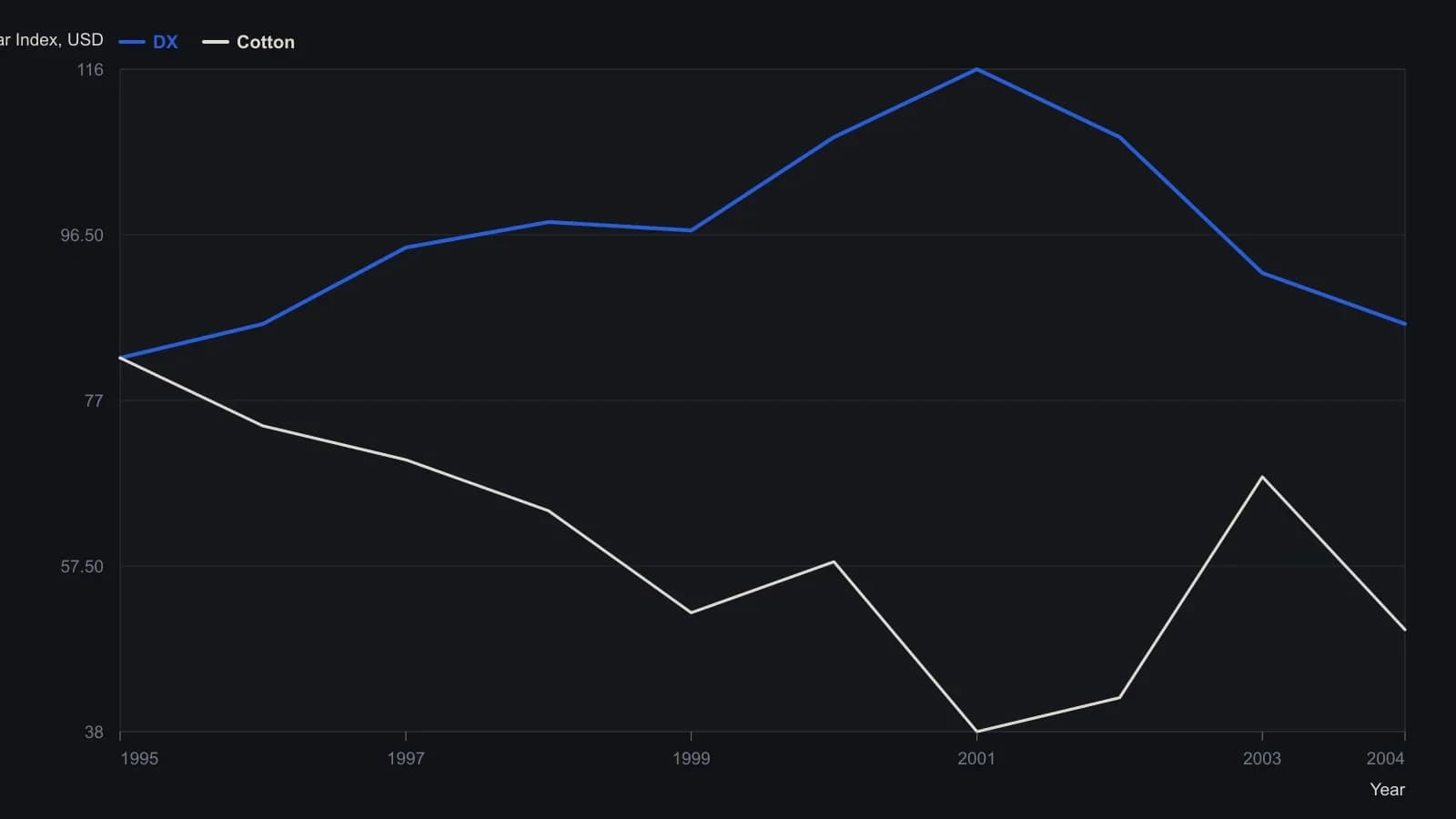
Approximate yearly readings from the raster; dual axes are not interchangeable, so each series stays in its own published unit.
An income-funded municipal-bond overlay
A worked municipal-bond example uses a $1,000,000 book generating $50,000 a year and considers placing 10% of that income into commodity calls plus a dollar put.
That bond overlay is described as protection against a weaker dollar and a sharp rise in inflation, using contracts that omit interest-rate and equity components.
An income-funded large-cap overlay
A worked large-cap example uses a $1,000,000 book generating $20,000 a year and considers placing 10% of that income into commodity puts plus a dollar call.
That equity overlay is described as protection against a stronger dollar that would weaken US competitiveness and against a disinflationary, recessionary setting.
Out-of-the-money options as catastrophe insurance
Out-of-the-money options are framed mainly as catastrophe insurance whose occasional payoff can reduce the net cost of the cover. Editorial: that framing is catastrophe-insurance, meaning deep out-of-the-money options bought so a rare, abrupt move can pay while the usual cost stays limited.
The option-controlled notional in one worked sleeve is given as about $472,812.20 against an outlay of $5,087.
A two-contract dollar-commodity pair
A two-contract overlay shorts the dollar-index futures and holds the Reuters Jeffries CRB index futures so the pair can be used against a fall in the dollar. Editorial: this is a dollar-commodity-pair, a two-leg construction that shorts a dollar-index contract and holds a broad commodity-index contract so a weaker dollar or a commodity spike can offset dollar-based portfolio damage.
With DX near 88 valued at $88,000 and CR near 312 valued at $62,400, posting under $2,000 margin per contract is presented as likely to trigger margin calls, so a $1,000,000 securities book is the scale used for that futures pair. Editorial: hold a margin-call-reserve, meaning cash or unused buying power set aside because listed index futures can require additional funds when marked to market.
All readings on this track · 23 readings
- 1982Basis-managed hedges and related market substitutes
- 1990Options as insurance unless the process is complete
- 1996A price-weighted technology index as a hedge and sector proxy
- 2002Single-stock futures as a month, margin, and hedge overlay
- 2004Listed volatility futures as a portfolio volatility hedge
- 2006Customized commodity hedges for bond and equity portfolios
- 2007Use of capital for overnight pairs and hedge layers
- 2007Opening auctions, limit envelopes, and overnight hedges
- 2008A two-gate intermarket test for equity bear hedges
- 2010Gold futures after a large setback: cluster risk and hedge timing
- 2011Partial commodity hedges, seasonal timing, and option income
- 2011Commodity-linked shares are a wrapper, a performance-bond, and a hedge-design problem
- 2012Hedging an open bull vertical
- 2012Construct a two-pair and three-pair hedge rule book
- 2014Equity and SPY stress pairs with a scaled index hedge
- 2015Yearly at-the-money covered calls on a dividend basket
- 2015Pair hedge to hold a valid idea through noise
- 2015Unused peer hedge after an ATR-qualified pair entry
- 2016Continuous index hedges fail the annual cost test
- 2016A VIX overlay as three stacked constraints
- 2018Late-cycle index overlay to keep equity dividends
- 2019Treat a bear-market hedge as a regime switch
- 2019Hedged pairs as game-theory payoffs