2008issue C071-2
A two-gate intermarket test for equity bear hedges
Use one equity stress week to drop folklore offsets that moved the wrong way, then rank the same candidates on dated drawdown windows under one uniform holding rule. Treat the listed access vehicle as an implementation choice after that test, not as evidence that a hedge works.
- A stress-week snapshot can falsify a folklore hedge when the supposed offset falls with equities rather than against them.
- Candidates that survive that snapshot should be scored on the same predefined drawdown windows under one uniform holding rule.
- Offset consistency is the share of those windows in which a candidate rose while equities fell, not the existence of an access vehicle.
- In the six-window sample, only the Swiss franc rose in every equity drawdown; the yen, gold, long Treasuries, and the listed stocks did not.
Two gates for hedge selection
Hedge selection can be taught as a two-gate procedure. The first gate is a stress-week snapshot, a single large equity decline used to inspect contemporaneous moves in currencies, bonds, metals, and defensive stocks. The second gate ranks the same candidate set on dated equity drawdown windows under one uniform holding rule.
A folklore hedge is a widely repeated offset, such as gold, defensive sectors, or a mixed currency basket, treated as a hypothesis until a panel confirms or rejects it. An access vehicle is the instrument used to hold an intermarket offset. It is kept separate from whether that offset historically moved the right way.
The archive records the January 2008 snapshot and the later scoring of the same candidates. It does not, by itself, name those steps as two gates.
The stress-week snapshot
In the week ended 18 January 2008, a major US equity average posted a large decline while gold also declined, so a long gold position did not offset that week's equity loss.
In that same week the Japanese yen and US 10-year and 30-year Treasury contracts rose, while gold and the listed consumer-staple and utility names fell. Consumer-staple and utility names in the weekly panel declined with equities, so those sector proxies did not function as a hedge in that episode.
After that week failed to confirm several common hedge stories, the same candidate set was scored across six US equity drawdowns beginning in 1987.
The drawdown-window panel
A drawdown window is a dated equity peak-to-trough interval used as the common holding period for every hedge candidate. The six windows ran from 25 August to 20 October 1987, 17 July to 11 October 1990, 31 January to 4 April 1994, 20 July to 1 September 1998, 14 January 2000 to 10 October 2002, and 27 October 2007 to 22 January 2008.
The uniform holding rule entered each candidate the session after the equity average's pre-drawdown high and exited the session after the average's drawdown low. There was no intra-window timing.
Offset consistency in the six windows
Offset consistency is the share of predefined drawdown windows in which a candidate rose while equities fell. In that six-episode sample the Swiss franc was the only candidate that rose in every equity drawdown window. The yen, gold, and long Treasuries rose in some windows but not all.
Individual stocks in the panel were inconsistent offsets. Only two names were positive in half the windows, and the remaining stocks were net negative across the corrections.
The access vehicle comes last
A listed Swiss franc currency exchange-traded fund was noted as an account-structure alternative to spot foreign exchange or currency futures. No timing rule was given for when to hold the hedge.
Hedge-candidate returns across six Dow drawdowns
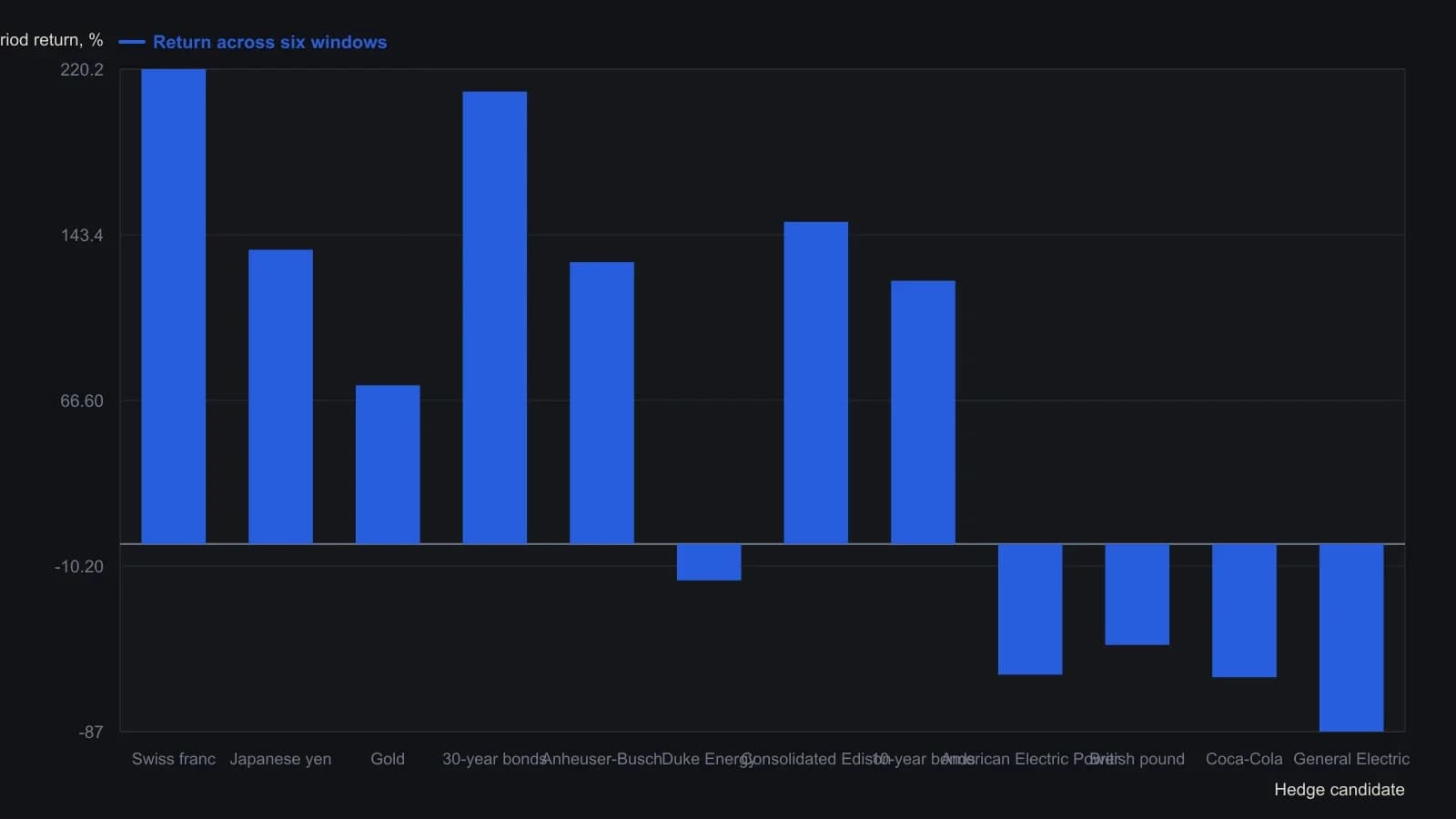
Each name was bought the day after the DJIA pre-correction high and sold the day after the DJIA low. Windows: 25 Aug–20 Oct 1987; 17 Jul–11 Oct 1990; 31 Jan–4 Apr 1994; 20 Jul–1 Sep 1998; 14 Jan 2000–10 Oct 2002; 27 Oct 2007–22 Jan 2008.
All readings on this track · 23 readings
- 1982Basis-managed hedges and related market substitutes
- 1990Options as insurance unless the process is complete
- 1996A price-weighted technology index as a hedge and sector proxy
- 2002Single-stock futures as a month, margin, and hedge overlay
- 2004Listed volatility futures as a portfolio volatility hedge
- 2006Customized commodity hedges for bond and equity portfolios
- 2007Use of capital for overnight pairs and hedge layers
- 2007Opening auctions, limit envelopes, and overnight hedges
- 2008A two-gate intermarket test for equity bear hedges
- 2010Gold futures after a large setback: cluster risk and hedge timing
- 2011Partial commodity hedges, seasonal timing, and option income
- 2011Commodity-linked shares are a wrapper, a performance-bond, and a hedge-design problem
- 2012Hedging an open bull vertical
- 2012Construct a two-pair and three-pair hedge rule book
- 2014Equity and SPY stress pairs with a scaled index hedge
- 2015Yearly at-the-money covered calls on a dividend basket
- 2015Pair hedge to hold a valid idea through noise
- 2015Unused peer hedge after an ATR-qualified pair entry
- 2016Continuous index hedges fail the annual cost test
- 2016A VIX overlay as three stacked constraints
- 2018Late-cycle index overlay to keep equity dividends
- 2019Treat a bear-market hedge as a regime switch
- 2019Hedged pairs as game-theory payoffs