2002issue C041-2
Single-stock futures as a month, margin, and hedge overlay
A single-stock future was a 100-share obligation on one equity, not a claim on the company. This note records the listing arithmetic and, as an editorial reading, treats the new contract as a three-gate overlay: pick the contract month that covers the cash holding, cap size at the 20 percent futures-margin posting, then sell the matching future as the hedge.
- A single-stock future is a 100-share futures obligation on one equity. It does not transfer company ownership, and a 1-dollar cash move marked 100 dollars on the future.
- Listed contract months followed the March-June-September-December cycle and the three nearest months from the trade date, so the overlay month can be chosen to cover the cash holding.
- The futures-margin posting was 20 percent of the underlying stock value, against a cash-equity margin floor of 50 percent. A 100-priced stock implied a 2,000-dollar futures posting versus 10,000 dollars for 100 cash shares.
- Selling the matching future against a longer cash holding was presented as a simpler hedge overlay than a spread or options structure, but a thin electronic book could leave that hedge on longer than planned.
What a single-stock future was
A single-stock future is a futures obligation on one equity. It does not convey ownership of the company.
Contracts were specified in 100-share units. A 1-dollar move in the cash stock mapped to a 100-dollar mark on the future.
Choose the contract month that covers the cash holding
Listed months followed the March-June-September-December cycle and also included the three nearest months from the trade date.
Editorial reading: the first gate is contract-month selection. The expiry has to cover the cash holding if the future is an overlay rather than a separate directional book.
Cap the overlay at the futures-margin posting
Futures margin was set at 20 percent of the underlying stock value, against a cash-equity margin floor of 50 percent.
In the worked example, a 100-priced stock implied a 2,000-dollar futures posting versus 10,000 dollars for 100 cash shares. A 5-point move marked 500 dollars on both sides.
Editorial reading: the cheaper futures-margin posting is the second gate. Size the overlay so the futures book cannot outrun the stock book just because less capital is posted.
Use the short future as the hedge overlay
A longer cash holding could be offset by selling the matching single-stock future. That structure was presented as simpler than a spread or an options overlay.
The futures short could be placed without the cash-market short-sale rules that can block a decline-day short. Those cash-market rules are the short-sale constraint.
Editorial reading: the hedge overlay is the third gate, used only after the month and the posting are set. It is not a standalone directional short.
Return on a five-point IBM move by margin posting
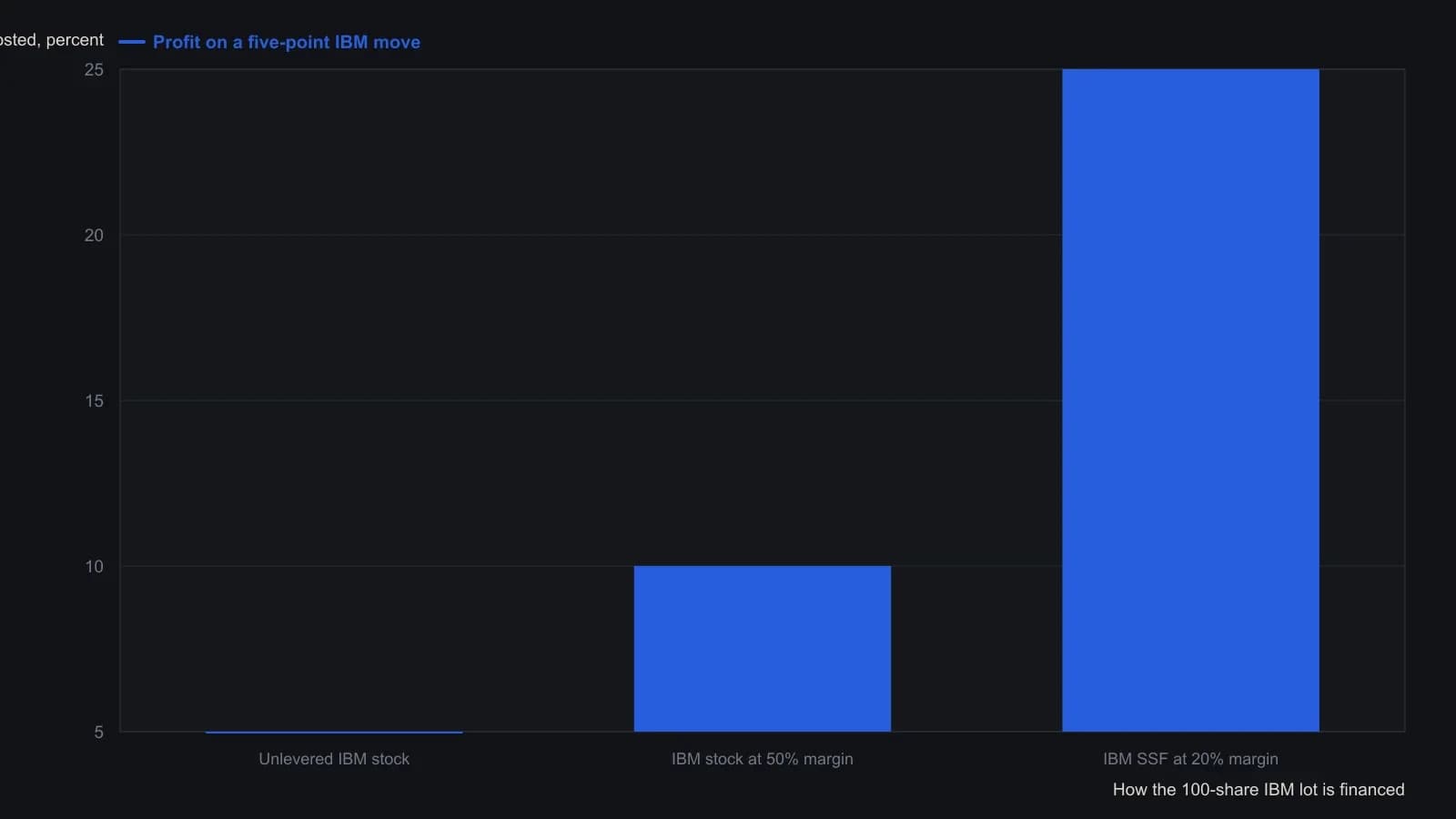
The source fixes IBM at 100 and a five-point day and sets aside interest on the leveraged equity loan.
Session hours and unresolved listing details
Three US electronic venues were expected to list the contracts during an 8:30 a.m. to 3:00 p.m. Central cash session. The name roster and account-settlement rules were still unresolved before the planned March 2002 start.
All readings on this track · 23 readings
- 1982Basis-managed hedges and related market substitutes
- 1990Options as insurance unless the process is complete
- 1996A price-weighted technology index as a hedge and sector proxy
- 2002Single-stock futures as a month, margin, and hedge overlay
- 2004Listed volatility futures as a portfolio volatility hedge
- 2006Customized commodity hedges for bond and equity portfolios
- 2007Use of capital for overnight pairs and hedge layers
- 2007Opening auctions, limit envelopes, and overnight hedges
- 2008A two-gate intermarket test for equity bear hedges
- 2010Gold futures after a large setback: cluster risk and hedge timing
- 2011Partial commodity hedges, seasonal timing, and option income
- 2011Commodity-linked shares are a wrapper, a performance-bond, and a hedge-design problem
- 2012Hedging an open bull vertical
- 2012Construct a two-pair and three-pair hedge rule book
- 2014Equity and SPY stress pairs with a scaled index hedge
- 2015Yearly at-the-money covered calls on a dividend basket
- 2015Pair hedge to hold a valid idea through noise
- 2015Unused peer hedge after an ATR-qualified pair entry
- 2016Continuous index hedges fail the annual cost test
- 2016A VIX overlay as three stacked constraints
- 2018Late-cycle index overlay to keep equity dividends
- 2019Treat a bear-market hedge as a regime switch
- 2019Hedged pairs as game-theory payoffs