2019issue C0128-31
Treat a bear-market hedge as a regime switch
The archive framed inverse ETFs as a long-only way to express a short market view, but only after the market regime turned defensive. Daily compounding made those funds a timed hedging strategy rather than a standing short.
- Name the market regime before placing an inverse-fund hedge.
- An inverse ETF is built to track the opposite of an index for a single day, not to mirror a multi-day decline.
- A hedging strategy needs entry, exit, and abstention rules. A bull regime was treated as a reason to stay out.
- Simple inverse index funds and leveraged bear products are different tools because both reset daily.
Classify the regime before the hedge
The archive described a long advance in the major averages as a bull run and then asked when a short market view belonged in a portfolio. It defined a correction and a bear market as distinct market-regime states. Inverse ETFs were treated as a long-only index proxy for that short view, including in accounts that do not allow short sales.
Editorial reading: TradersWeek treats the case as a sequence. Classify the market regime first. Only then apply a hedging strategy that can enter, exit, or abstain. A permanent short is not that sequence.
An inverse fund is a single-day index proxy
The first inverse funds were built to move opposite their benchmarks on a single day rather than over a multi-day hold. That design let a long position stand in for a short sale of the index. The archive presented those products as an index proxy for a defensive book, not as a general replacement for short selling.
Daily compounding is the holding-period problem
Because of daily compounding, multi-day results can differ from a simple reverse of the index path. The archive used a major bear-market window to show that inverse funds on large-cap, industrial, and Nasdaq benchmarks did not produce a one-for-one mirror of those indexes.
Inverse ETF returns versus the S&P 500 in the 2009–2018 bull market
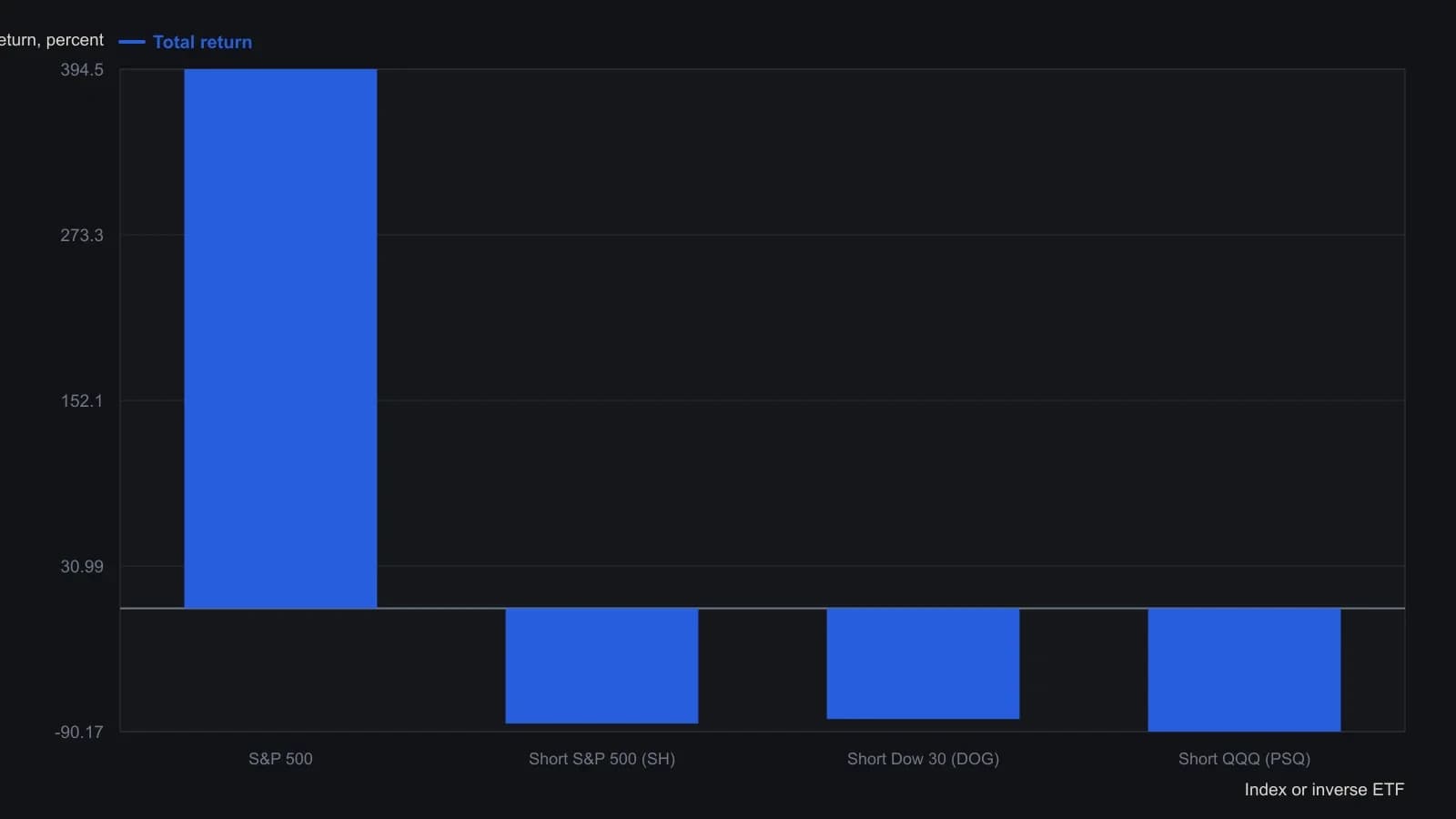
Values are the labeled bar totals on the StockCharts comparison, not heights estimated from the scale. Inverse funds reset daily, so the multi-year results are not a simple mirror of the index. The article’s separate 315 percent S&P figure uses an October 2018 cutoff and excludes dividends.
Switch from offense to defense
The archive treated buy-and-hold use of inverse funds in a bull market as unsuitable. The hedging strategy in the case was a regime switch. Weekly or monthly technical tools such as moving averages, MACD, and RSI were used to mark a change from offense to defense. A monthly Nasdaq chart was cited as one way to generate sell signals around deep historical declines.
Editorial reading: the sell signal is a classified change in market regime that turns the inverse-fund rules on. It is not a claim about the next print.
Anti-beta is a different defensive book
An alternative hedge discussed in the archive was a monthly-rebalanced, market-neutral anti-beta fund. That construction holds low-beta names long and high-beta names short and was not available during an earlier bear market. Later short windows were used only to compare it with a simple inverse index fund.
Simple inverse funds are not leveraged bear products
The archive distinguished simple inverse index funds from leveraged bear products that also reset daily. It warned that compounding can push results far from the intended daily multiple if the market moves against the position.
Editorial reading: both product types remain single-day instruments. Neither is a multi-week forecast of the index.
All readings on this track · 23 readings
- 1982Basis-managed hedges and related market substitutes
- 1990Options as insurance unless the process is complete
- 1996A price-weighted technology index as a hedge and sector proxy
- 2002Single-stock futures as a month, margin, and hedge overlay
- 2004Listed volatility futures as a portfolio volatility hedge
- 2006Customized commodity hedges for bond and equity portfolios
- 2007Use of capital for overnight pairs and hedge layers
- 2007Opening auctions, limit envelopes, and overnight hedges
- 2008A two-gate intermarket test for equity bear hedges
- 2010Gold futures after a large setback: cluster risk and hedge timing
- 2011Partial commodity hedges, seasonal timing, and option income
- 2011Commodity-linked shares are a wrapper, a performance-bond, and a hedge-design problem
- 2012Hedging an open bull vertical
- 2012Construct a two-pair and three-pair hedge rule book
- 2014Equity and SPY stress pairs with a scaled index hedge
- 2015Yearly at-the-money covered calls on a dividend basket
- 2015Pair hedge to hold a valid idea through noise
- 2015Unused peer hedge after an ATR-qualified pair entry
- 2016Continuous index hedges fail the annual cost test
- 2016A VIX overlay as three stacked constraints
- 2018Late-cycle index overlay to keep equity dividends
- 2019Treat a bear-market hedge as a regime switch
- 2019Hedged pairs as game-theory payoffs