2016issue C0330-32
Continuous index hedges fail the annual cost test
An illustrated 90-day at-the-money protective put on a 100,000-unit book can annualize to 14 percent of notional. Convert one-period put quotes and a full index-futures short into an annual drag test and an upside-forfeit test before the overlay is allowed to count as risk control.
- Repeating an illustrated 3,500-unit at-the-money 90-day protective put each quarter on a 100,000-unit book produces a 14 percent annualized insurance drag.
- Even the cheapest illustrated catastrophe put still annualizes near 2.4 percent of notional and pays only after an index decline of about 15 percent.
- A continuous protective-put overlay is not a fixed-cost insurance line, because premia rise when implied volatility is elevated and fall when it is depressed.
- A full futures hedge can leave residual upside limited to dividends plus basis and is hard to justify except when turbulence signals are severe and prices sit near multiyear highs.
Size the book before the overlay counts as cover
With the equity index at 2,000 and each futures point worth 50 currency units, one emini-style contract notionally matches a 100,000-unit stock book. A protective put against that book is a long index put that can offset a broad decline only after an upfront premium is paid.
The archive facts describe a historical workflow that prices one-period cover, and a full short of the index future, against that 100,000-unit book. Editorial reading: a default insurance overlay is a hedging strategy only after it is judged as one procedure, including the premium, leftover basis, and the choice to stand aside. Those one-period quotes still have to be turned into an annual drag test and an upside-forfeit test before the overlay is allowed to count as risk control.
The at-the-money overlay as a 14 percent yearly outlay
An at-the-money protective put sold as full 90-day cover is illustrated at about 70 points, or 3,500 currency units, when the implied-volatility gauge is near 20. Repeating that 3,500-unit at-the-money overlay each quarter on a 100,000-unit book produces an illustrated annual outlay of 14 percent of notional.
That 14 percent is the annualized insurance drag in the illustration. It is the one-period hedge premium multiplied across a year and divided by the book notional being protected, not a later premium forecast.
Catastrophe puts still fail a cheap-looking yearly test
The same implied-volatility and tenor assumptions price cheaper far out-of-the-money puts at about 29, 21, and 12 points, or 1,450, 1,050, and 600 currency units, for the 1,850, 1,800, and 1,700 strikes. Those catastrophe puts are cheaper per period.
Even the cheapest illustrated put can still annualize near 2.4 percent of a 100,000-unit book and pays only after an index decline of about 15 percent. Editorial reading: a lower strike changes when the offset starts. It does not remove the yearly drag test.
90-day emini S&P put premia on a $100,000 book
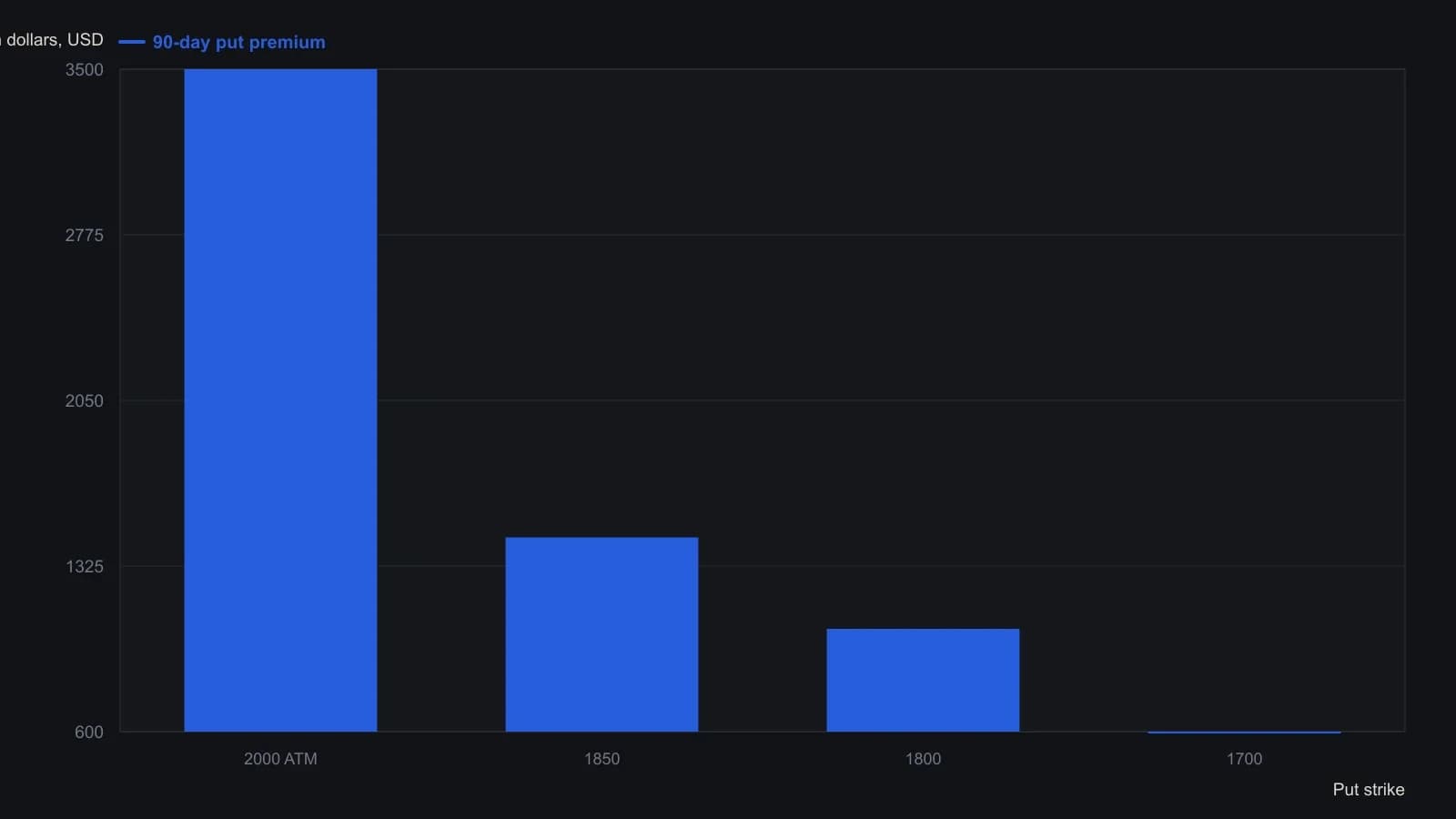
The example holds the S&P 500 at 2,000, VIX near 20, a $50 emini multiplier and 90-day expiry. Annual drag was obtained by repeating the one-period outlay four times.
Implied volatility moves the insurance line
Put premia rise when implied volatility is elevated and fall when it is depressed, so a continuous protective-put overlay is not a fixed-cost insurance line. Implied volatility is the options-market price of uncertainty that makes the same protective put more expensive when fear is elevated and cheaper when it is subdued.
A full futures hedge forfeits further advance
A full futures hedge is a short equity-index futures position sized to the book. It can cancel directional exposure and leave residual upside limited to dividends, because the book is then long cash equities and short the index future, with leftover profit or loss from basis versus the actual holdings.
A standing full futures hedge is hard to justify except when turbulence signals are severe and prices sit near multiyear highs, because the overlay also forfeits participation in further advances. Editorial reading: that upside-forfeit test sits beside the annualized insurance drag test. Neither overlay becomes risk control by default.
All readings on this track · 23 readings
- 1982Basis-managed hedges and related market substitutes
- 1990Options as insurance unless the process is complete
- 1996A price-weighted technology index as a hedge and sector proxy
- 2002Single-stock futures as a month, margin, and hedge overlay
- 2004Listed volatility futures as a portfolio volatility hedge
- 2006Customized commodity hedges for bond and equity portfolios
- 2007Use of capital for overnight pairs and hedge layers
- 2007Opening auctions, limit envelopes, and overnight hedges
- 2008A two-gate intermarket test for equity bear hedges
- 2010Gold futures after a large setback: cluster risk and hedge timing
- 2011Partial commodity hedges, seasonal timing, and option income
- 2011Commodity-linked shares are a wrapper, a performance-bond, and a hedge-design problem
- 2012Hedging an open bull vertical
- 2012Construct a two-pair and three-pair hedge rule book
- 2014Equity and SPY stress pairs with a scaled index hedge
- 2015Yearly at-the-money covered calls on a dividend basket
- 2015Pair hedge to hold a valid idea through noise
- 2015Unused peer hedge after an ATR-qualified pair entry
- 2016Continuous index hedges fail the annual cost test
- 2016A VIX overlay as three stacked constraints
- 2018Late-cycle index overlay to keep equity dividends
- 2019Treat a bear-market hedge as a regime switch
- 2019Hedged pairs as game-theory payoffs