2014issue C1142-53
When Commitment of Traders smart money fails as an intermarket regime filter
Weekly CFTC positioning shows how commercials, large specs, and small traders are aligned. Editorial reading: treat a crowded book that related markets refuse to confirm as a do-not-trade filter, not as a buy signal.
- The weekly CFTC positioning report maps how commercials, large specs, and small traders are aligned. That map is a regime check, not an entry.
- Market participant analysis asks who is long or short and whether that book is extreme, crowded, or failing to move price.
- Intermarket analysis compares rates, equities, commodities, and the dollar so one futures stance is judged in a broader regime.
- Blocking trades the core logic cannot handle, including crowded unconfirmed regimes and unstable bar times, reduces the burden placed on optimization and protects the equity curve.
Positioning describes alignment, not permission
The weekly CFTC positioning report is used to infer how commercials, large specs, and small traders are aligned across futures markets. Alignment is information about the regime. It is not a standalone reason to enter.
Editorial reading: the so-called smart money is already a poor entry cue once that book is crowded. Commitment of Traders figures belong in a filter that asks whether the stance is still an open regime or a finished crowd.
Crowded books that fail to move price
Market participant analysis means reading who is long or short, and whether that positioning is extreme, crowded, or failing to move price.
Editorial reading: a large commercial or speculative position that price does not follow is a failed confirmation from the tape. It is a warning about the regime, not a delayed invitation to join the crowd.
Related markets have to confirm
Intermarket analysis compares related markets such as rates, equities, commodities, and the dollar so a single futures stance is judged in a broader regime.
Editorial reading: if those related prices refuse to confirm the crowded futures book, the case is unreadable. It belongs with other blocked structures, not as an entry.
Filters protect the equity curve from the optimizer
A useful equity path is defined by reasonably steady growth and tolerable pullbacks, not by the ending account value alone. The equity curve is that running path of account value. Smoothness and drawdown matter more than a high ending balance.
An optimizer searches for the least-objectionable parameter set. It can abandon a productive setting when a few dangerous bars outweigh the good trades.
Blocking trades in data structures the formula cannot handle, including a do-not-trade condition, reduces the burden placed on optimization. A do-not-trade filter is a hard rule that blocks entries in bar sizes, times, or regimes the core logic cannot handle, so the optimizer is not asked to paper over those cases.
Editorial reading: crowded, unconfirmed positioning is one of those regimes. Keep it out of the search so a few hostile bars do not erase a setting that was otherwise productive.
One-contract emini S&P system equity, June–August 2013
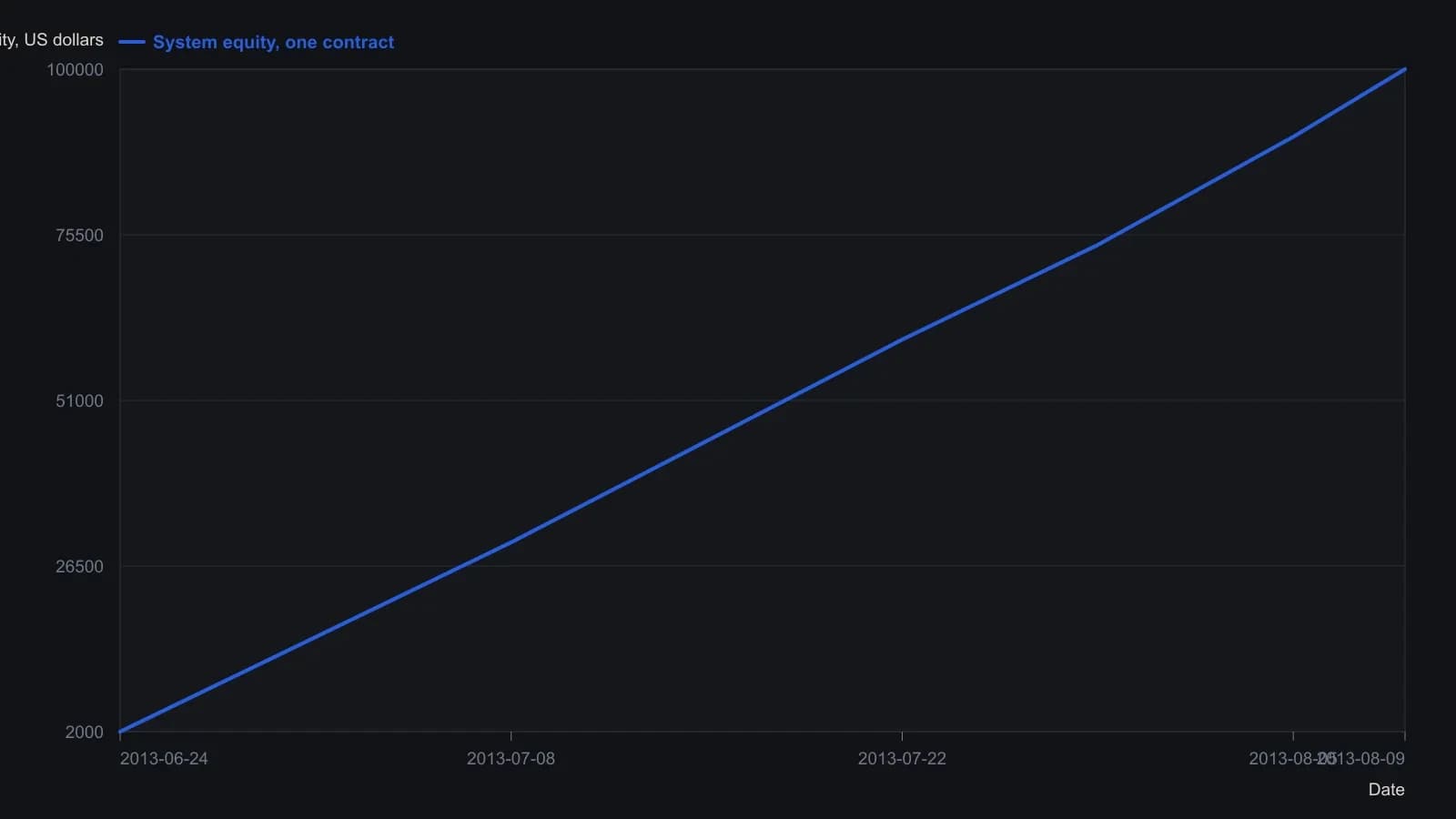
Out-of-sample NeuroShell run on 0.25-point range bars, $4 round-turn commissions, no slippage. The source states $2,300 starting equity, 8,535 trades and 82 percent winners. The companion 75-percent-of-equity pane, which the article takes to $47 trillion and then calls unexecutable, is omitted so the one-contract dollars stay on scale.
Unstable opens and mismatched payoff styles
For US stocks and index futures, the open around 9:30 a.m. Eastern can produce the most unstable bars, while conditions around 1:00 p.m. Eastern are often quieter.
Trend-following methods in the source discussion tend to win less often and need large favorable moves to offset frequent losers, whereas mean-reversion or scalp styles tend to win more often with shorter adverse runs.
Editorial reading: an unstable open, a quieter afternoon, and a crowded positioning regime are different structures. Each can be blocked so the core method is not forced to digest bars or crowds it cannot handle.
All readings on this track · 20 readings
- 1990Constructing a COT index from the commercial-speculative spread
- 1990Crowded price rules need abstention and a regime overlay
- 1991Advisor consensus fails as weekly contrarian timing
- 1996When speculative flows decouple bonds from stocks
- 1996Score each trader class against itself, then slice by month
- 1996Pork belly Commitment of Traders signals depend on the seasonal window
- 2002Constructing regime context from trader commitment nets
- 2002Trader net positions as regime context for chart setups
- 2003Three states for a daily futures advisor consensus
- 2005Commitment of Traders open-interest extremes as regime filters
- 2005Commitment of Traders participant imbalance as regime context for commodity position trades
- 2006Housing slowdown as a cross-market regime lesson
- 2007Evaluate an index stance as a spread between trader books
- 2011Constructing weekly participant positioning ledgers
- 2012Commitment of Traders as crowded-book context, not a copy signal
- 2014When Commitment of Traders smart money fails as an intermarket regime filter
- 2014Constructing Commitment of Traders regime context when commercial hedgers fail
- 2015Leave a yen bottom unconfirmed until gold and positioning agree
- 2016Stacking volume, open interest, and trader books around expiration
- 2025Post-crash cash and regime-aware watchlists