1990issue C051-9
Constructing a COT index from the commercial-speculative spread
A monthly three-group futures book can be turned into a historically ranged commercial-versus-speculative spread. The constructed 0-100 COT index places one market in a weeks-to-months regime context instead of a raw net-long or net-short headline.
- Commitments of Traders is a monthly public snapshot of futures open interest split among commercial hedgers, large speculators, and small traders, and it covers only markets where five or more traders exceed the reporting level.
- A commercial net position is longs minus shorts and can be scaled to non-spreading open interest, but that raw share is not yet a historically ranged reading.
- The COT index places commercial net contracts minus the combined net of large speculators and small traders on a 0-100 scale against that spread's own historical maximum and minimum.
- High readings mark commercial-relative oversold conditions, the reverse of conventional public-sentiment scales, and a sharp one-month change is a timing overlay rather than a stand-alone system.
Start from the monthly three-group book
The public monthly table is a Commitments of Traders snapshot of futures open interest split among three trader groups: commercial hedgers, reportable non-commercial speculators, and the residual small-trader remainder. It covers only markets where five or more traders exceed the reporting-level thresholds and partitions reportable open interest into commercial hedgers and non-commercial speculators, with the remainder labeled small traders.
Compiled trader-group positions were issued only monthly, yet the figures were released to news wires within four to six trading days of tabulation and typically circulated the following morning. Daily filings of actual large commercial-hedger futures positions were used to construct a sentiment-style index that replaces advisor polls and delayed market-letter tallies.
Publication stopped in 1982 and resumed in January 1983 with altered collection procedures and higher reporting levels, after which commodity funds displaced large individual speculators inside the large-speculator bucket. In editorial terms, TradersWeek treats the construction task as converting that monthly book into a historically ranged commercial-versus-speculative spread so one market can be placed in a weeks-to-months regime context.
Convert each book into a net share
Group net position equals longs minus shorts and can be scaled to non-spreading open interest. On January 1, 1990 in sugar No. 11, commercials were 27 percent long and 39 percent short for a 12 percent net-short reading, while large speculators were 4 percent net long and small traders 8 percent net long.
Gold net positions by trader group, 1989
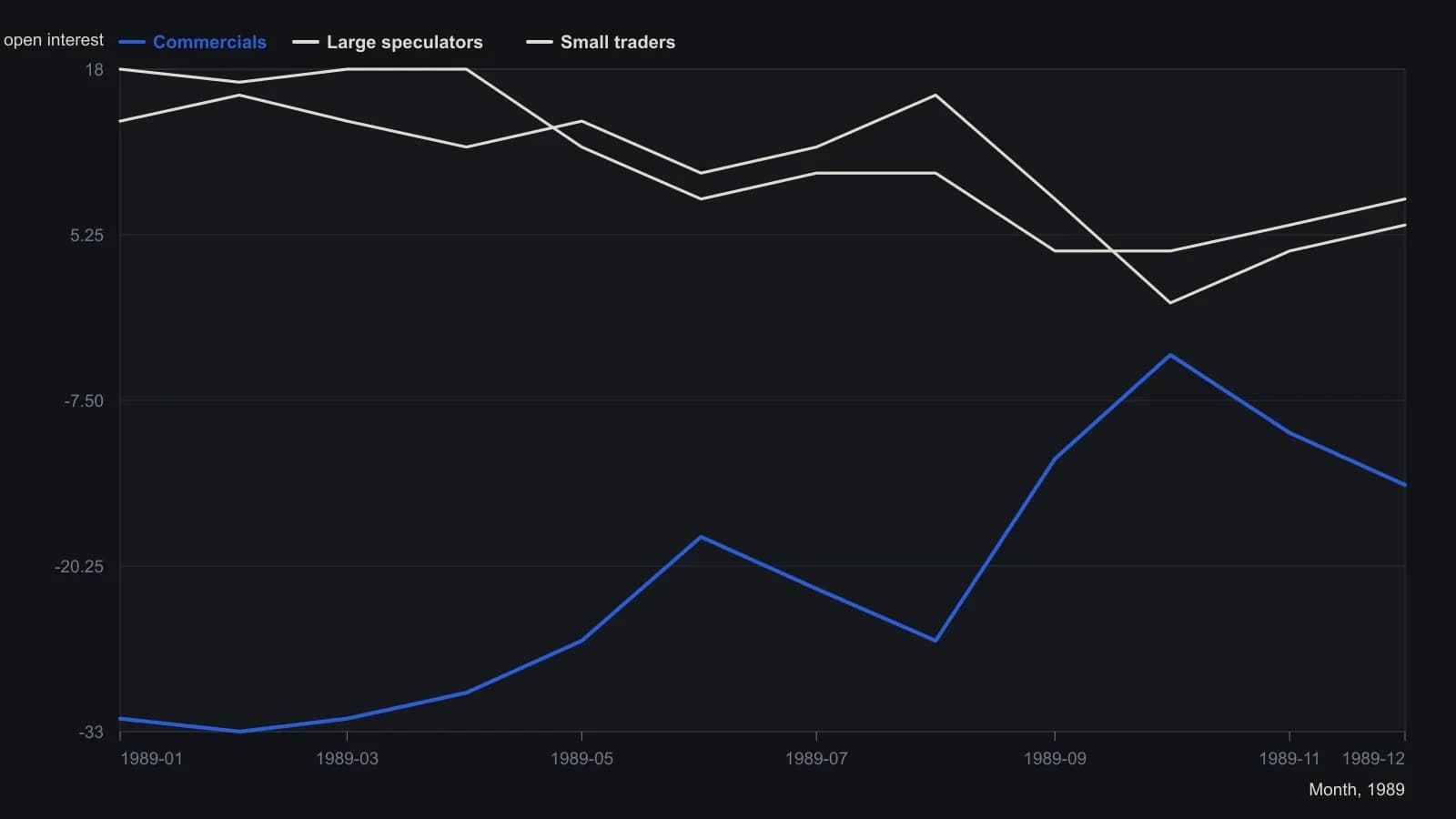
Y values are approximate readings from the printed grid; the source plots net position as percent of non-spreading open interest, with net shorts below zero. Point a is the September 1989 commercial dump described in the article.
Rank the commercial-speculative spread on 0-100
The constructed COT index places commercial net contracts minus the combined net of large speculators and small traders on a 0-100 scale by measuring that difference against its own historical maximum and minimum over a comparison window. Working extremes cited for the scale were 90-100 at one pole and below 5 at the other, relaxable to 75 and 25 when the reading moved more than 50 points in one month.
High index readings correspond to commercial-relative oversold conditions and low readings to overbought conditions, the reverse of conventional public-sentiment scales, because the construction tracks the commercial rather than the public side.
Keep the reading as a timing overlay
A sharp one-month change in the constructed reading, illustrated by a 77-point drop to zero in gold after commercials reduced long holdings, was framed as a timing overlay to other methods rather than a stand-alone system, because the series is built from reported positions rather than from price, volume, or open interest. In editorial terms, TradersWeek reads that overlay as the way to put a single trade into a weeks-to-months regime context after the three-group book has been converted into a historically ranged spread.
All readings on this track · 20 readings
- 1990Constructing a COT index from the commercial-speculative spread
- 1990Crowded price rules need abstention and a regime overlay
- 1991Advisor consensus fails as weekly contrarian timing
- 1996When speculative flows decouple bonds from stocks
- 1996Score each trader class against itself, then slice by month
- 1996Pork belly Commitment of Traders signals depend on the seasonal window
- 2002Constructing regime context from trader commitment nets
- 2002Trader net positions as regime context for chart setups
- 2003Three states for a daily futures advisor consensus
- 2005Commitment of Traders open-interest extremes as regime filters
- 2005Commitment of Traders participant imbalance as regime context for commodity position trades
- 2006Housing slowdown as a cross-market regime lesson
- 2007Evaluate an index stance as a spread between trader books
- 2011Constructing weekly participant positioning ledgers
- 2012Commitment of Traders as crowded-book context, not a copy signal
- 2014When Commitment of Traders smart money fails as an intermarket regime filter
- 2014Constructing Commitment of Traders regime context when commercial hedgers fail
- 2015Leave a yen bottom unconfirmed until gold and positioning agree
- 2016Stacking volume, open interest, and trader books around expiration
- 2025Post-crash cash and regime-aware watchlists