2016issue C0642-43
Stacking volume, open interest, and trader books around expiration
On a weekly equity-index futures continuation chart, simultaneous surges in volume and open interest can mark major futures and futures-options expiration events. Combined with the weekly trader-category split, those prints are used to infer the crowd psychology behind a price rather than reading price in isolation.
- On a weekly equity-index futures continuation chart, joint surges in volume and open interest can mark a futures and futures-options expiration-auction.
- Volume-confirmation uses traded size to test whether a price print is actually being filled when activity jumps around contract maturity.
- Open-interest-analysis asks whether futures or options risk is being created or extinguished, not whether open interest is a single directional vote.
- A Tuesday commitment-of-traders release splits the commercial-book, noncommercial-book, and nonreportable-book so the auction can be seated in a weeks-to-months positioning-regime.
Expiration can print as a joint surge
On a weekly equity-index futures continuation chart, simultaneous surges in open interest and volume can mark major futures and futures-options expiration events. That pattern is the visible form of an expiration-auction: the liquidity burst when those contracts mature, often seen as a joint surge in volume and open interest on a continuation series.
Weekly E-mini S&P 500 continuation, 2013–2015
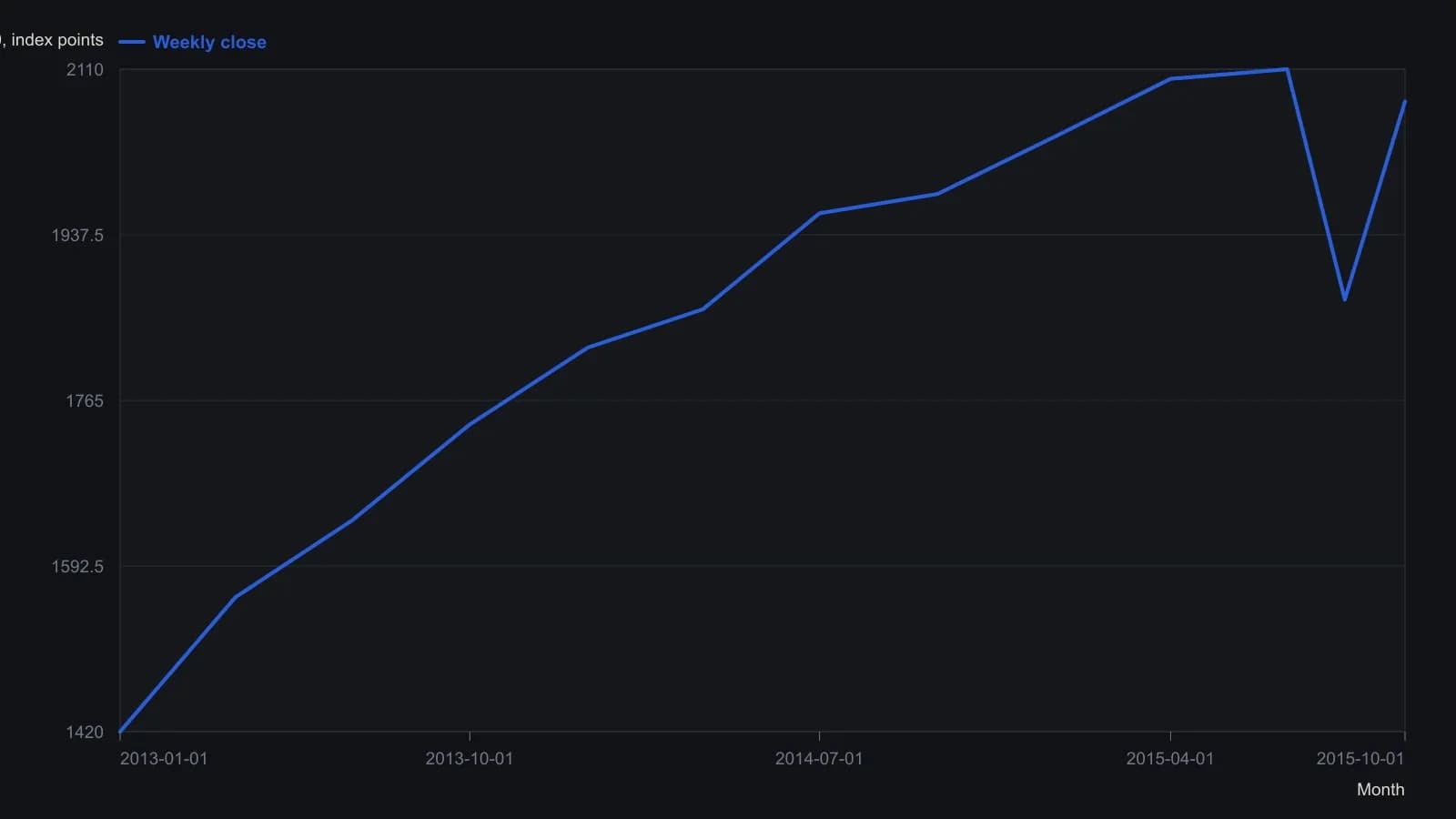
Except for that final platform close, prices are approximate to about 40 index points. Volume (last print 1,431,427) and open interest (1,421,909) sit in the lower pane as the expiration signal but cannot be recovered bar by bar at contract precision from this raster, so they are not plotted.
Volume tests whether the print was filled
Volume-confirmation uses traded size to test whether a price print is actually being filled, especially when activity jumps around contract maturity. Combining volume, open interest, and the weekly trader-category split is presented as a way to infer the crowd psychology behind a price print instead of reading price in isolation.
Open interest is not a directional vote
Open-interest-analysis reads whether futures or options risk is being created or extinguished as price and volume change, rather than treating open interest as a single directional vote. After a one-sided burst of motivated buying or selling is absorbed, remaining participants may lack urgency, and that exhaustion can coincide with a market extreme.
Weekly books set the positioning-regime
A weekly commitments-of-traders release, typically issued on Tuesday, partitions open interest into commercial, noncommercial, and nonreportable categories. The commercial-book is framed as producer or consumer hedges of operating exposure in the underlying, the noncommercial-book as large speculative accounts such as funds, and the nonreportable-book as the residual open interest held below official reporting size.
Commitment-of-traders uses that weekly split as a weeks-to-months regime overlay. The weekly category series can be inspected on multiyear charts to connect current open-interest composition with longer-running drivers of price movement. The positioning-regime is the slower stance implied by how those three books are stacked, used to place one auction inside a diversified market context.
All readings on this track · 20 readings
- 1990Constructing a COT index from the commercial-speculative spread
- 1990Crowded price rules need abstention and a regime overlay
- 1991Advisor consensus fails as weekly contrarian timing
- 1996When speculative flows decouple bonds from stocks
- 1996Score each trader class against itself, then slice by month
- 1996Pork belly Commitment of Traders signals depend on the seasonal window
- 2002Constructing regime context from trader commitment nets
- 2002Trader net positions as regime context for chart setups
- 2003Three states for a daily futures advisor consensus
- 2005Commitment of Traders open-interest extremes as regime filters
- 2005Commitment of Traders participant imbalance as regime context for commodity position trades
- 2006Housing slowdown as a cross-market regime lesson
- 2007Evaluate an index stance as a spread between trader books
- 2011Constructing weekly participant positioning ledgers
- 2012Commitment of Traders as crowded-book context, not a copy signal
- 2014When Commitment of Traders smart money fails as an intermarket regime filter
- 2014Constructing Commitment of Traders regime context when commercial hedgers fail
- 2015Leave a yen bottom unconfirmed until gold and positioning agree
- 2016Stacking volume, open interest, and trader books around expiration
- 2025Post-crash cash and regime-aware watchlists