1996issue C101-5
Pork belly Commitment of Traders signals depend on the seasonal window
In the historical pork-belly study, whether a trader class was a useful directional guide or a fade depended on the seasonal window rather than on a single all-year rule.
- Whether a trader class was a useful directional guide or a fade depended on the seasonal window rather than on a single all-year rule.
- Commercial-hedger extremes on a 12-period Commitment of Traders index, long above 90 and short below 10, produced 58 February pork-belly trades, with 10- and 15-day win rates of 64 percent and chi-square values of 3.88.
- An all-year large-speculator rule was weaker than an August-only rule, and November was treated as a fade window because large speculators were often wrong on direction.
- Small-speculator extremes were presented as the strongest contrary setup, consistent with late-crowd positioning at turning points in a highly speculative meat market.
A seasonal reading, not a single rule
In the historical pork-belly study, whether a trader class was a useful directional guide or a fade depended on the seasonal window rather than on a single all-year rule.
The historical workflow combined Commitment of Traders positioning with Seasonal analysis of the calendar window, and it used a Contrarian strategy when a class was treated as a fade rather than a follow.
Commercial hedgers in February
Commercial-hedger extremes on a 12-period Commitment of Traders index, long above 90 and short below 10, produced 58 February pork-belly trades, with 10- and 15-day win rates of 64 percent and chi-square values of 3.88.
Large speculators by month
A more liberal all-year large-speculator rule, long above 60 and short below 40, generated 99 trades and weaker results, with a 10-day win rate of 54 percent and a chi-square of 0.36.
Restricting large-speculator signals to August, long above 80 and short below 20, reduced the sample to 7 trades and raised the 15-day win rate to 100 percent with a chi-square of 5.14.
In November, large speculators were often wrong on direction, so the study treated that month as a fade window rather than a follow window.
Small speculators as a contrary setup
Small-speculator extremes were presented as the strongest contrary setup, consistent with late-crowd positioning at turning points in a highly speculative meat market.
February 1996 pork-belly futures, August 1995 through expiration
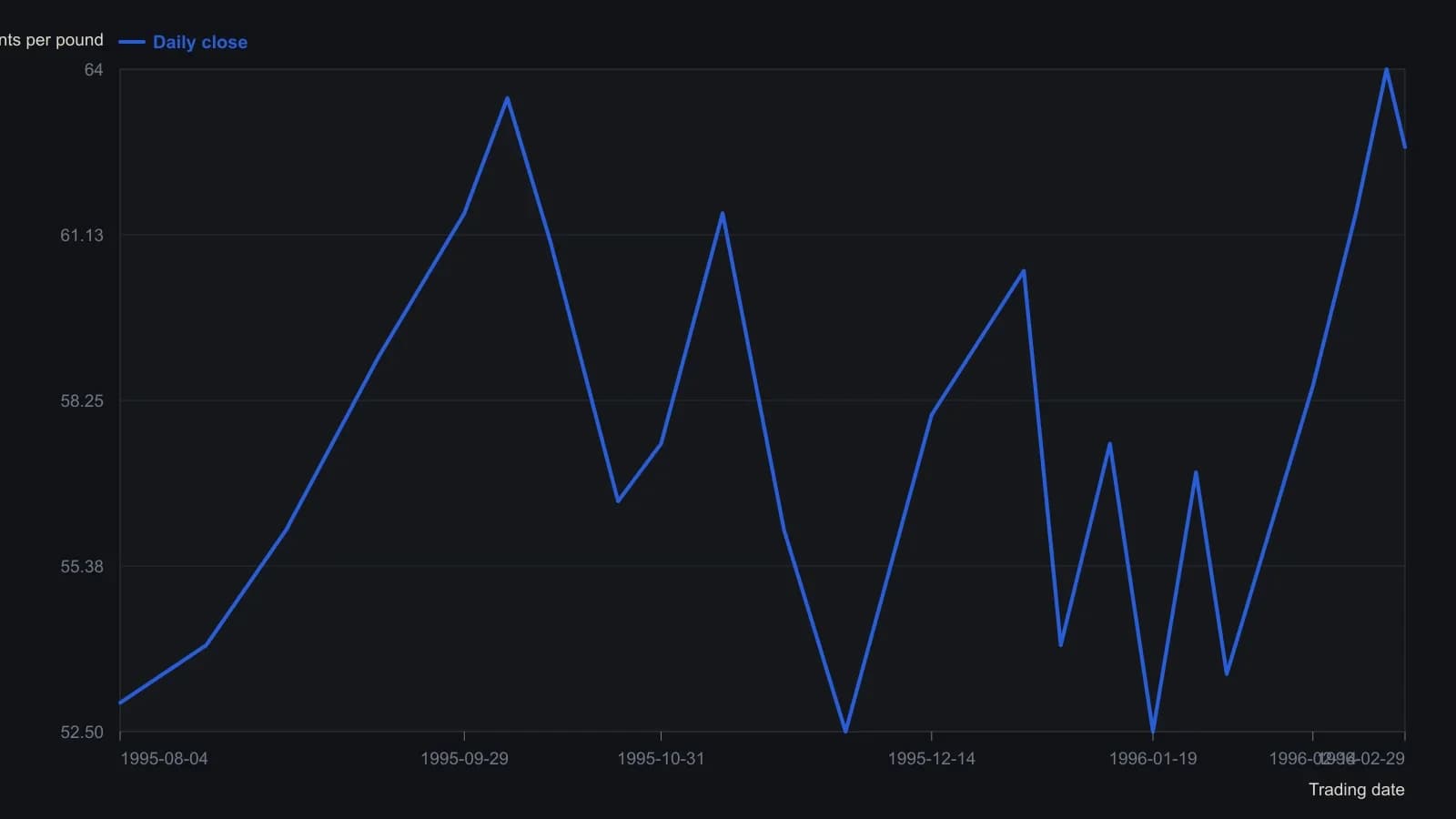
Closes were read off the daily candlestick raster to the nearest half-cent against a two-cent grid. The 29 February 1996 value of 62.65 is the printed quote, not a bar reading. The window begins in early August, later than the June start of Barrie’s study.
How a holding period was judged
The study judged a holding period statistically notable when chi-square was at least 3.86, using the open after the Commitment of Traders release versus later settlement.
All readings on this track · 20 readings
- 1990Constructing a COT index from the commercial-speculative spread
- 1990Crowded price rules need abstention and a regime overlay
- 1991Advisor consensus fails as weekly contrarian timing
- 1996When speculative flows decouple bonds from stocks
- 1996Score each trader class against itself, then slice by month
- 1996Pork belly Commitment of Traders signals depend on the seasonal window
- 2002Constructing regime context from trader commitment nets
- 2002Trader net positions as regime context for chart setups
- 2003Three states for a daily futures advisor consensus
- 2005Commitment of Traders open-interest extremes as regime filters
- 2005Commitment of Traders participant imbalance as regime context for commodity position trades
- 2006Housing slowdown as a cross-market regime lesson
- 2007Evaluate an index stance as a spread between trader books
- 2011Constructing weekly participant positioning ledgers
- 2012Commitment of Traders as crowded-book context, not a copy signal
- 2014When Commitment of Traders smart money fails as an intermarket regime filter
- 2014Constructing Commitment of Traders regime context when commercial hedgers fail
- 2015Leave a yen bottom unconfirmed until gold and positioning agree
- 2016Stacking volume, open interest, and trader books around expiration
- 2025Post-crash cash and regime-aware watchlists