2015issue C108-11
Leave a yen bottom unconfirmed until gold and positioning agree
The archive treated a suspected yen bottom as a single-chart guess until gold versus the dollar printed a confirming turn and the weekly speculator-hedger spread stopped fighting the same idea. TradersWeek editorial teaching is a two-gate habit for currency-regime calls, not a forecast that either market has changed.
- Editorial habit: treat a suspected yen bottom as unconfirmed until gold versus the dollar and the speculator-hedger spread stop disagreeing with the single-chart reversal.
- Intermarket analysis reads gold and the yen through a shared fear bid across bonds, commodities, currencies, and equities, not through each market's own price history alone.
- The weekly commitment of traders report splits commercials, institutional speculators, and small traders, then measures the speculator-hedger spread to see how far those viewpoints have diverged.
- Until gold and the yen rise together, the working assumption remains the prior multiyear downtrend.
A single chart is not a regime
A suspected yen bottom can look finished on one currency chart and still be only a single-chart reversal. In the archive workflow, that reading stayed unconfirmed until two other pictures stopped disagreeing with it: a related dollar-haven market, and the weekly gap between institutional speculators and commercial hedgers.
TradersWeek editorial: keep those as two separate gates. A confirming turn in gold versus the dollar is not the same evidence as a speculator-hedger spread that has stopped fighting the new idea. Either disagreement leaves the currency-regime call on hold.
Read gold and the yen through shared drivers
Intermarket analysis means reading one market through shared drivers that also move another market, rather than through that market's own price history alone. The work was framed as tracing shared cause-and-effect drivers across bonds, commodities, currencies, and equities. Those links were often summarized with a correlation reading, which describes whether two markets tend to travel together or in opposite directions.
Gold and the yen were treated as sharing a fear-related driver. The fear bid is demand that appears when inflation control or monetary credibility is questioned, historically associated with gold and, in this pairing, the yen.
Gold versus the dollar was described as peaking amid expectations that monetary expansion would erode dollar purchasing power. The expected inflation outcome was described as not arriving in the following years. Major central banks were projecting inflation that stayed low, and the dollar strengthened.
Gold and the yen were described as historically rising together when the dollar weakened, so a joint advance was treated as possible again. Until that joint rise appeared, a continued multiyear downtrend remained the working assumption.
A meaningful gold advance versus the dollar was presented as the clearest confirming turn: evidence that the yen had bottomed and that yen crosses would reverse lower. Yen crosses quote another currency against the yen, so yen weakness appears as those pairs rising.
Use weekly positioning as the second gate
The weekly futures positioning report was used as a commitment of traders breakdown with three groups: commercials, institutional speculators, and small traders. A separate reading watched the speculator-hedger spread, the gap between institutional speculative holdings and commercial hedging, to see how far those viewpoints had diverged.
Large yen speculators were approaching a net-long stance that had not been seen for years. That stance was characterized as early after dollar-yen continued higher.
After failed attempts to fade yen-cross strength, covering was described as helping drive the market to multiyear highs. One week was marked as the largest yen-futures positioning change in years.
TradersWeek editorial: a speculative lean that is still early, or covering after failed fades, is disagreement, not confirmation. Market participant analysis becomes useful here only as the second gate, once the speculator-hedger spread stops arguing against the suspected turn.
Yen futures versus the weekly speculator–hedger COT spread, 2005–2015
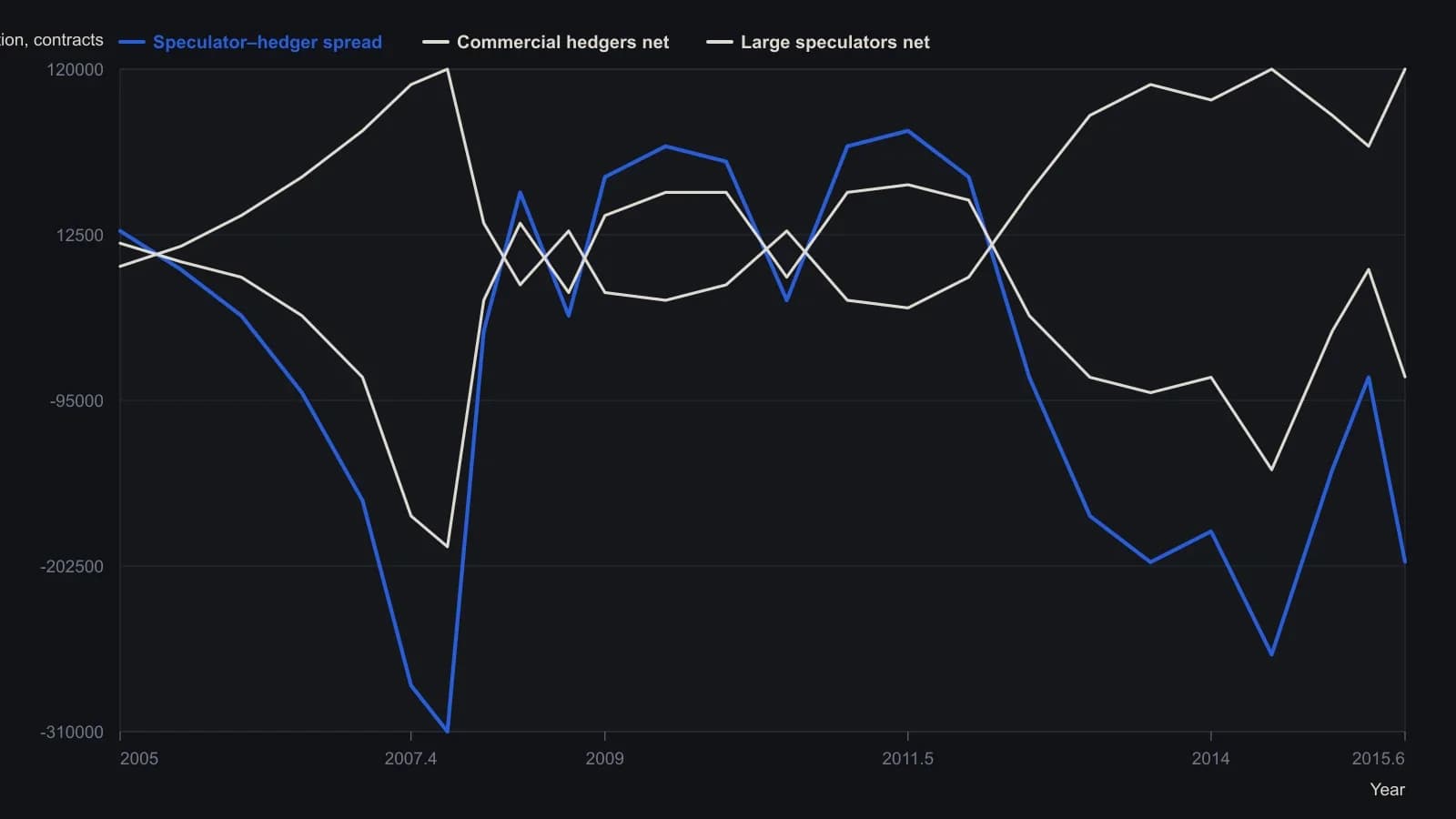
Raster read of an 11-year weekly chart; dates are approximate year-fractions and contract counts are rounded to the nearest few thousand. Current print at the right edge is 0.80095 on price and −199,697 on the spread. Spread is institutional speculators minus commercial hedgers.
All readings on this track · 20 readings
- 1990Constructing a COT index from the commercial-speculative spread
- 1990Crowded price rules need abstention and a regime overlay
- 1991Advisor consensus fails as weekly contrarian timing
- 1996When speculative flows decouple bonds from stocks
- 1996Score each trader class against itself, then slice by month
- 1996Pork belly Commitment of Traders signals depend on the seasonal window
- 2002Constructing regime context from trader commitment nets
- 2002Trader net positions as regime context for chart setups
- 2003Three states for a daily futures advisor consensus
- 2005Commitment of Traders open-interest extremes as regime filters
- 2005Commitment of Traders participant imbalance as regime context for commodity position trades
- 2006Housing slowdown as a cross-market regime lesson
- 2007Evaluate an index stance as a spread between trader books
- 2011Constructing weekly participant positioning ledgers
- 2012Commitment of Traders as crowded-book context, not a copy signal
- 2014When Commitment of Traders smart money fails as an intermarket regime filter
- 2014Constructing Commitment of Traders regime context when commercial hedgers fail
- 2015Leave a yen bottom unconfirmed until gold and positioning agree
- 2016Stacking volume, open interest, and trader books around expiration
- 2025Post-crash cash and regime-aware watchlists