2002issue C041-3
Constructing regime context from trader commitment nets
This editorial construction treats the weekly trader-class book as a weeks-to-months regime overlay. One futures idea is read against who is hedging, who is taking risk, and who is residual, not against another pass over the same price series.
- Public commitment reports place identified accounts in a commercial class, a noncommercial class, or leftover nonreportable positions, and one entity is not both commercial and noncommercial in the same commodity.
- Class-level commitments cannot be recovered from price, volume, or aggregate open interest, so they are a second construction input beside the price tape.
- A class net commitment is longs minus shorts. Only noncommercials carry a spreading column, and those matched legs are left out because each spread is one long and one short.
- Editorial use: keep the Tuesday snapshot as a weeks-to-months overlay that asks who is already committed, rather than building another oscillator from price.
What the weekly book records
Public commitment reports assign identified futures accounts to a commercial class, a noncommercial class, or a leftover nonreportable group. One entity is not labeled both commercial and noncommercial in the same commodity.
The report snapshots each Tuesday's open interest in markets where at least 20 traders hold positions at or above the official reportable level. The series began as a month-end compilation released the following month and later moved to more frequent, then weekly, publication.
Commercial status is reserved for cash-side firms that hedge with futures or options. Those commercial hedger accounts are exempt from speculative position limits and post smaller margins than speculators.
Reportable noncommercial speculators take risk for profit, are commonly treated as trend-following size, and are most informative at crowded extremes because their buying or selling can move the market.
The nonreportable remainder now mixes below-threshold speculators with small hedgers. That mix makes nonreportable positions a weaker contrary read than when small commercials were kept separate.
Class nets sit beside the price tape
Class-level commitments cannot be recovered from price, volume, or aggregate open interest alone, so they are a second construction input beside the price tape. Commitment of traders is the public weekly breakdown of futures open interest by trader class, used to see who is already committed rather than what price alone implies.
Open interest is the contracts still outstanding because they have not been offset, delivered, or exercised. Aggregate longs equal aggregate shorts.
How the condensed table is totaled
In the condensed table the printed total is only commercial plus noncommercial open interest. Nonreportable size is shown apart. Only noncommercials carry a spreading column.
A class net commitment is longs minus shorts. Spreading is omitted from that net because each spread is one long and one short, and the pair is net-neutral by construction.
In the corn short-form example, noncommercials were net long 7238 contracts, commercials were net long 25040, and nonreportable traders were net short 32278. Those three nets offset.
CBOT corn net commitments by trader class, 2 October 2001
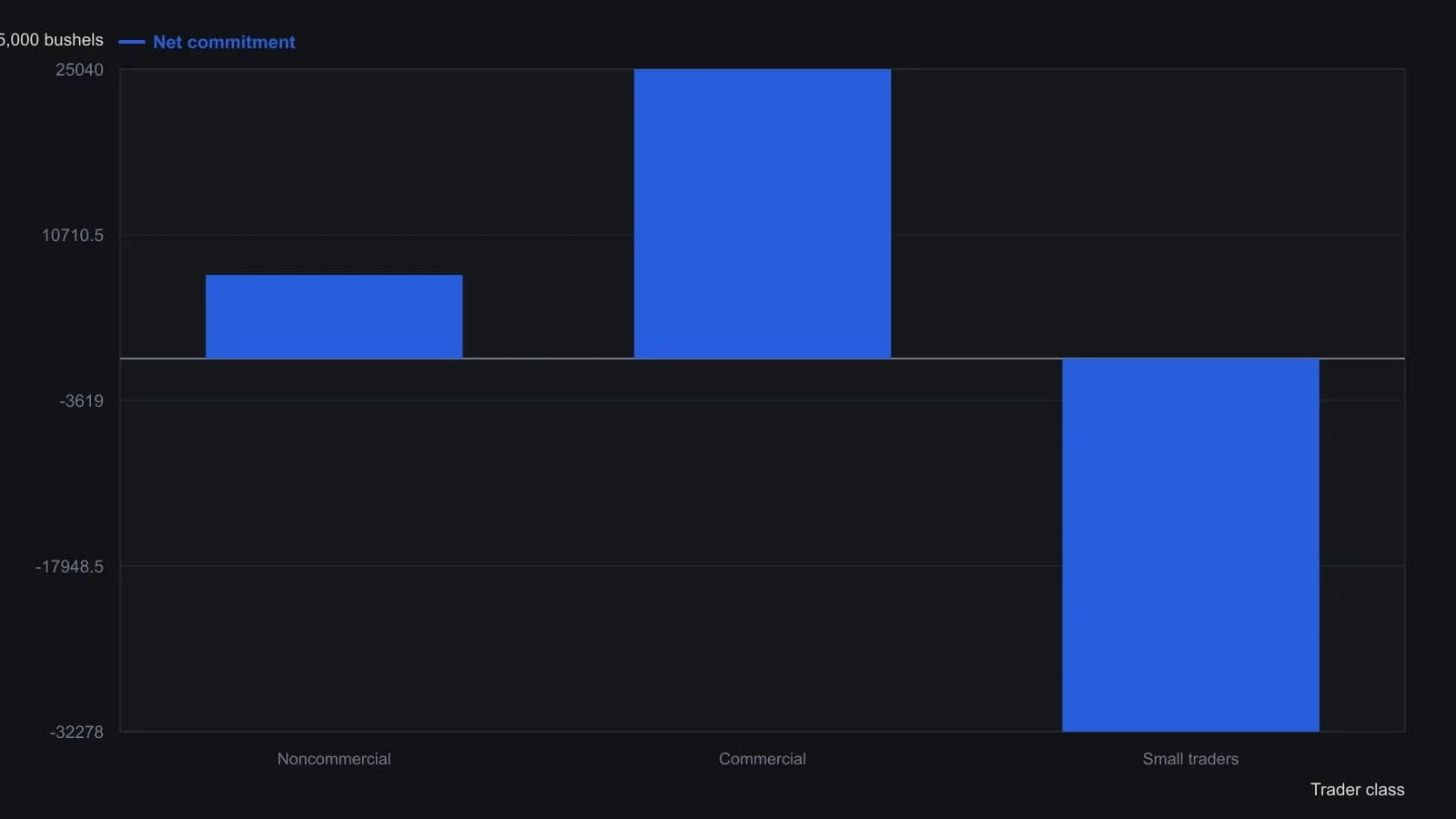
Noncommercial spreading of 39,166 contracts is omitted from the nets; a spread is one long and one short and does not change the difference. Open interest on the report was 407,446 contracts of 5,000 bushels.
What a group net describes
Group nets describe commitment without a price-based valuation of the contract. Commercials are often short because they are hedging, while small accounts are often long because they stay optimistic.
All readings on this track · 20 readings
- 1990Constructing a COT index from the commercial-speculative spread
- 1990Crowded price rules need abstention and a regime overlay
- 1991Advisor consensus fails as weekly contrarian timing
- 1996When speculative flows decouple bonds from stocks
- 1996Score each trader class against itself, then slice by month
- 1996Pork belly Commitment of Traders signals depend on the seasonal window
- 2002Constructing regime context from trader commitment nets
- 2002Trader net positions as regime context for chart setups
- 2003Three states for a daily futures advisor consensus
- 2005Commitment of Traders open-interest extremes as regime filters
- 2005Commitment of Traders participant imbalance as regime context for commodity position trades
- 2006Housing slowdown as a cross-market regime lesson
- 2007Evaluate an index stance as a spread between trader books
- 2011Constructing weekly participant positioning ledgers
- 2012Commitment of Traders as crowded-book context, not a copy signal
- 2014When Commitment of Traders smart money fails as an intermarket regime filter
- 2014Constructing Commitment of Traders regime context when commercial hedgers fail
- 2015Leave a yen bottom unconfirmed until gold and positioning agree
- 2016Stacking volume, open interest, and trader books around expiration
- 2025Post-crash cash and regime-aware watchlists