1996issue C091-6
Score each trader class against itself, then slice by month
A Commitment of Traders index rescales each class against its own recent range. Seasonal analysis then reads that score by calendar month on July corn, and a Chi-square test marks which holding periods after a report cleared a set bar.
- A 12-report Commitment of Traders index rescales each class net position between its recent minimum and maximum without smoothing, so the reading is aggression versus that class's own history.
- In the January-through-June window for July corn, April and June are the months where group-level Commitment of Traders results are most uneven, so the same class can look useful in one month and ordinary in another.
- Price change was measured from the open after a report to later settlements, and a Chi-square test treated a holding period as significant at a value of at least 3.86.
- No CFTC class is uniformly right or wrong across months. A mediocre positioning reading becomes more useful only when it is interpreted inside a seasonal market state.
A history score, then a calendar month
The historical workflow on July corn starts with Commitment of Traders classes, not with a year-round verdict on which group is smart. Open interest can be split into commercial, noncommercial, and small-trader long and short classes, with commercials defined as hedgers and noncommercials defined as accounts at or above a reporting threshold.
A 12-report lookback Commitment of Traders index rescales each class net position between its recent minimum and maximum without smoothing, so a reading shows how aggressively that class is positioned versus its own history.
How holding periods were tested
Price change is measured from the open on the first session after a report release to settlements 5, 10, 15, 20, 25, and 30 days later. A holding period is treated as significant when its Chi-square test value is at least 3.86.
In the January-through-June window for July corn, April and June stand out as the months where group-level Commitment of Traders performance is most uneven, so the same class can look useful in one month and ordinary in another.
COT index by trader class, corn 1994–1996
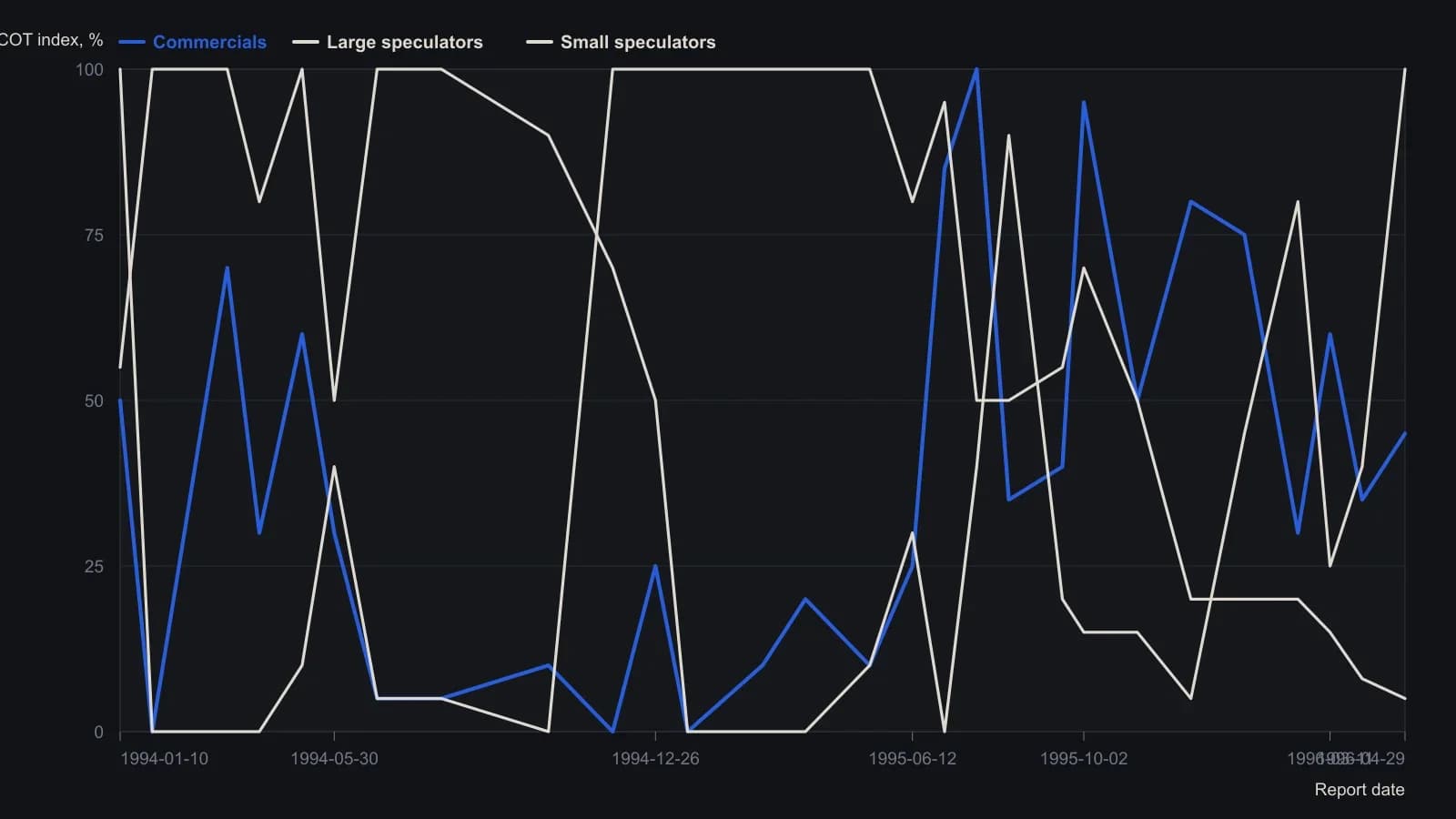
Twelve-report lookback on net position (longs minus shorts), unsmoothed, matching the source formula. Y-values are approximate readings from the published raster, not a numeric table.
What April and June showed
In the historical workflow, an April fade of commercials on July corn bought when the commercial Commitment of Traders index was at or below 40 percent and sold when it was at or above 60 percent. That rule produced more right than wrong outcomes at every tested horizon, with several Chi-square test values at or above 3.86.
Following small speculators on July corn with a 75 percent buy and 25 percent sell threshold showed a 10-day Chi-square test of 5.33, while other nearby horizons in that same follow rule did not all clear the 3.86 bar.
A June fade of small speculators, buying when their Commitment of Traders index is at or below 30 percent and selling when it is at or above 50 percent, produced a 15-day Chi-square test of 5.25 and a 25-day Chi-square test of 4.36.
The stated lesson
The historical workflow's stated lesson is that no CFTC class is uniformly right or wrong across months, and a mediocre positioning reading becomes more useful only when it is interpreted inside a seasonal market state.
All readings on this track · 20 readings
- 1990Constructing a COT index from the commercial-speculative spread
- 1990Crowded price rules need abstention and a regime overlay
- 1991Advisor consensus fails as weekly contrarian timing
- 1996When speculative flows decouple bonds from stocks
- 1996Score each trader class against itself, then slice by month
- 1996Pork belly Commitment of Traders signals depend on the seasonal window
- 2002Constructing regime context from trader commitment nets
- 2002Trader net positions as regime context for chart setups
- 2003Three states for a daily futures advisor consensus
- 2005Commitment of Traders open-interest extremes as regime filters
- 2005Commitment of Traders participant imbalance as regime context for commodity position trades
- 2006Housing slowdown as a cross-market regime lesson
- 2007Evaluate an index stance as a spread between trader books
- 2011Constructing weekly participant positioning ledgers
- 2012Commitment of Traders as crowded-book context, not a copy signal
- 2014When Commitment of Traders smart money fails as an intermarket regime filter
- 2014Constructing Commitment of Traders regime context when commercial hedgers fail
- 2015Leave a yen bottom unconfirmed until gold and positioning agree
- 2016Stacking volume, open interest, and trader books around expiration
- 2025Post-crash cash and regime-aware watchlists