2003issue C111-3
Three states for a daily futures advisor consensus
TradersWeek editorial framing: treat one daily advisor-consensus-scale as a three-state playbook. Stay aligned while the reading still trends with price, open a contrary-after-long-horizon-extreme watch only after a long-horizon stretch, and use range-abstention when the tape is a range and both informed and uninformed accounts look equally lost.
- A rising advisor-consensus-scale in a market where a participant is already long is framed as a check that the position is aligned with the prevailing move.
- A sentiment-extreme under 20 or over 80 is a guidepost, not an automatic action level, and contrary-after-long-horizon-extreme waits for a 24-month high or low before a contrary stance is treated as timely to evaluate.
- Range-abstention applies when price is consolidating and informed and uninformed accounts look equally undecided.
- When a dedicated futures sentiment series is uncommon, a commitment-of-traders-breakdown is often parsed as an indirect ranking of which markets look more bullish.
What the daily print records
A futures-specific consensus procedure compiles buy and sell recommendations from leading analysts and commodity trading advisors across about 36 markets covering grains, meats, softs, energies, currencies, indexes, and interest rates.
The same process also records those advisors' actual positions as an advisor-position-profile, a daily map of professional buying and selling.
The advisor-consensus-scale is a daily 1-to-100 reading of how bullish the monitored group is on a given market. A reading of 1 marks extreme bearishness and a reading of 100 marks extreme bullishness.
When the print is treated as informative
Market-sentiment study is presented as most informative when a market is near an apparent high or low that looks out of step with fundamentals, or when it shows a divergence on a key indicator.
It is not presented as most informative during trendless ranges, when informed and uninformed accounts can be equally undecided. During consolidations, informed accounts may use lower volatility to accumulate or distribute. A market that is not trending is treated as a period to wait rather than to force a sentiment trade inside the range. That waiting stance is range-abstention.
Stay aligned until a long-horizon extreme
Because many commodity trading advisors follow trends, a rising share of bullish advisor readings in a market where a participant is already long is framed as a check that the position is aligned with the prevailing move. The suggested use is to let the consensus trend with the market while that alignment holds.
The same scale can be read in a contrary way by locating unusually stretched markets and then monitoring price charts or fundamental reports for a break from that overbought or oversold condition. Readings under 20 and over 80 are generally treated as oversold and overbought guideposts rather than automatic action levels. The trend in the rating is described as sometimes as important as the level itself.
Contrary-after-long-horizon-extreme waits until a consensus series makes a long-horizon extreme, such as a 24-month high or low in a commodity's reading. After that point a contrary opinion is described as more likely, and a close or reverse is framed as more timely to consider.
A dollar and pork-belly window
On 29 April 2003 the US dollar consensus stood at 23 against a 51.3 average across 31 futures markets, then fell to 14 by 27 May, the most bearish rated contract. Continuous dollar futures moved from 98.62 to 93.23, and an intraday low of 92.37 printed on 16 June after about two further weeks.
Over the same window pork-belly consensus rose from 75 on 29 April, when continuous futures closed at 76.475, to 85 on 27 May, when they closed at 84.850 and held the highest rating among the rated commodities. The contract then peaked about five days later at 88.525.
TradersWeek editorial note: in that window the dollar became a bearish sentiment-extreme while price continued lower, and the pork-belly contract held the most bullish rating while price continued higher before a nearby peak. That pairing is a stay-aligned illustration, not a rule to fade every stretched print.
An indirect ranking without a dedicated series
When dedicated futures sentiment series are uncommon, a commitment-of-traders-breakdown of commercial traders, large speculators, and other groups is often parsed as an indirect ranking of which markets look more bullish.
Pork-belly daily closes through the spring 2003 rally
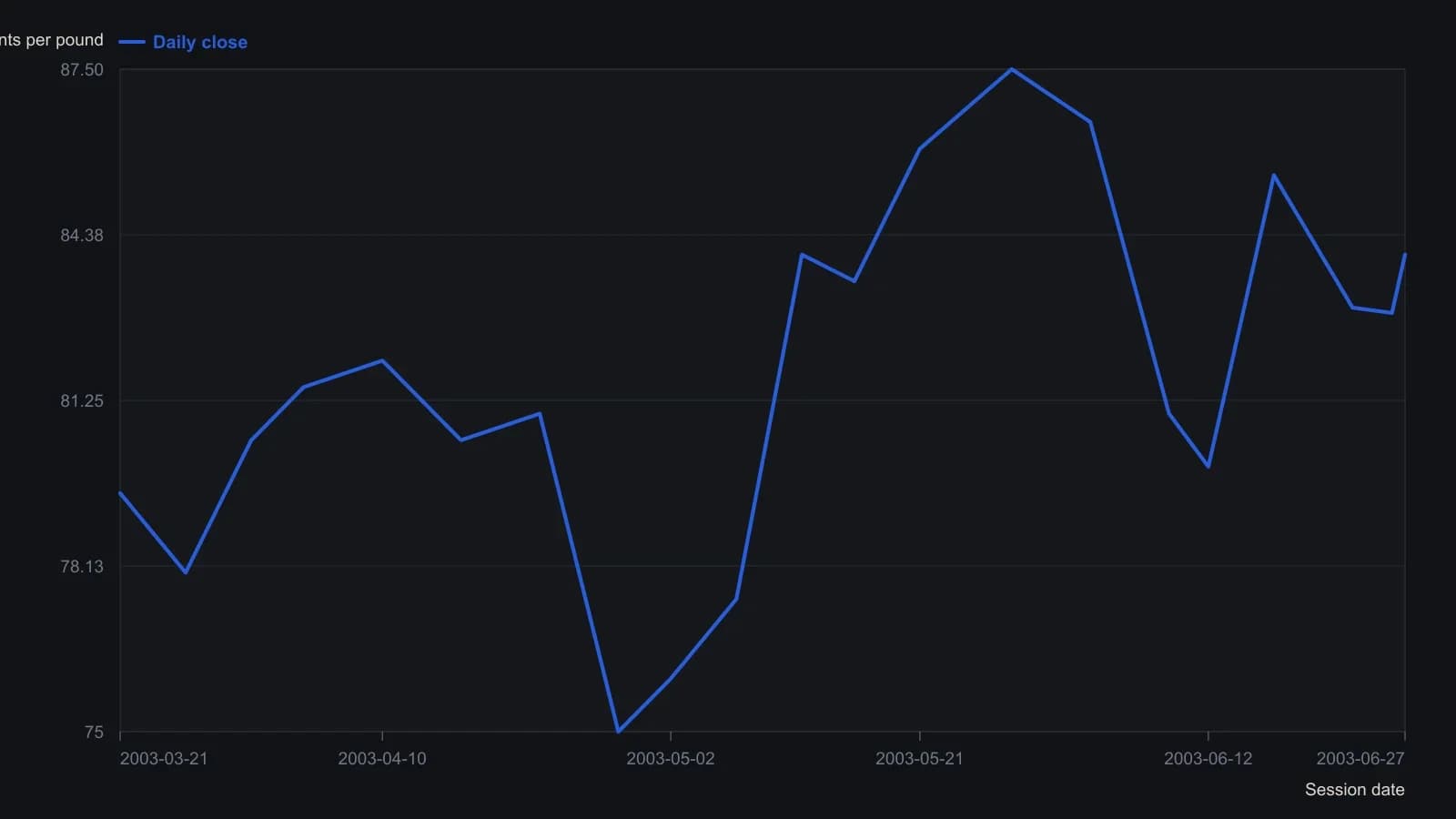
All but the two header prints are approximate visual readings of daily closes on a coarse grid. Session dates follow the April–June axis in the November 2003 issue and are week-scale, not exchange settlement dates. The lower oscillator pane is not the Bullish Consensus 0–100 scale and is omitted.
All readings on this track · 20 readings
- 1990Constructing a COT index from the commercial-speculative spread
- 1990Crowded price rules need abstention and a regime overlay
- 1991Advisor consensus fails as weekly contrarian timing
- 1996When speculative flows decouple bonds from stocks
- 1996Score each trader class against itself, then slice by month
- 1996Pork belly Commitment of Traders signals depend on the seasonal window
- 2002Constructing regime context from trader commitment nets
- 2002Trader net positions as regime context for chart setups
- 2003Three states for a daily futures advisor consensus
- 2005Commitment of Traders open-interest extremes as regime filters
- 2005Commitment of Traders participant imbalance as regime context for commodity position trades
- 2006Housing slowdown as a cross-market regime lesson
- 2007Evaluate an index stance as a spread between trader books
- 2011Constructing weekly participant positioning ledgers
- 2012Commitment of Traders as crowded-book context, not a copy signal
- 2014When Commitment of Traders smart money fails as an intermarket regime filter
- 2014Constructing Commitment of Traders regime context when commercial hedgers fail
- 2015Leave a yen bottom unconfirmed until gold and positioning agree
- 2016Stacking volume, open interest, and trader books around expiration
- 2025Post-crash cash and regime-aware watchlists