2020issue C1240-46
Stacking wave counts, retracements, and median lines
This archive article shows how a wave count, a Fibonacci grid, and a median-line pitchfork were stacked on a swing after simpler candle and pattern work. An editorial reading treats the setup as live only where those three descriptions overlap.
- A wave label names the chapter of a swing, a Fibonacci grid measures how far that chapter can run, and a median-line pitchfork frames the path.
- Fibonacci targets and retracements, with counts of impulse and correction waves, are the principal advanced techniques in the archive stack, layered on after candle reading and basic price-pattern work.
- Combination accepts a trade idea only when more than one of the wave, ratio, and median-line maps agrees.
- The editorial reading treats a setup as live only where all three descriptions overlap, and treats the next extreme that breaks any one of them as a rewrite of the whole map.
A stacked reading of one swing
The editorial aim of this article is to teach one live map of a swing. A wave label names the chapter, a Fibonacci grid measures how far that chapter can run, and a median-line pitchfork frames the path.
The archive itself is a historical workflow. Wave-and-ratio techniques are layered onto candle reading and basic price-pattern work after that simpler layer is already in use.
What each layer is for
An Elliott wave count is a labeled sequence of impulsive and corrective swings used to hypothesize which part of a larger price move is underway and where a reversal may form. An impulse-wave is a directional swing that advances the larger trend inside that count. A correction-wave is a counter-trend swing that interrupts an impulse sequence and is counted as a pause rather than a new trend. In the archive workflow, those impulse-wave and correction-wave counts are used to look for reversal conditions.
A Fibonacci retracement is a set of ratios drawn across a completed swing to mark where a pullback may stall or a later price target may sit. The archive uses those retracements on the chart to project price targets and to anticipate later swings.
A median line is a three-point pitchfork whose center line and parallels frame the expected path of a trend and the zones where price may stall or reverse. A pitchfork is grouped with rectangles and price retracements as a basic geometric method for projecting targets.
Order of work in the archive
Fibonacci targets and retracements, together with counts of impulse and correction waves, are named as the principal advanced techniques in the stack. They are not the first pass. The wave-and-ratio layer is added only after candle reading and basic price-pattern work are already in use.
An earlier advanced chapter reused the same timespan as the basic-analysis chapter so the two layers could be compared on identical bars. The closing installment then applies Fibonacci retracements and Elliott wave counts to a later market window than the earlier examples, rather than to a single selected stretch of price history. Because that later window is shown, the stack is presented as a map that can be drawn again, not as a reading locked to one chosen stretch.
Three-month industry leaders on the Barchart heat map
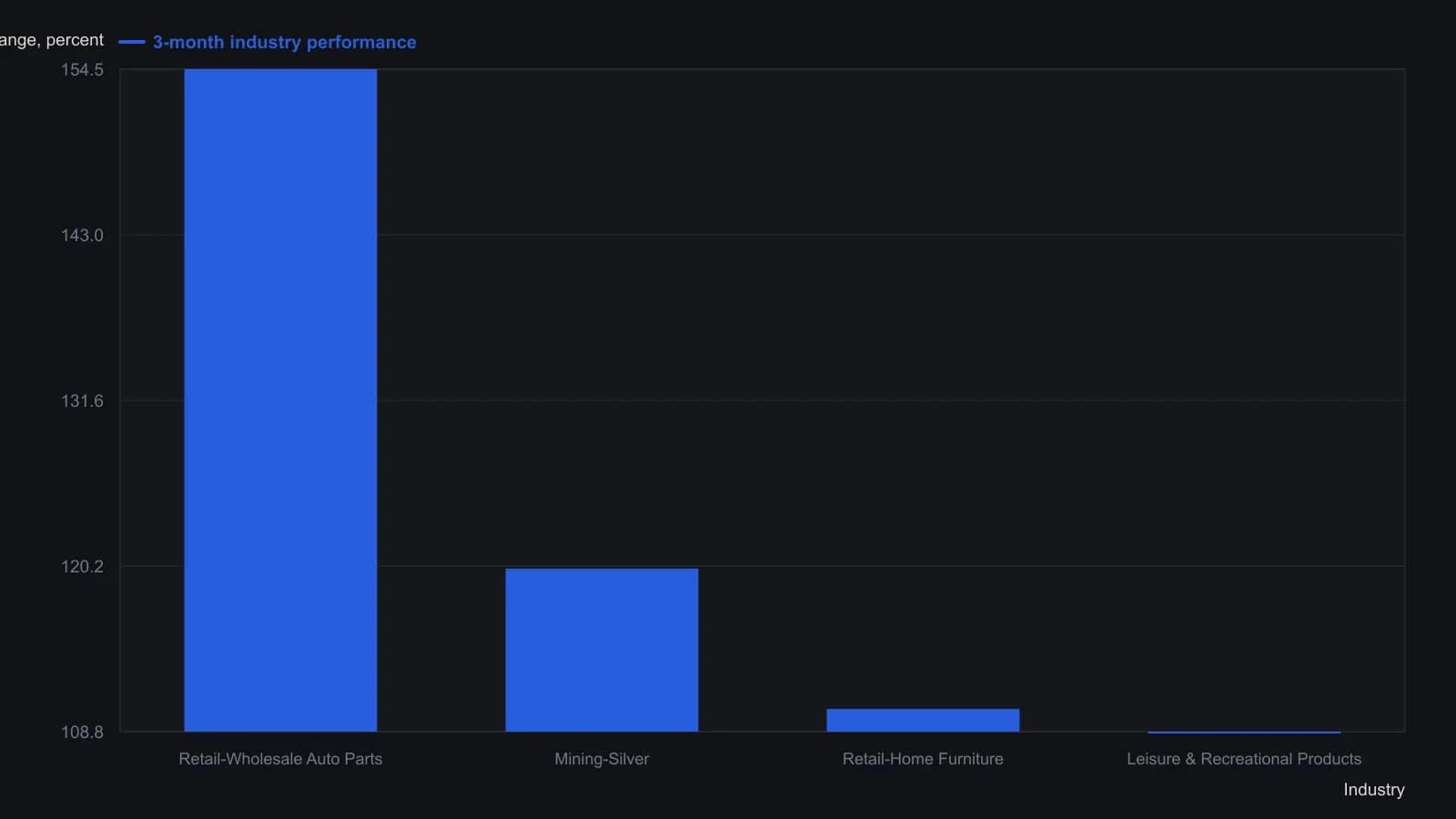
The source heat map ranks a large industry universe and only the top of the page is shown. This series keeps the four leading cells whose names and percentages can be read with certainty.
When a trade idea is accepted
Combination, as used here, means using wave structure, Fibonacci ratios, and a median-line channel together so a trade idea is accepted only when more than one of those maps agrees. Agreement is the filter. A lone wave label, a lone retracement, or a lone pitchfork is not enough.
All readings on this track · 19 readings
- 1985Constructing median lines from graded pivots
- 1986Constructing median and action-reaction lines from pivots
- 1989Median line construction from three market turns
- 1990A failed median-line test marks the start of wave three
- 1995Constructing three-pivot median-line channels
- 1996Median-line pitchfork construction for trend and reversal tests
- 2000Nested median-line channels as falsifiable swing tests
- 2002Median-line versus speed-resistance on one trend
- 2003Independent witnesses: a median-line miss, a breadth average, and volume bands
- 2012Constructing oblique trendlines and median-line channels
- 2013Gold futures wave four, competing complexes, and written ratio tests
- 2013The weekly 1-2-3 map as a permission layer
- 2014Measured-move and daily pivot price-projection construction
- 2014Constructing median-line channels from a pivot
- 2016Median-line far parallel as a precommitted exit
- 2017How high is high: Elliott wave landmarks
- 2017A three-layer veto for a suspected third-wave high
- 2020Basic chart rules for Nasdaq trend reversals
- 2020Stacking wave counts, retracements, and median lines