2004issue C011-5
Construct TRIX entry, exit, and rest windows as one recipe
A long-only TRIX construction names four oscillator states, then enters on a golden cross, exits on a fall, and stays flat in a rest window until the next golden cross. The same mapping is applied, unchanged, on monthly, weekly, and daily Nasdaq Composite charts.
- TRIX is a triple-smoothed rate line: successive exponential averages of the close, then the latest change in the third average divided by its prior value.
- The long-only recipe enters on a golden cross, exits on a fall, and stays in a rest window from that fall until the next golden cross.
- A 5-period inner stack and a 3-period signal line define the worked construction, and the same states are reused on monthly, weekly, and daily Nasdaq Composite charts.
- A 20-period simple or exponential moving average is only optional confirmation, and the construction is not applied on minute bars because TRIX signals arrive with lag.
Build the triple-smoothed rate line
TRIX is a triple-smoothed rate line. It is built by taking an n-period exponential average of the close, two further exponential averages of that series, then dividing the latest change in the third average by its prior value.
The worked construction uses a 5-period inner stack and a 3-period exponential average of TRIX as a signal line. That signal line is meant to reduce false crossings.
Name four discrete states
Four discrete states are defined before any order is placed. A golden cross is TRIX crossing upward through its signal line. A dead cross is TRIX crossing downward through its signal line. A bounce is TRIX turning from down to up without requiring a signal-line cross. A fall is TRIX turning from up to down without requiring a signal-line cross.
Enter, exit, then stay in a rest window
The long-only rule-based-entry procedure enters on a golden cross, exits on a fall, and stays in a rest window from that fall until the next golden cross. During the rest window no new long is opened.
The full cycle is one recipe: named TRIX states supply the rule inputs, and entry, exit, and the flat interval are tested together rather than as separate discretionary choices.
Apply the same mapping on three charts
The same TRIX(5,3) enter-exit-rest mapping is applied, without changing the states, to monthly, weekly, and daily Nasdaq Composite charts.
Monthly tests approximate the index as the average of that month’s open and close, omit fees and taxes, and allow the entry or exit print to fall anywhere inside the month.
Monthly Nasdaq TRIX longs and their approximate gains, 1995–2003
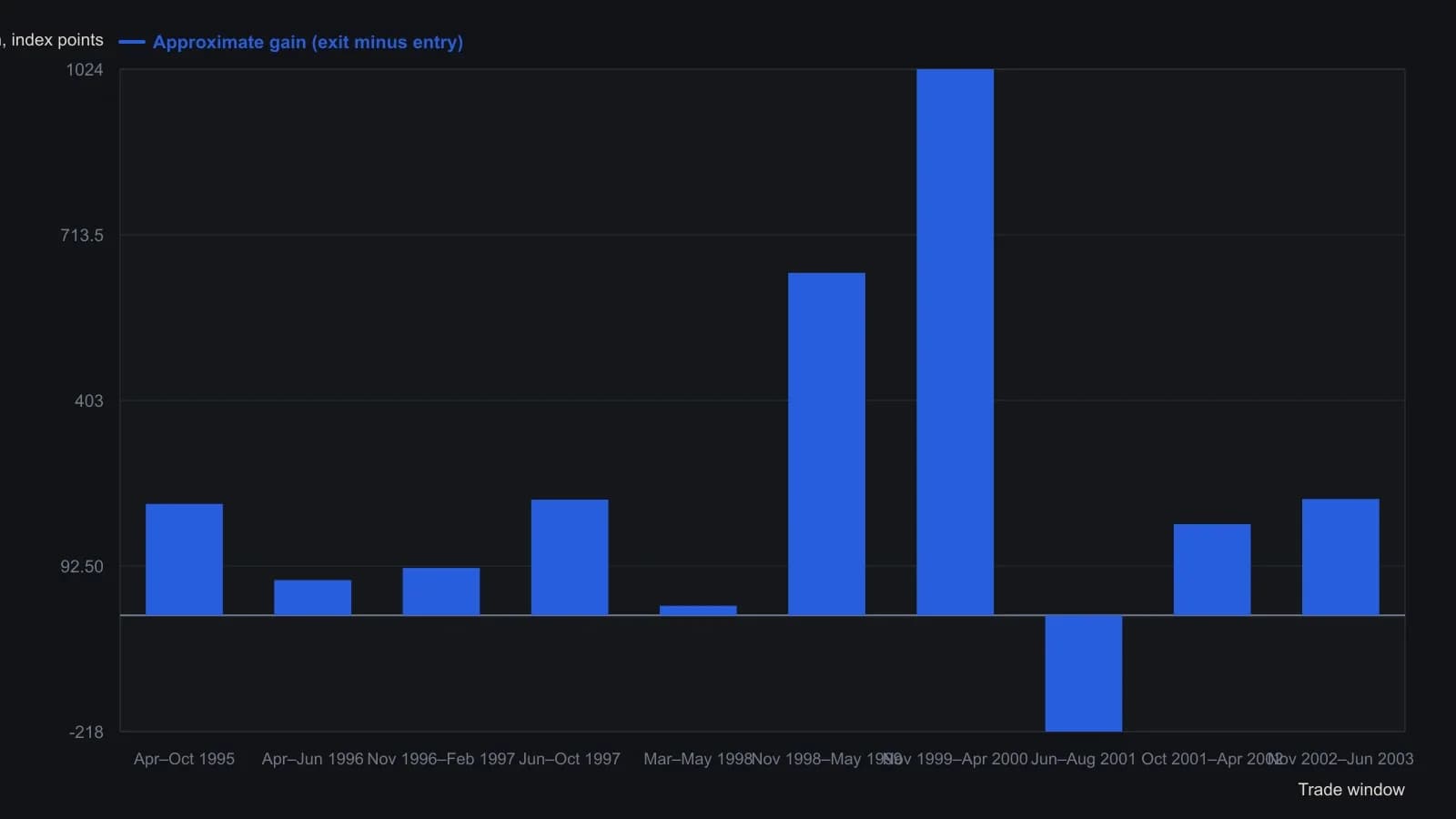
Long-only TRIX(5,3): enter on a golden cross, exit on a fall, rest until the next golden cross. Gains exclude fees and taxes. Entry and exit can fall anywhere between that month’s open and close.
Add a moving average only as confirmation
A 20-period simple or exponential moving average sloping up is treated as optional confirmation to stay long. Both averages sloping down are treated as extra reason to exit. The moving average sits around the named TRIX states. It does not replace them.
Keep the later variant and the lag limit separate
A later, discretionary variant may enter on a bounce instead of a golden cross and may delay the exit from a fall to a dead cross. That variant is not the core enter-exit-rest recipe.
The construction is not applied on minute bars because TRIX signals arrive with lag. Shorter-horizon use is limited to a higher-timeframe filter for when a session may be traded.
All readings on this track · 15 readings
- 1984Constructing TRIX from a cutoff to one shared alpha
- 1988Isolate nested formulas before judging signals
- 1992Constructing TRIX from triple exponential smoothing
- 1992Constructing a TRIX oscillator from daily declines
- 1992A pre-trade checklist that stays flat until weekly support and TRIX agree
- 1992Constructing TRIX as triple-smoothed log-price momentum
- 1992Building TRIX crossover and momentum entries on a period grid
- 1992TRIX lookback and momentum derivative parameters
- 1994Seeding TEMA and DEMA with time-trend regression
- 1997Constructing the TRIX oscillator from triple smoothing
- 2002Constructing TRIX from triple-smoothing to signal rules
- 2002Lock the TRIX construction before reading a zero-line cross
- 2003Constructing TRIX from nested exponential averages
- 2004Construct TRIX entry, exit, and rest windows as one recipe
- 2004TRIX momentum and fundamental overlays for medium-term stock selection