1992issue C061-8
A pre-trade checklist that stays flat until weekly support and TRIX agree
This archive article teaches a single checklist-process whose default outcome is to stand aside. A trade becomes legal only when price is at a previously mapped weekly support or resistance, TRIX has made a momentum-turn with that structure, and daily price action agrees, with the exit written in advance at the weekly invalidation-price.
- The weekly-first-filter ignores daily signals until price reaches a support-resistance neighborhood already mapped on the weekly chart.
- A TRIX momentum-turn is required before a test of weekly support or resistance can become a trade.
- Daily agreement and a written invalidation-price complete the sequence. A sideways on-balance-volume line remains a caution even when price looks constructive.
- The abstention-rule is a required checklist outcome whenever the weekly level has not been reached or when momentum and daily structure disagree.
Entry, exit, and standing aside are one procedure
The checklist-process is a fixed sequence that treats entry, exit, and standing aside as one testable procedure rather than separate discretionary acts. Editorial note: the working default is the abstention-rule. No position is opened until every gate in the sequence has opened.
Weekly charts are inspected first to locate price levels given importance by prior major reversals or major trendlines, and trades are withheld until the market reaches those levels. That weekly-first-filter means daily signals are ignored until weekly structure has identified a significant support-resistance neighborhood.
Weekly support and resistance define the hypothesis
Support-resistance, in this workflow, means historically tested price levels and trendlines that define where a market hypothesis may start and where it is declared false. An upward weekly channel of higher highs and higher lows defined the illustrated bond market as an uptrend. A break of the long-term support line would reverse that classification to downtrend.
A historically significant resistance near 105-00, previously reached in April 1986, was treated as a level where selling overwhelmed buyers and price then declined to the lower boundary of the rising channel. Editorial note: the lower channel boundary is the neighborhood in which a long hypothesis can be considered at all. Until price is there, the checklist stays on the abstention-rule.
Weekly bond futures channel and support tests
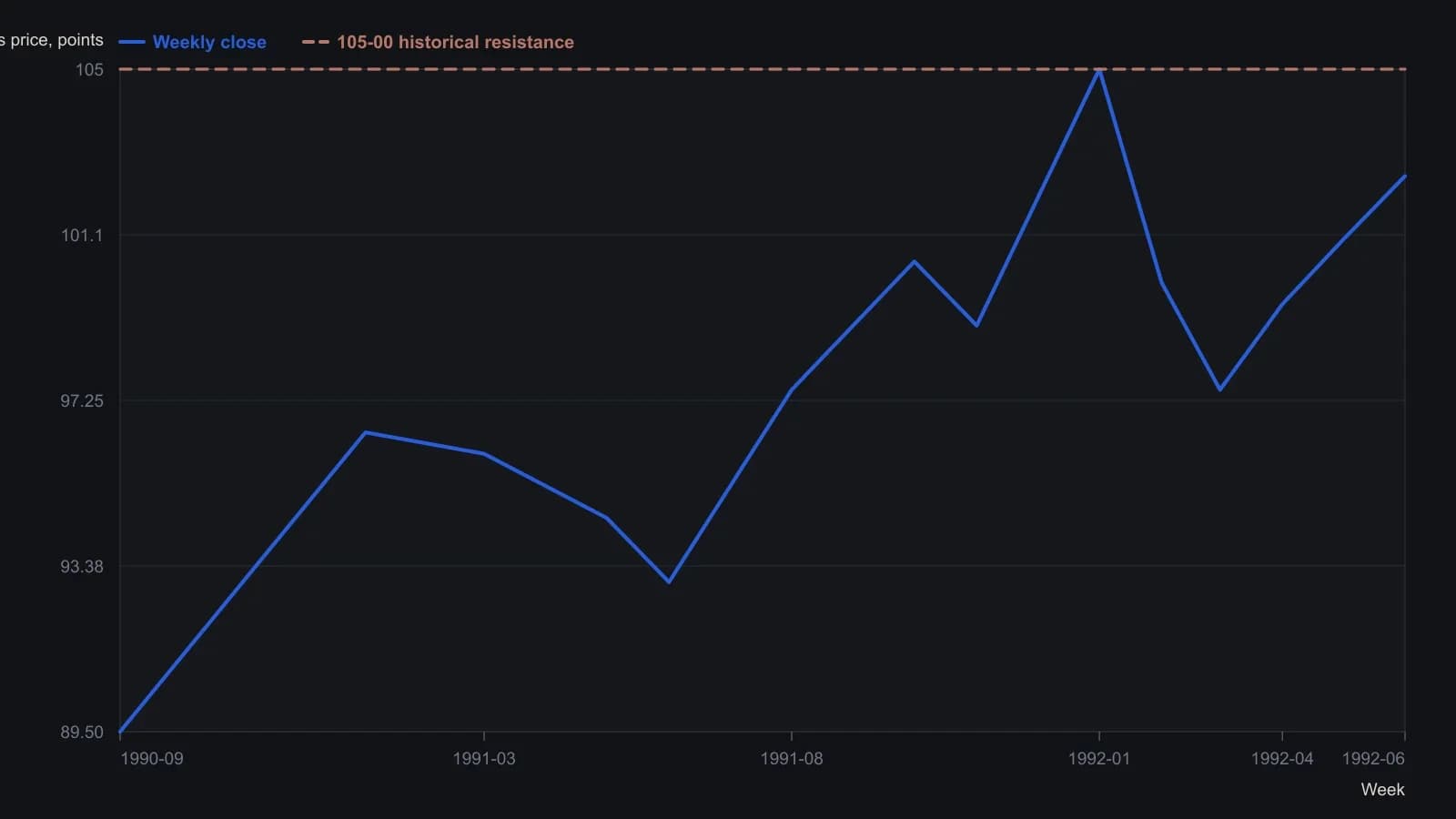
Approximate weekly closes read from the printed bar chart; bond quotes are in points (105-00 style).
TRIX classifies momentum, not direction
TRIX is a momentum measure formed from the one-day change in a triple exponential smooth of log price, used to classify whether momentum is rising or falling over a chosen lookback. The archive definition is the same construction: the one-day difference of the triple exponential smooth of the logarithm of price. An increasing value is classified as rising momentum and a decreasing value as falling momentum.
The illustrated TRIX used a smoothing constant equivalent to a 21-day average, computed as 2 divided by one plus that length. Cycles shorter than the chosen length are filtered, and the length can be changed to match the intended horizon. The momentum-turn is a change from falling to rising, or rising to falling, required before a support or resistance test can become a trade.
A 14-bar slow weekly stochastic was used only to confirm that a turn had already occurred on the bar chart, not to forecast direction. A late-March %K crossing %D was read as agreeing with the weekly rebound.
Daily action must ratify the weekly test
Daily confirmation required price to clear a descending trendline along the January-to-early-March highs and to show demand again near 97-16, the same area that had held in mid-February. Editorial note: the daily chart does not originate the trade. It can only agree with a weekly support-resistance test that already has a TRIX momentum-turn.
A sideways on-balance-volume line versus its 20-day average during the rally was treated as a caution that upside volume was not expanding, even while price structure looked constructive.
Write the invalidation-price before a position is allowed
Four technical changes clustered within about one week: an advance from major weekly support, a weekly stochastic buy signal, a TRIX momentum upturn, and daily breaks of descending trendlines. Editorial note: isolated pieces do not open a position. The checklist becomes complete only when the weekly advance, the momentum-turn, and daily agreement are present together.
A stop is placed at the price that would show the weekly analysis is wrong, illustrated as a violation of the major upward trendline. That invalidation-price is the chart level that, if broken, cancels the working hypothesis and triggers the planned exit. Editorial note: the exit belongs on the weekly line that would falsify the map, and it is written before the trade is treated as legal.
All readings on this track · 15 readings
- 1984Constructing TRIX from a cutoff to one shared alpha
- 1988Isolate nested formulas before judging signals
- 1992Constructing TRIX from triple exponential smoothing
- 1992Constructing a TRIX oscillator from daily declines
- 1992A pre-trade checklist that stays flat until weekly support and TRIX agree
- 1992Constructing TRIX as triple-smoothed log-price momentum
- 1992Building TRIX crossover and momentum entries on a period grid
- 1992TRIX lookback and momentum derivative parameters
- 1994Seeding TEMA and DEMA with time-trend regression
- 1997Constructing the TRIX oscillator from triple smoothing
- 2002Constructing TRIX from triple-smoothing to signal rules
- 2002Lock the TRIX construction before reading a zero-line cross
- 2003Constructing TRIX from nested exponential averages
- 2004Construct TRIX entry, exit, and rest windows as one recipe
- 2004TRIX momentum and fundamental overlays for medium-term stock selection