2012issue C0462-65
A seasonal window still needs regime and chart confirmation
A seasonal workbook can place a dated long or short seasonal-tendency among related markets and a multi-year seasonal-average-path. Editorial reading: treat that window as a regime hypothesis and keep it only when a confirmation-stack agrees; otherwise apply an abstention-rule.
- A seasonal workbook can open each month by grouping markets into seven major categories and noting which long or short seasonal-tendency falls near the beginning, middle, or end of that month.
- Each commodity idea is shown next to related stocks, indexes, currencies, or funds, so one dated seasonal-tendency can be read through a regime-filter before any entry rule is armed.
- Featured plays specify a trading-day-of-month entry, a holding-window, and a record of prior-year outcomes, so entry, hold, and exit stay one documented procedure.
- Editorial view: keep the dated window only when the confirmation-stack of calendar tendency, related-market context, and seasonal-average-path agrees; otherwise the abstention-rule is to ignore the date.
How the workbook opens a month
A seasonal workbook can open each month by grouping markets into seven major categories and noting which long or short tendencies fall near the beginning, middle, or end of that month.
A compact strategy calendar lists long and short seasonal tendencies across a fixed roster of nineteen commodity markets so one idea can be compared with other markets on the same dates.
Each commodity seasonal idea is presented next to related stocks, indexes, currencies, or funds so one dated tendency can be read as part of a broader market context. Editorial note: that cross-market calendar is the regime-filter used to locate one seasonal idea among several asset groups before any entry rule is armed.
Entry, hold, and exit as one procedure
Featured seasonal plays are specified as a trading-day-of-month entry, a stated holding length, and a record of prior-year outcomes, making entry, hold, and exit one documented procedure.
Some seasonal windows last less than a month while others span two, three, or more months, which matches a weeks-to-months holding-window rather than a single-session signal.
The text states that seasonal trading is not completed by entering on one calendar date and exiting on another, because other variables can change the result or even the expected direction.
Average seasonal paths and later management
For each market, a narrative of production, use, and typical annual peaks and lows is paired with a chart of five-year and twenty-five-year average seasonal paths from January through December. Editorial note: those multi-year averages are the seasonal-average-path against which a live chart can be compared.
A historical databank of annual highs, lows, and closes, plus monthly closes and monthly percent changes over multiple decades, is offered so current prices can be compared with past calendar milestones.
Alongside the calendar, the workbook describes case studies, option structures, spread constructions, and positioning reports as ways to manage a seasonal idea after the date window is identified.
Editorial reading: confirmation or abstention
Editorial interpretation, not an archive claim: a seasonal-tendency on the calendar is only a hypothesis about the prevailing regime. The workbook already refuses to treat a start date and an end date as a complete trade, because other variables can change the result or even the expected direction.
Editorial reading of the confirmation-stack: the calendar tendency, the related-market context, and a chart-level match to the seasonal-average-path must all agree before the setup is treated as one testable procedure.
Editorial abstention-rule: if related markets or the chart structure fail to confirm the dated window, the date is ignored. The archive still offers case studies, option structures, spread constructions, and positioning reports as ways to manage an idea after a window is identified, which keeps later management separate from the decision to arm the date.
Large-cap relative strength on the 9 February 2012 RMO swing-buy list
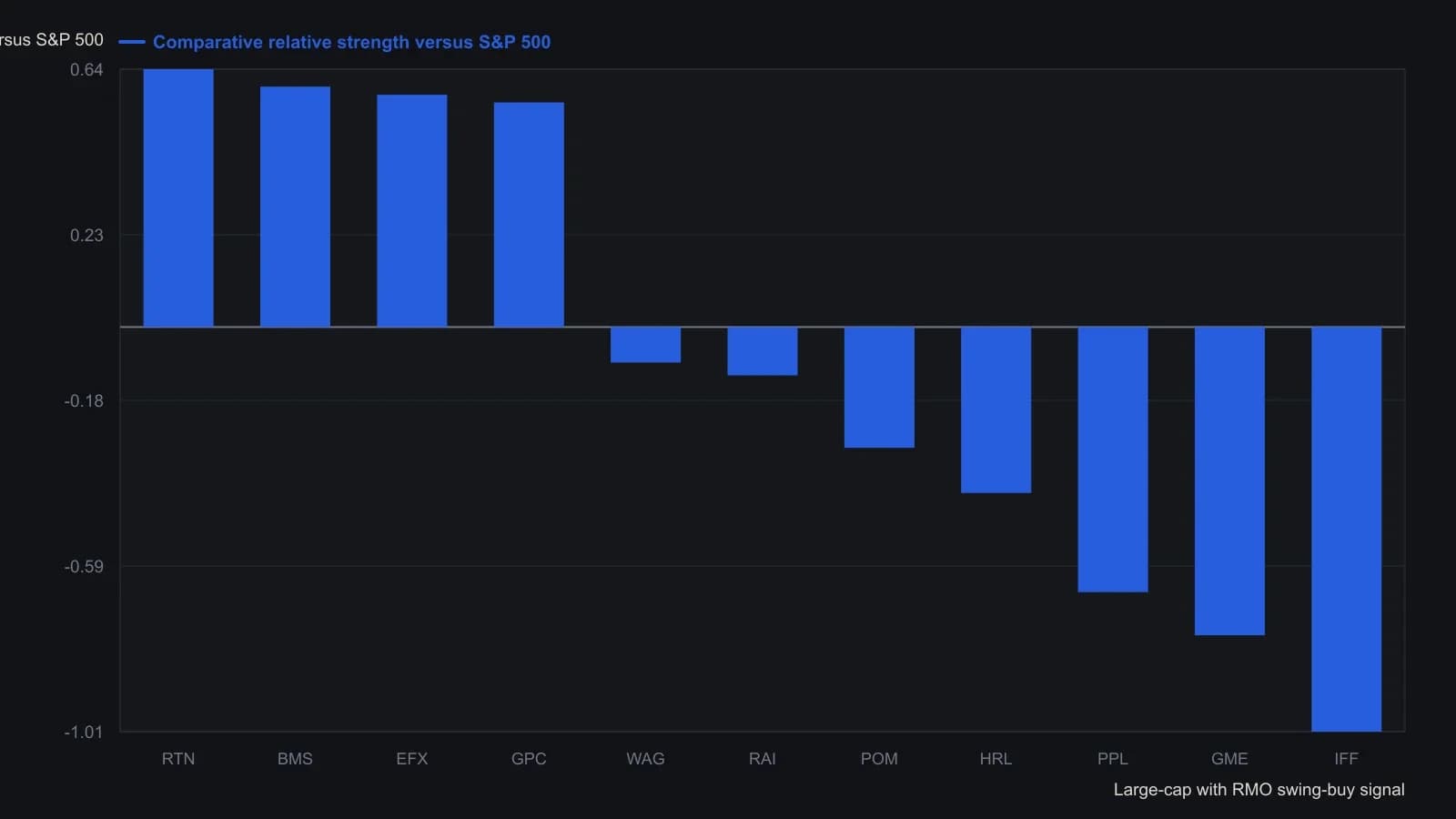
The source ranked only large-cap names that fired a long Rahul Mohindar swing-buy signal at that close; this is not a broad-market relative-strength universe.
All readings on this track · 16 readings
- 1989Weekday price paths are regime-dependent
- 1990The January barometer as a rest-of-year scoring problem
- 1990Calendar windows as testable index-futures procedures
- 1991Testing the July-August summer rally as an occurrence count
- 1996Nested calendar clocks in long-bond futures
- 2006Stacking one-session calendar filters on index regimes
- 2008The January effect as a short window versus the month
- 2012A seasonal window still needs regime and chart confirmation
- 2013Calendar seasonality as a regime filter, not a standalone signal
- 2016A monthly seasonal heatmap as a three-gate regime filter
- 2016Payroll windows and settlement regimes
- 2017Memorial Day seasonal windows across equity, rates, and euro
- 2018Month-turn window, posture, and an open menu
- 2019Monthly FX regimes as three-state stances
- 2019Seasonal windows inside renewable cost regimes
- 2020When a breakdown fails by one box, treat it as a regime filter