1989issue C101-4
Christmas tree construction as a five-week monthly procedure
A Christmas tree is a same-expiration package: buy an at-the-money vertical, sell a farther out-of-the-money option as an income overlay, and keep adjustment points plus a good-till-cancelled cover inside one monthly procedure.
- A Christmas tree buys a same-expiration vertical and sells a farther out-of-the-money option, with the net long strike placed at the money.
- The package is a predetermined monthly procedure about five weeks before expiration, not an ad hoc single-leg trade.
- The farther short is an income overlay that cuts net debit and can leave the book net short by both delta and contract count.
- Pre-set adjustment points and a good-till-cancelled buy-to-close keep a sudden move through the far short, or a leftover cheap short, from sitting unmanaged.
What a Christmas tree is
A Christmas tree is assembled by buying a same-expiration vertical spread and selling a farther out-of-the-money option, with the net long strike placed at the money. The farther short is the income overlay sold against that debit spread.
Spreads are typed by contract mix. A vertical spread differs only by strike. A horizontal spread differs only by expiration. A diagonal spread differs by both strike and expiration. The Christmas-tree package itself is a same-expiration construction.
The five-week window and the debit cap
The package is meant to be put on as a predetermined monthly procedure about five weeks before expiration, not as an ad hoc single-leg trade.
A stated construction limit is not to pay more than a two-and-one-half-point debit for the at-the-money vertical, with a preferred five-week debit near two points. That debit cap is the ceiling on what may be paid for the at-the-money vertical before the income overlay is added.
How the income overlay changes the book
Selling the farther out-of-the-money option against the debit spread reduces the net cash outlay. The income overlay can leave the combined book net short by both delta and contract count.
December OEX Christmas tree call premiums
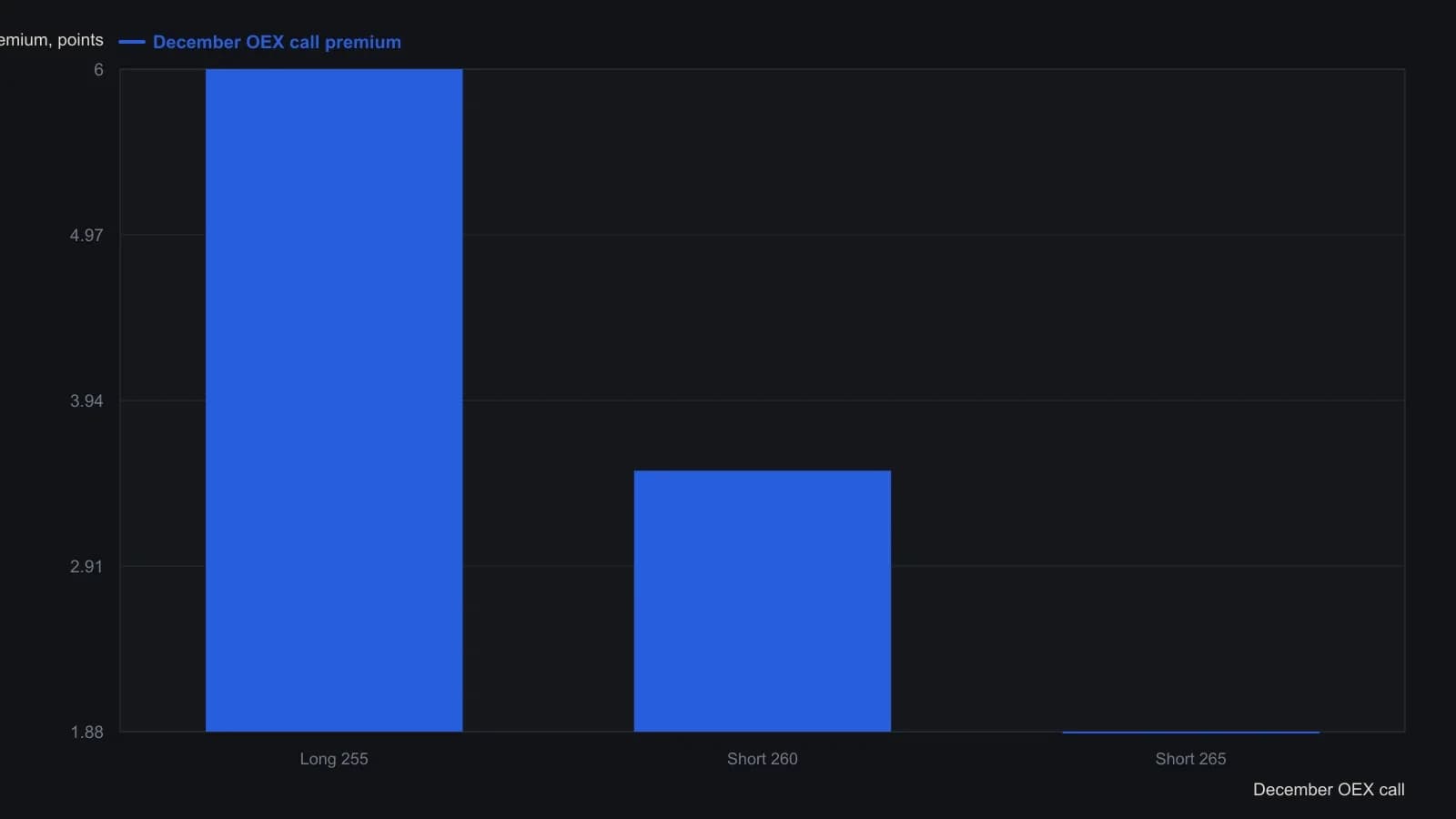
The attached illustration is a formation cartoon, not an expiration payout grid. Only the three December OEX quotes given in the prose are plotted.
Adjustment points and the put-tree counterpart
Without pre-set contingent adjustment levels, a sudden move through the far short can produce a loss larger than the remaining debit, while an unadjusted decline to expiration limits loss to that remaining debit. An adjustment point is a pre-chosen index level at which the package is changed so a net-short book is not left unmanaged.
A put tree is the counterpart construction when the expected range sits below the money, and a net-short put book is paired with contingent lower-index stops.
Collateral, legging, and the residual cover
After October 1987, uncovered index shorts were described as needing a minimum of ten percent of the index plus the full premium. Converting those shorts into a credit spread cut the stated collateral by about two-thirds. Editorial: that collateral cut is why the farther short is kept inside a spread rather than left uncovered.
Completing longs and shorts at different times, or legging, can leave an unhedged book at the close. A compromise is to enter half the intended size as one package and complete the rest later.
When remaining short premium falls to one-sixteenth or one-eighth, a good-till-cancelled buy-to-close is used so cheap shorts are not left to expire. The standing order remains live until filled or cancelled.
All readings on this track · 8 readings
- 1982Swing charts, stop-loss orders, and good-till-cancelled covers in a bond-market coil
- 1982Park good-till-cancelled targets after commissions at the chart bands
- 1987Write the danger-point stop before the trade is accepted
- 1989Christmas tree construction as a five-week monthly procedure
- 2006Constructing the single-price open from overnight flow
- 2008Overnight session routing for good-till-cancelled, limit, and market orders
- 2013Session cutoffs, good-till-cancelled orders, and exchange margin
- 2013Depth of market ladder versus resting order ticket