2013issue C1016-19
Rounded turns as slope-first trade hypotheses
Two prints can share one price and still disagree as a long: one is an unfinished decline, the other is a rounded bottom that has already turned up. A left-shifted moving average can outline that smile and the later frown only after the series is complete.
- Two points can share one price and still disagree as long entries: the print while the series is still falling is treated as premature, and the same print after a rounded bottom has turned up is treated as the better long location.
- The preferred long arrives after the rounded-bottom low rather than at the exact low, because the series is then rising even though the theoretically cheapest print has already passed.
- If the rounded-top peak is missed, selling while price is still rising is preferred to holding until the matching price reappears on the decline, because declines are described as typically unfolding faster than advances.
- A left-shifted moving average can outline those turns only on a completed series. In real time the line chart, or a hand-drawn link of peaks or valleys, has to carry the smile-versus-frown read.
Rounded bottoms and rounded tops
A rounded bottom is a U-shaped price turn, also called a smile, in which the series stops falling, forms a low, and then advances. A rounded top is an inverted-U price turn, also called a frown, in which the series stops rising, forms a high, and then declines.
The archive workflow judges those turns by direction after the extreme, not by matching a familiar price. Two chart locations can share one price and still sit on opposite sides of a turn. That same-price opposite-slope pairing means one print is still moving into the extreme while the other has already reversed.
Long after the low
On an idealized wave, two points can share one price yet disagree as long entries. The print while price is still falling is treated as premature. The same print after a rounded bottom has already turned up is treated as the better long location.
The preferred long is described as arriving after the rounded-bottom low rather than at the exact low, because the series is then rising even though the theoretically cheapest print has already passed.
An early exit at the rounded top
On the same idealized wave, the best illustrated exit is the rounded-top peak. If that peak is missed, selling while price is still rising is preferred to holding until the matching price reappears on the decline.
That early-versus-late exit is stated this way: declines are described as typically unfolding faster than advances, so waiting through the rollover shrinks an open gain more quickly than an early sale forgoes remaining upside.
The same locations across styles
The same rounded-bottom entry and rounded-top exit locations are presented as style-independent. They apply whether the holding period is multi-year, swing, or intraday.
Line charts and a left-shifted overlay
A candlestick or bar display is described as making rounded bottoms and rounded tops hard to see. A closing-price line chart makes the same turns easier to judge.
On a daily line chart, a 50-day simple moving average shifted left by 25 days is used as a historical overlay to outline those turns. A 100-bar average would be shifted by 50 bars. The moving average here is a simple average of closes used as a smoother, not as a live crossover trigger.
A left-shifted overlay plots that average earlier by half its lookback so historical rounded turns line up with price on a completed series. The left shift is only available on a completed series, so in real time the overlay is not visible on the trade day. The line chart, or a hand-drawn link of peaks or valleys, has to carry the smile-versus-frown read.
A daily cement-and-aggregates case
In the illustrated daily cement-and-aggregates case, the left-shifted average traced a rounded bottom in September 2006 and a rounded top that peaked in June. The marked long was opened in November after the upward turn and closed in July after the top had already rolled over.
The pre-trade pairing
The pre-trade check is whether the action is a long after a rounded bottom has turned up or a sale into a rounded top. Buying a rounded top or selling a rounded bottom is labeled the worst pairing.
Eagle Materials daily closes and a left-shifted 50-day average
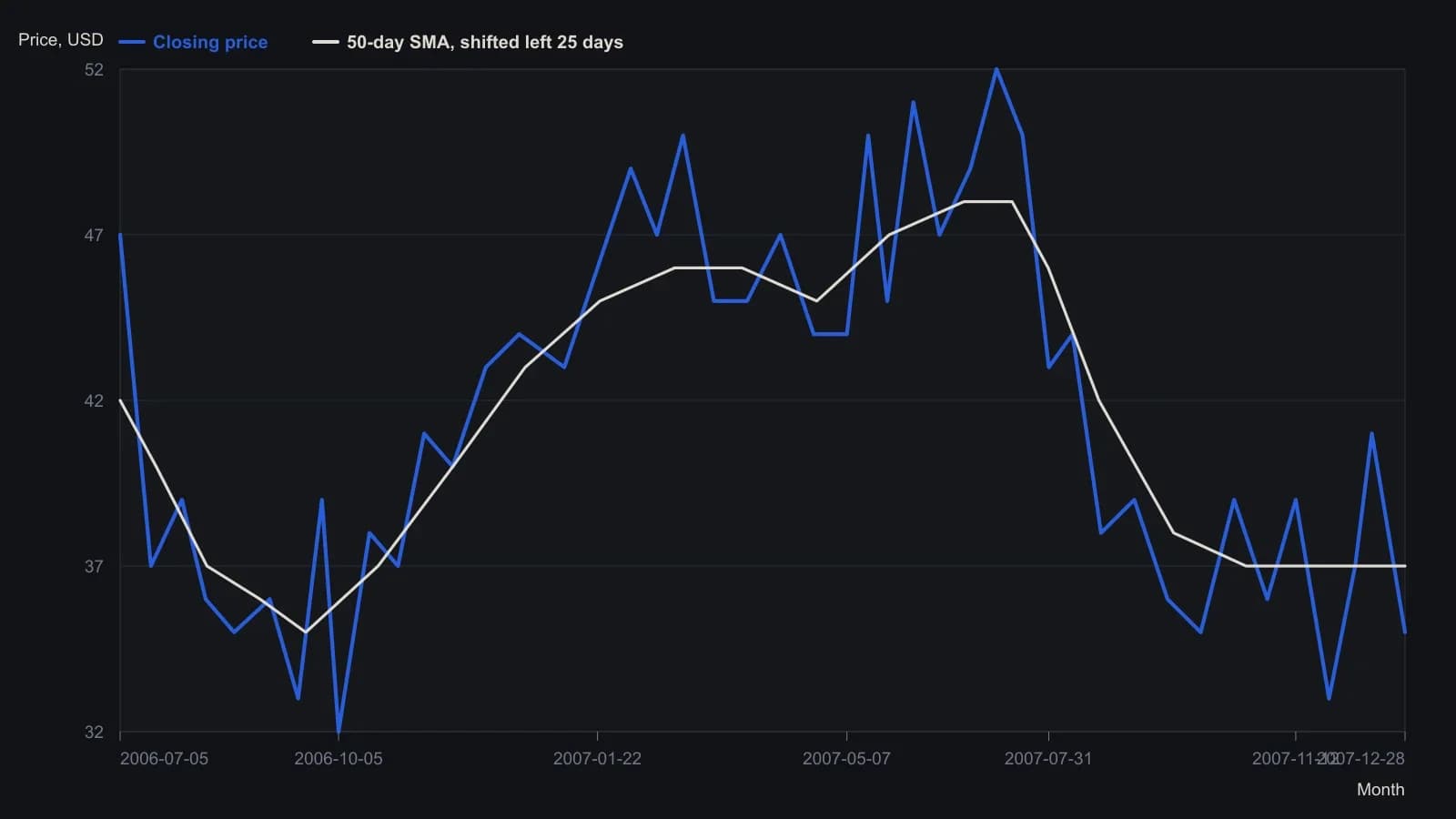
The source used a 50-day simple moving average shifted left by 25 days on a completed daily series. That left shift is only a historical stencil and is not available on the live bar.
All readings on this track · 14 readings
- 1990Constructing falsifiable reversal patterns from price structure
- 1995Cup-with-handle construction: confirm the cup, the handle, then the breakout
- 1995Cup-completion cheat before the handle breakout
- 1998Constructing rounded-bottom cups as testable entries
- 1999Rounded bottom landmarks, invalidation, and breakout rules
- 2003Constructing rounded bottoms, triangles, and pennants
- 2006A five-by-five grid that accepts or rejects a cup
- 2006NTRI and the 2005 bowl breakout case
- 2006Rounded-bottom screens, first-try breakouts, and Fibonacci retracements
- 2007Constructing rounded bottoms as multi-year bases
- 2011Early semi-cup construction from the left rim and base
- 2011Early rounded bottom recognition on a locked log-price grid
- 2013Rounded turns as slope-first trade hypotheses
- 2017Evaluating a rounded bottom as a testable payoff structure