1990issue C101-10
Constructing falsifiable reversal patterns from price structure
Reversal silhouettes stay unfinished until sequential peaks or a saucer, a hinge, and a volume sequence that questions demand or supply are marked. Only then is a height-based objective stated, and that objective can be invalidated if the hinge does not break.
- A topping structure expresses a shift from accumulation to distribution; construction starts by marking sequential peaks or a saucer, then the hinge that must break.
- Valid head-and-shoulders construction requires a higher central peak, a decline after the head that falls below the left-shoulder peak, and lighter volume on the third peak than on the first two.
- A double top is confirmed only by a break of the intervening valley, and a double bottom only by a break of the intervening peak.
- A rounding-bottom forms as a saucer over several months and is confirmed by rising-side volume or an uptrend through the rising lows, not by a single decisive buy trigger.
Price, demand, and distribution
Price on a chart can only advance, decline, or travel sideways. An advance reflects demand exceeding supply. A topping structure is the chart expression of a shift from accumulation to distribution.
Accumulation is a support-phase condition in which buying interest absorbs offerings and keeps price from making a new decline. Distribution is a resistance-phase condition in which selling exceeds remaining demand and price can no longer extend the prior advance.
Editorial: TradersWeek treats the named reversal silhouettes as unfinished checklists, not finished shapes. Construction proceeds by marking sequential peaks or a saucer, defining the neckline or intervening swing as the hinge, requiring a volume sequence that questions demand or supply, and only then stating a height-based objective that can be invalidated if the hinge does not break.
Building the three-peak reversal
A head-and-shoulders top is built as a first peak, a higher second peak, and a third lower peak, typically after a long advance. The inverted form at the end of a decline is often flatter. That inverted form uses three troughs with a deeper central trough.
Valid head-and-shoulders construction requires the decline after the head to fall below the left-shoulder peak before the right-shoulder rally. Volume on that third peak must be lighter than on the first two for the top to count as valid construction.
The neckline joins the troughs on either side of the head and may be level or sloped. After the right shoulder, a break through the neckline is the directional trigger. Some observers require travel equal to 5 percent of the neckline-to-head distance before treating the break as valid.
The measured-move construction takes the neckline-to-head height and projects that same distance beyond the neckline, provided the prior trend already covered at least that height. That projection is the measured-objective for this formation.
Two extremes and the intervening swing
Double and triple tops or bottoms are successive peaks or troughs of roughly equal height. A double top resembles an M and a double bottom a W. They lack the distinctly higher central peak of a head-and-shoulders.
A double top is not confirmed until price breaks the intervening valley low. A double bottom is not confirmed until price exceeds the intervening peak. One spacing rule requires the two extremes to be at least one month apart, with the intervening trough or peak at least 15 percent away from the formation extreme.
The saucer that forms over months
A rounding bottom forms slowly over several months as a saucer-shaped curve and has no single decisive buy trigger. Confirmation is constructed either as a sharp volume increase on the rising side of the curve or as an uptrend line through the lows of that rising side.
A hinge that can fail
Editorial: TradersWeek treats the hinge break as the step that makes the hypothesis falsifiable. If price does not break the neckline, the intervening valley, or the intervening peak, the directional trigger is absent and the measured-objective is not applied. A silhouette that never clears its hinge remains an unfinished checklist.
Home Depot daily rising wedge, 1993
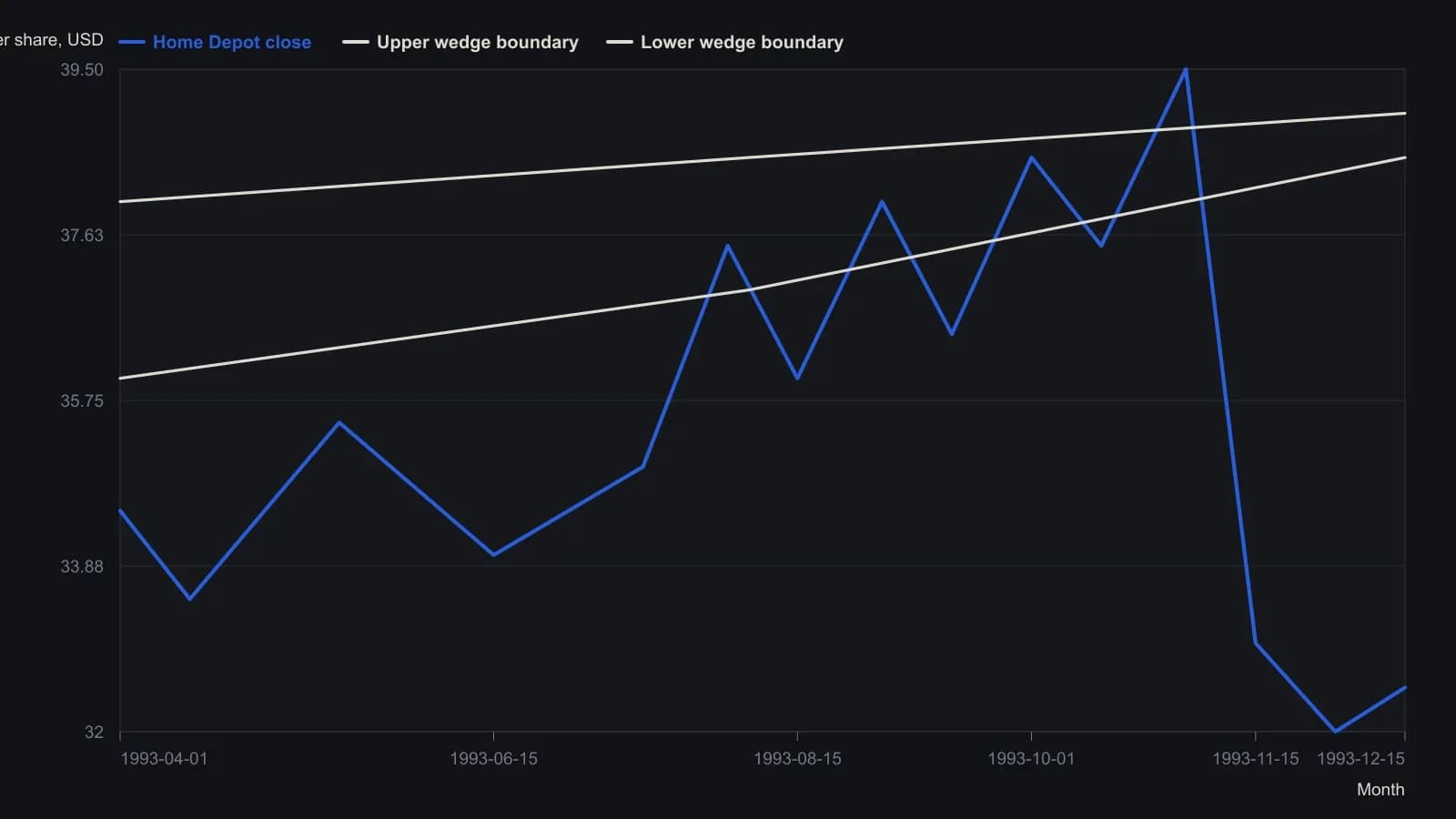
The magazine scan plots higher dollar prices toward the bottom of the frame. Values follow the printed 31–41 scale rather than pixel height, and dates follow the month ticks; neither closes nor session dates are tick-exact.
All readings on this track · 14 readings
- 1990Constructing falsifiable reversal patterns from price structure
- 1995Cup-with-handle construction: confirm the cup, the handle, then the breakout
- 1995Cup-completion cheat before the handle breakout
- 1998Constructing rounded-bottom cups as testable entries
- 1999Rounded bottom landmarks, invalidation, and breakout rules
- 2003Constructing rounded bottoms, triangles, and pennants
- 2006A five-by-five grid that accepts or rejects a cup
- 2006NTRI and the 2005 bowl breakout case
- 2006Rounded-bottom screens, first-try breakouts, and Fibonacci retracements
- 2007Constructing rounded bottoms as multi-year bases
- 2011Early semi-cup construction from the left rim and base
- 2011Early rounded bottom recognition on a locked log-price grid
- 2013Rounded turns as slope-first trade hypotheses
- 2017Evaluating a rounded bottom as a testable payoff structure