1998issue C111-3
Constructing rounded-bottom cups as testable entries
A rounded-bottom construction can label the start of the setup, both rims, and the trough, hold a horizontal reference at the right-hand rim, and keep qualification, invalidation, and volume-confirmed clearance as separate tests.
- A construction can mark four labels on the price series: the start of the setup, the left rim, the right-hand rim, and the trough.
- A horizontal reference at the right-hand rim can stay in force until clearance or until the close drops through an invalidation floor at 80 percent of that rim.
- Cup-and-handle qualification and later clearance of the right-hand rim are two alerts, each able to stay live for a four-bar cap.
- Volume confirmation can accept clearance only when the close is above the right-hand rim and current volume is above a 50-bar average, while a computer definition can still omit or flag cups a chartist would judge differently.
Four labels on the cup
A rounded-bottom is a U-shaped trough between two rims that is encoded from ordered highs, lows, and closes instead of being left as a freehand sketch.
A rounded-bottom cup construction can place four labels on the price series: the start of the setup, the left rim, the right rim, and the trough. The setup phase is the bars that precede the finished cup and that a construction may mark as the start of the formation.
The right-hand rim is the later peak of the cup. It is the horizontal reference from which both the kill level and the clearance are measured.
A kill rule for a live setup
Once those labels exist, a horizontal reference at the right-rim price can remain in force until price clears that level or the close drops through a pre-set floor.
The invalidation floor is a pre-set fraction of the right-hand rim that, if closed through, ends the live pattern. One kill rule ends the live setup if the close falls below 80 percent of the right-rim price.
Rule-based entry is a single procedure that states when a clearance counts, when to stand aside, and when a live setup is dead.
Aeroflex daily close with cup rims and right-rim line
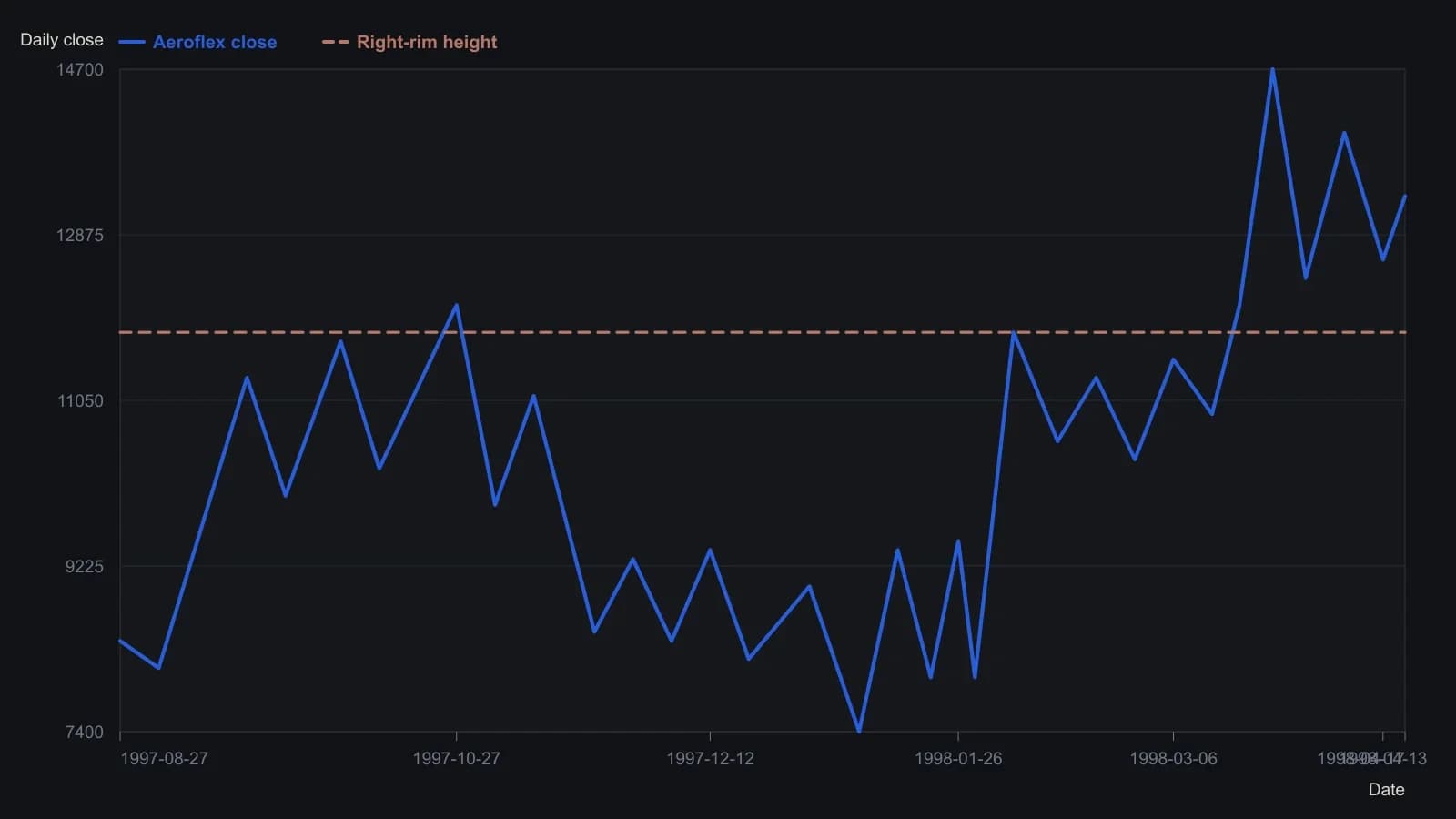
Turning points only; the raster does not support bar-by-bar closes. The source also voids the setup if close falls under 80 percent of the right rim, but that lower band is not drawn on the figure.
Two alerts with a short life
The same construction can raise two distinct alerts: first when the cup-and-handle structure qualifies, and later when price clears the right rim.
A single integer, illustrated as four bars, can cap how long either alert stays live after the event that triggered it.
Volume-confirmed clearance
Volume confirmation is a requirement that current or recent volume exceed a multi-bar average before a structure or a clearance is accepted.
One entry rule treats clearance as complete only when the close is above the right rim and current volume is above a 50-bar average, after a construction step that already compared a 5-bar volume peak with that same average.
Scanner points and local turns
Pattern recognition is matching an explicit, programmable definition of a price structure against later bars on the same series.
A scanner construction can locate five named points by both price and bar index, ten quantities in all, and then impose joint relationship constraints among those quantities.
One quality filter requires the last of those points to sit above a blend equal to 80 percent of one earlier point plus 20 percent of another, and it also requires minimum bar gaps of 20, 3, and 2 among specified location pairs.
A separate five-bar neighborhood rule can mark a local bottom when the close two bars ago is lower than the closes on both sides of that window, mark a local top from the mirrored neighborhood, and issue the event only when four sequential close comparisons are all true.
An incomplete computer definition
Encoding the rounded bottom as a computer definition is incomplete by design. The same rules can omit formations a chartist would accept and can flag formations a chartist would reject.
Editorial: The construction is finished when the named rims, the invalidation floor, and the volume confirmation can each be marked true or false on later bars.
All readings on this track · 14 readings
- 1990Constructing falsifiable reversal patterns from price structure
- 1995Cup-with-handle construction: confirm the cup, the handle, then the breakout
- 1995Cup-completion cheat before the handle breakout
- 1998Constructing rounded-bottom cups as testable entries
- 1999Rounded bottom landmarks, invalidation, and breakout rules
- 2003Constructing rounded bottoms, triangles, and pennants
- 2006A five-by-five grid that accepts or rejects a cup
- 2006NTRI and the 2005 bowl breakout case
- 2006Rounded-bottom screens, first-try breakouts, and Fibonacci retracements
- 2007Constructing rounded bottoms as multi-year bases
- 2011Early semi-cup construction from the left rim and base
- 2011Early rounded bottom recognition on a locked log-price grid
- 2013Rounded turns as slope-first trade hypotheses
- 2017Evaluating a rounded bottom as a testable payoff structure